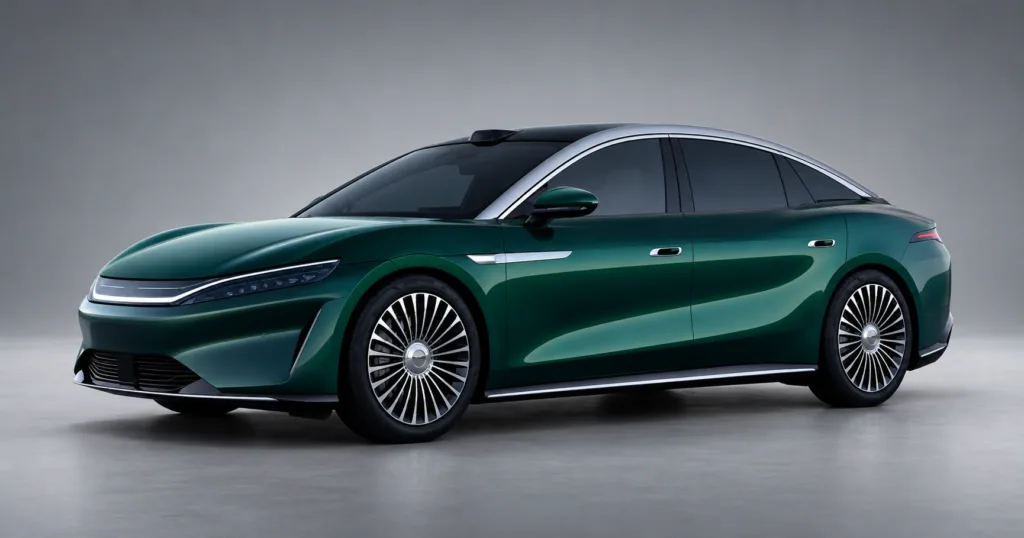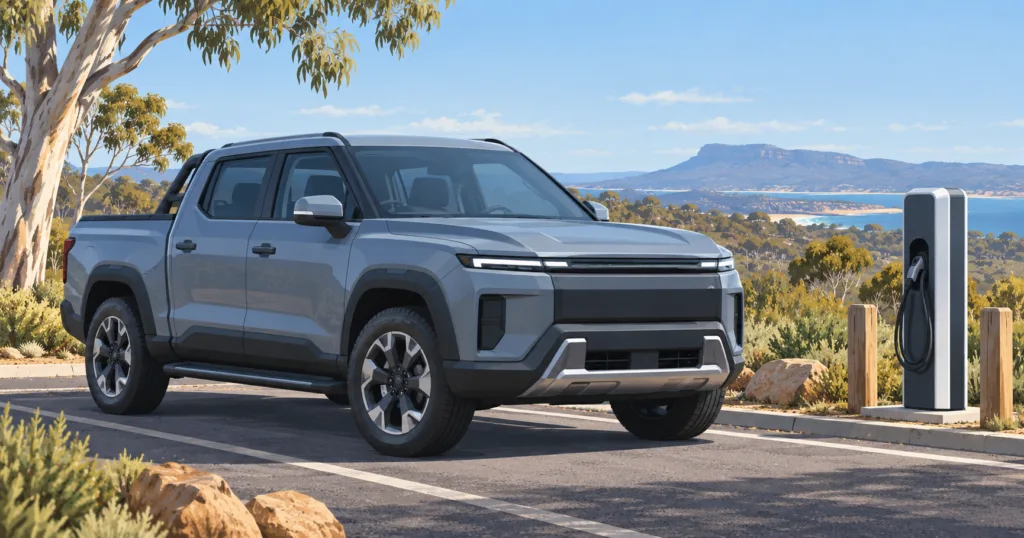
South Korean carmaker KGM launched its first fully electric ute, the Musso EV, in Australia on 1 December 2025, with private-buyer pricing starting at A$60,000 drive-away. The entry price is below published starting prices for rivals including the LDV eT60, although its towing capacity is lower than that of many diesel dual-cab utes.
The front-wheel-drive Musso EV costs A$60,000 drive-away, the two-wheel-drive Black Edge edition A$62,000 and the all-wheel-drive version A$64,000.
Published competitor starting prices include A$74,000 excluding GST and on-road costs for the Tembo Tusker, A$92,990 before on-road costs for the LDV eT60 and A$169,900 before on-road costs for the Ford F-150 Lightning Pro. AusEV imports the Lightning and converts it to right-hand drive; it is not sold through Ford Australia.
The launch comes as battery-electric vehicles accounted for 9.7% of Australian new-car sales in the three months to September 2025, according to Australian Automobile Association figures. Federal Chamber of Automotive Industries data showed utes occupied three of the top five positions in the 2024 new-vehicle sales rankings, led by the Ford Ranger and Toyota HiLux.
Battery range and load limits
KGM says both Musso EV drivetrains use an 80.6kWh lithium iron phosphate battery. Claimed WLTP laboratory range is approximately 420km for the two-wheel-drive versions and 380km for the all-wheel-drive model. Actual range varies with driving style, journey type, vehicle configuration, battery age and condition, accessory use and environmental conditions.
The company claims a 20–80% DC charge takes approximately 31 minutes under its test conditions. Actual charging times depend on charging conditions and battery temperature. Vehicle-to-load functionality allows the battery to power external equipment, including tools and camping appliances.
Braked towing capacity is rated at 1,800kg, compared with up to 3,500kg for many diesel dual-cab utes. Maximum payload is 905kg for the two-wheel-drive versions and 805kg for the all-wheel-drive model.
KGM describes the Musso EV as “purpose-built for lifestyle” use. Its Australian marketing manager, Stevan Dimitrovski, said the emphasis was less on towing boats and caravans and more on carrying bicycles and golf clubs.
Hussein Dia, professor of future urban mobility at Swinburne University, described it as Australia’s “first genuinely affordable” electric ute. He said the price would appeal to “mainstream buyers rather than early adopters”, while suggesting people using their utes for demanding work might question its suitability.
Nathan Moore, a behavioural scientist at the University of Technology Sydney, said ute and SUV buyers often associate those vehicles with work capability or a rugged, off-road lifestyle, and that these groups tend not to view EVs in the same way.
Equipment, dimensions and safety
Equipment includes two 12.3-inch dashboard displays, self-levelling rear suspension and a surround-view camera. The Musso EV measures 5,160mm long, 1,920mm wide and 1,750mm high. At the time of its launch, it had not been assessed by ANCAP or Euro NCAP.
The launch coincides with wider concerns about Australia’s road toll. Figures compiled by the federal Bureau of Infrastructure and Transport Research Economics recorded about 1,300 road deaths in 2024, the highest annual total since 2012. Those national figures do not establish a causal link between the increase and the Musso EV.
Public charging access
Journalist Jessica O’Bryan described difficulties accessing public chargers during an unpaid suburban Sydney road test. She visited three locations listed on the NSW government’s EV charging map. At the first, all three charging spaces were occupied and restricted to club patrons. She could not find the second station at the mapped location, and the third was occupied.
O’Bryan said she did not need to recharge before returning the vehicle. Her account documented availability at those locations during the visit; it did not measure the Musso EV’s range or charging performance. She also noted wireless phone charging in the all-wheel-drive vehicle she drove.
Dia said a 4,000km Melbourne-to-Darwin journey undertaken for his research into charging gaps required careful planning. He warned that some rural areas “don’t have any coverage at all”.