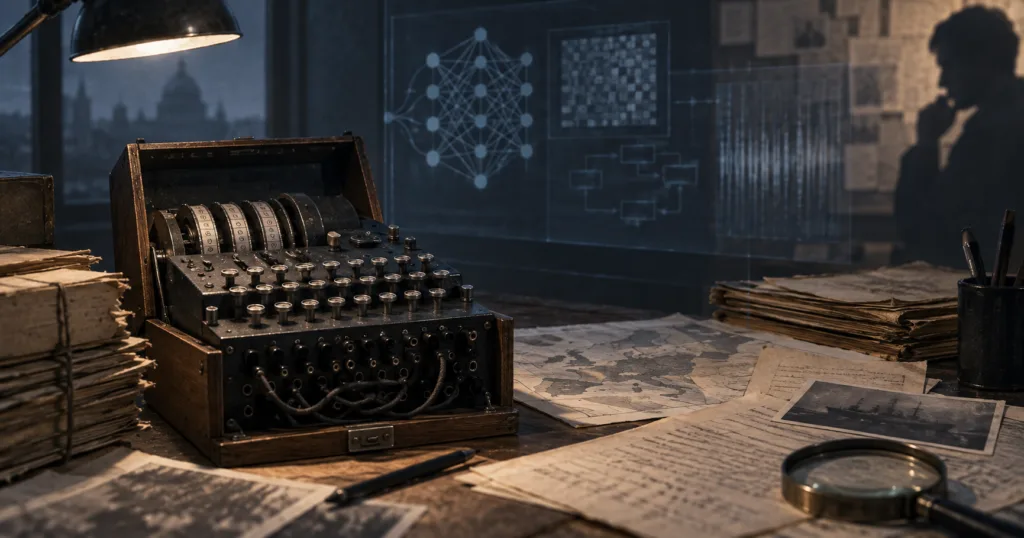
Two researchers claim they used AI models to decode long-unsolved Enigma messages. Their descriptions involve archival research, a software simulation and clues buried in historical context. The claimed decryptions and the details of how they were achieved have not been independently verified.
Developer Carter Leffen’s effort involves a model identified as OpenAI’s Astra. A separate effort by Jack Willis involves a model identified as Anthropic’s Claude Opus 5. The distinction between the two accounts is how much direction the person supplied: Leffen describes a broad assignment, while Willis’s approach reportedly involved more specific guidance.
Astra’s claimed route from archives to plaintext
Leffen’s account begins with a straightforward request: find an unsolved message in an Enigma database and decode it. That would leave the model responsible for choosing a target as well as working out how to attack it.
The claimed workflow went beyond producing a possible translation. Astra is described as conducting archival research, looking for contextual clues and building an Enigma simulator before recovering readable text. The message was reportedly one that had resisted researchers since 2005, although both that history and the claimed recovery remain unconfirmed.
Leffen also describes using Astra to create an interactive website explaining the problem. Such a presentation could make the proposed solution easier to follow, but it would not, by itself, establish that the decryption was correct.
Cryptology researcher Frode Weierud is credited with maintaining Crypto Cellar, the collection associated with the effort. He is also said to have validated Leffen’s solution. Those details, including the validation and its timing, have not been independently confirmed.
A further uncertainty concerns the material Astra may have used. Its logs reportedly discussed messages held in a private collection that was not hosted by Weierud. Mentioning those records would not establish that the model accessed them, and the account leaves that question unresolved.
Weierud’s suggested explanations include another researcher having made copies available online or the model finding relevant material in Germany’s public archives. Both remain possibilities, rather than established descriptions of what happened. The distinction matters to understanding the claimed AI-assisted research: identifying a document, accessing it and using it successfully are separate steps.
Opus’s claimed solution involved a more specific clue
Willis’s account describes a different balance of human and machine work. He reportedly gave Claude more guidance and used the known signature of a particular officer as a clue to a separate unsolved message. The claimed result and the role of that clue have not been independently verified.
That difference limits what can reasonably be inferred from placing the two efforts side by side. A broad instruction to locate and solve a message is a different assignment from an investigation shaped by a person’s historical knowledge. These descriptions do not establish a controlled comparison between the models or show that either would consistently outperform the other.
Weierud is also credited with a tally of seven remaining unsolved messages, plus one for which readable text is known but the encryption remains unresolved. That count is unverified and should not be treated as a comprehensive total of every surviving unsolved Enigma message.
The central question is whether the proposed decryptions and the described workflows hold up to independent examination. Until then, these remain two specific claims about AI-assisted cryptanalysis, with different levels of human involvement and unresolved details about the underlying work.