Biohub has outlined a $1.8 billion expansion of its Virtual Biology Initiative, an effort to assemble the data needed to train AI models that predict how cells behave. Biohub says the plan brings together US research agencies, Meta, Google DeepMind and Isomorphic Labs around a shared goal: making biological experiments possible in software.
The headline figure combines several kinds of support. Biohub describes a package of funding, existing datasets, computing resources and measurement technology. That distinction matters: the total includes resources developed through earlier federal spending, alongside commitments to future work.
Biohub’s head of science, Alex Rives, argues that accurate predictive models could let scientists explore biological questions digitally and accelerate discovery. Building models reliable enough to do that is the initiative’s central research goal.
How the funding would fit together
Biohub puts the combined commitment from Meta, Google DeepMind and Isomorphic Labs at $300 million. It describes the Department of Energy’s planned contribution as more than $500 million for laboratory measurement, modeling and computation over five years.
The proposed DOE work would run through the Genesis Mission. Its contribution is expected to draw on exascale supercomputers, X-ray and neutron scattering, cryo-electron microscopy and autonomous laboratories. Those resources would support the effort to collect biological measurements and turn them into useful training data.
The NIH contribution has a different structure. Biohub says the agency plans to coordinate datasets and repositories developed through more than $500 million in previous federal investment. Biohub would help standardize that material for AI training, making existing research resources useful to the initiative.
Biohub’s own announced $500 million commitment anchors the initiative. Its planned allocation sets aside $400 million for generating data and developing technologies to measure biology, with another $100 million intended to support research outside the organization.
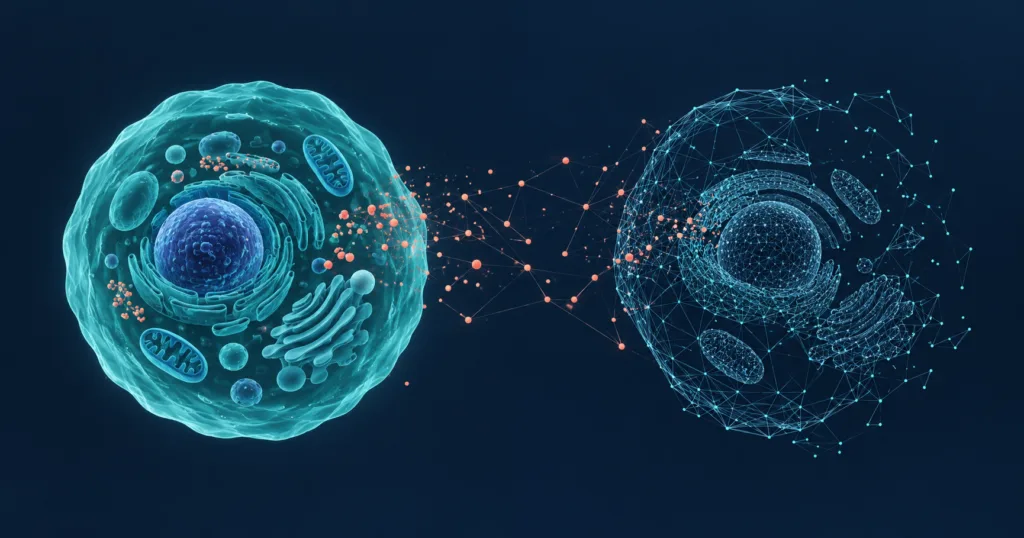
Building toward a virtual cell
The initiative’s premise is that better models need a much larger biological data foundation. Biohub wants to pair improved ways of measuring cells with datasets that researchers can use across institutions.
Biohub lists the Allen Institute, Broad Institute, Gladstone Institutes and Wellcome Sanger Institute among the organizations expected to contribute to the broader effort. It also names the Human Cell Atlas and Human Protein Atlas, bringing established cell and protein mapping projects into the collaboration.
Nvidia’s proposed role centers on computing infrastructure, software and technical expertise. Biohub also identifies Renaissance Philanthropy as a partner in seeking further support for data generation.
Publicly accessible datasets are a stated goal of the initiative. Creating them, standardizing them and building accurate predictive models are separate pieces of the work ahead. The announced commitments describe how Biohub and its partners intend to tackle that work.
For researchers, the potential payoff is the ability to test ideas digitally before committing to laboratory experiments. Delivering that capability is the scientific challenge behind the funding plan.