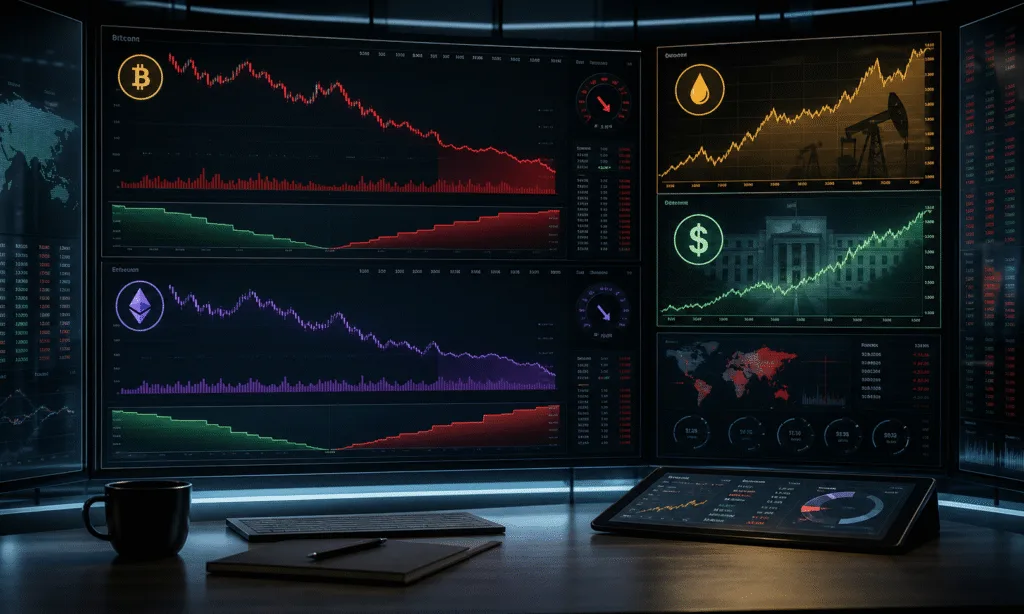
Bitcoin and ether were reported lower on Tuesday, May 12, 2026. Middle East tensions, firmer oil prices and a stronger U.S. dollar were cited as the backdrop to the reported pullback.
Reported intraday prices put bitcoin in the low-$80,000s and ether in the low-$2,000s, with ether described as falling more sharply than bitcoin. Most altcoins were also described as underperforming bitcoin and ether.
Tom Lee, described as Bitmine’s chairman, reportedly identified $76,000 as an important threshold for his assessment of bitcoin’s market cycle, saying a sustained break below it would be significant. Bitcoin reportedly remained above that level during the session.
Altcoin performance and the CRO proposal
CRO, CRV and TON reportedly gained between 5% and 10% over 24 hours. JUP, MON and SEI were described as among the weakest performers, with poor liquidity cited as an explanation for their losses. A proposed overhaul of CRO staking rewards was cited as a catalyst for CRO’s reported gain.
A May 5 draft by the Cronos team proposes gradually reducing inflation, introducing time-locked staking tiers and directing ecosystem revenue toward rewards. The proposed staking commitments span one, two and four years.
The draft envisages a transition from rewards funded through newly issued tokens to rewards funded by protocol revenue. A finite CRO reserve would supplement rewards while revenue develops, with reserve deployment subject to governance decisions. Implementation would require approval and a network upgrade.
Cronos says its long-term goal is to fund staking rewards through protocol revenue. Actual reward rates would depend on governance decisions and available revenue.
Futures positioning and options activity
Reported derivatives readings showed market-wide notional open interest in crypto futures rising while trading volumes declined. ZEC was described as experiencing a decline in futures open interest from a recent high alongside a falling token price.
Open interest in Canton’s CC token reportedly increased by more than 10%, accompanied by positive funding rates and positive open-interest-adjusted cumulative volume delta. ETH and XMR were also described as open-interest gainers, but with negative cumulative volume delta.
Volatility readings
BVIV, a 30-day bitcoin implied volatility index, was reported to be stabilizing near 40% after a prolonged decline. The VIX equity volatility gauge was reported up more than 10% for the week, to nearly 19.
Reported activity on Deribit included bitcoin calls at $80,000, $82,000 and $84,000 strikes, alongside puts at $65,000 and $74,000.
Separate developments in blockchain financing
Circle said on May 11 that an ARC token presale raised $222 million at a $3 billion fully diluted network valuation for Arc.
Digital Asset, the company behind Canton, was raising roughly $300 million at around a $2 billion valuation in a round led by a16z crypto, people with knowledge of the matter said. They said the financing was expected to close in coming weeks and the final amount could change. They asked not to be identified discussing private deliberations.
Tempo, a payments-focused blockchain developed by Stripe and Paradigm, had raised $500 million at a $5 billion valuation, five people familiar with the matter said in October 2025.
The amounts total just over $1 billion, including Digital Asset’s prospective financing. The stated valuations add to about $10 billion, with Arc’s figure representing a fully diluted network valuation rather than a company valuation.
In a May 12 memo, Bitwise Chief Investment Officer Matt Hougan described Arc, Canton and Tempo as purpose-built for stablecoins and tokenization. He argued that transaction privacy could become an important blockchain use case as the technology moves further into mainstream finance.
In a May 13 announcement, J.P. Morgan Asset Management said it had launched JPMorgan OnChain Liquidity-Token Money Market Fund, or JLTXX, on Ethereum. The firm described it as a U.S.-registered government money-market fund designed to support stablecoin issuers under the GENIUS Act. It said the fund invests only in U.S. Treasury securities and overnight repurchase agreements fully collateralized by U.S. Treasury securities and/or cash.