
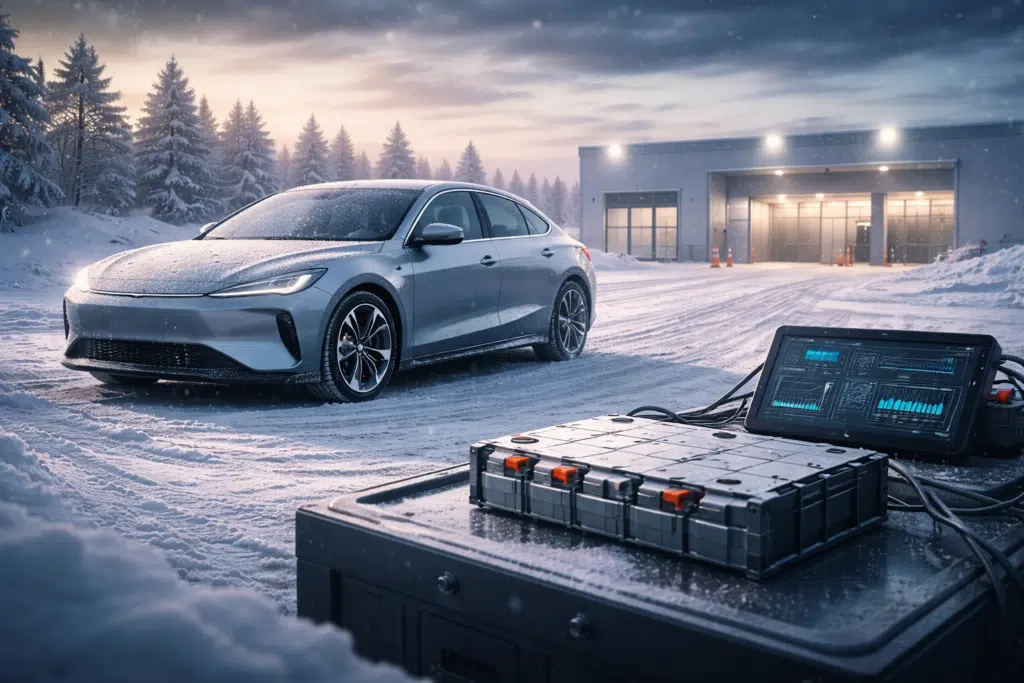
CATL and Changan unveiled a passenger electric vehicle equipped with Naxtra sodium-ion batteries on February 5, 2026, in Yakeshi, Inner Mongolia. CATL said the vehicle was scheduled to reach the market by mid-2026.
CATL described it as the world’s first mass-production sodium-ion passenger vehicle. Earlier sodium-ion EVs entered China’s market in late 2023, the International Energy Agency said in a 2025 analysis. CATL had also described Naxtra batteries as mass-produced when it introduced them on April 21, 2025.
Reports identify the vehicle as the Changan Nevo (Qiyuan) A06 with a 45 kWh battery. Reported range figures differ, describing either up to 400 km or more than 400 km—approximately 249 miles. A range exceeding 400 km on China’s CLTC test cycle has also been reported, although CATL’s announcement specifies more than 400 km without naming a test cycle.
CATL says Naxtra has an energy density of up to 175 Wh/kg. The company plans to supply the batteries across Changan’s Avatr, Deepal, Qiyuan and UNI brands, describing sodium-ion and lithium-ion as complementary technologies for different vehicle requirements.
Cold-weather performance and safety
Changan said sodium-ion-equipped vehicles were undergoing validation testing in severe conditions, including temperatures below −40°C. The announcement accompanied winter trials in Yakeshi.
CATL says Naxtra retains more than 90% of its capacity at −40°C and delivers stable power at temperatures as low as −50°C. At −30°C, the company claims discharge power is nearly three times that of equivalent-capacity lithium iron phosphate, or LFP, batteries. These are battery capacity and power measurements, rather than vehicle driving-range results at those temperatures.
CATL also says the battery continued supplying power without smoke or fire during crushing, drilling and sawing tests. Those specific results underpin the company’s safety claims; they do not establish that sodium-ion batteries are universally safer than lithium-ion alternatives.
Raw materials and cost
Sodium is more abundant than lithium, offering opportunities to diversify battery raw materials. The International Energy Agency identifies potential for a broader upstream supply base, while noting that sodium-ion cell, cathode and hard-carbon anode production remains dominated by China.
Abundant raw materials do not necessarily translate into cheaper finished batteries. In its 2025 analysis, the agency said sodium-ion batteries could compete with LFP on cost only when lithium prices were high or sodium-ion energy density improved significantly.
CATL’s separate lithium-ion claims
CATL has separately claimed that its next-generation 5C lithium-ion batteries can retain at least 80% of their capacity after 3,000 charge-discharge cycles at around 20°C (68°F), primarily under fast-charging conditions. The stated temperature and cycling conditions limit how broadly that result can be applied.
A sustained 5C charging rate corresponds to a theoretical full charge in about 12 minutes. The rating alone does not establish an actual empty-to-full charging time for a vehicle.
