

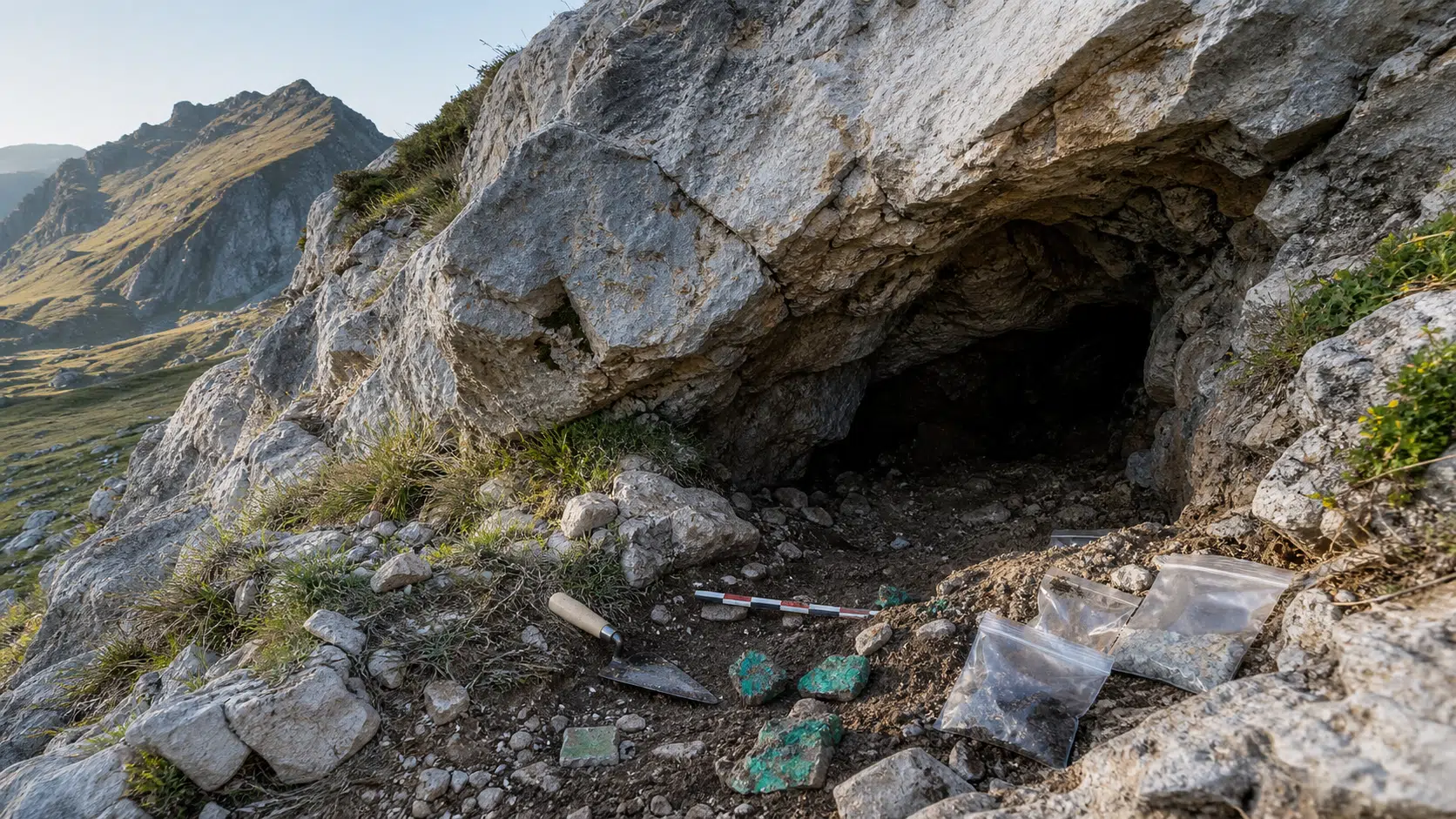

Getting to Cova 338 appears to have been no casual matter. The cave is described by researchers as a high-altitude site in the Núria Valley of northeastern Spain, at about 2,235 metres above sea level. The surrounding landscape is not an easy place to reach or work in, and the site has drawn attention because of what a relatively small excavation reportedly produced.
Across work carried out between 2021 and 2023, archaeologists examined only a limited portion of the cave entrance. Even so, the material described in the study is unusually dense: 23 combustion features, hundreds of pottery fragments, animal bones, personal ornaments, traces attributed to at least one child, and nearly 200 pieces of green mineral that the researchers identify cautiously as most likely malachite.
The argument is not that Cova 338 was a settlement in the ordinary sense. The stronger and more careful reading is that it may have been a repeatedly visited logistical site: a place known to prehistoric groups, reached with intent, and used for specific activities over a very long span of time. The researchers place those visits from the early 5th millennium BCE through the late 1st millennium BCE, though the occupation was not continuous.
That matters because high mountain caves have often been treated as marginal spaces in older interpretations of Pyrenean prehistory. Cova 338 complicates that picture. The evidence, as presented by the research team, suggests something more organized than occasional sheltering. It points to repeated use, planned movement through difficult terrain, and possibly mineral processing at altitude.
Why the Green Mineral Matters
The most striking material from Cova 338 is the green stone. Researchers report nearly 200 fragments of a copper-bearing mineral, described as most likely malachite. Because the identification still needs detailed mineralogical confirmation, it is better not to treat the material as definitively proven malachite yet. The cautious point is enough: the cave appears to have contained green copper-rich mineral fragments that were not simply part of the cave wall.
According to the study, many of those fragments show signs of heat exposure. The researchers also note that other materials in the cave do not show the same kind of alteration. That distinction is important because it makes accidental burning a weaker explanation. If the interpretation is right, people brought the mineral into the cave and exposed it to fire deliberately.
This is where the language has to stay precise. The study does not establish that copper metal was smelted inside Cova 338. Smelting copper ore requires particular conditions and very high temperatures, and the reported evidence does not by itself prove that the complete metallurgical process took place there. The safer conclusion is that prehistoric groups may have been processing or preparing copper-bearing minerals at the site.
That still makes the cave significant. A high-altitude location with repeated fire features and heat-altered copper-rich mineral fragments suggests knowledge of mineral resources and a reason to return. Whether the material was being prepared for later processing elsewhere, tested, altered for pigment, or used in some other technical sequence remains an open question from the available evidence.
Fire Pits and Repeated Visits
The 23 reported combustion structures are central to the interpretation of the site. In a small excavated area, that number suggests repeated activity rather than a single brief episode. Some fire features appear to overlap earlier ones, which the researchers interpret as evidence that fires were rebuilt in the same general area across separate visits.
That pattern supports the idea of a remembered place. Cova 338 was not necessarily occupied year-round, and the evidence does not require a permanent community living there. Instead, it fits better with seasonal or task-based movement: people going up into the mountains with a purpose, using the cave, and leaving again.
The pottery fragments add to that picture. More than 300 ceramic pieces were reportedly recovered from the excavated area, suggesting that containers were brought to the cave or possibly kept there during some phases of use. Animal bones with butchery marks point to food preparation. These details make the site feel less like an accidental refuge and more like part of a practical route or working landscape.
There is still a major unanswered question: how did knowledge of the cave persist? The reported chronology stretches across thousands of years, but not as one uninterrupted occupation. If different groups returned after long gaps, the location and its use must have been transmitted somehow, whether through route knowledge, seasonal practice, oral memory, or repeated rediscovery of a useful place.
The Child Remains and Personal Objects
The cave was not only a working space, at least not in any simple sense. The excavation reportedly recovered a finger bone and a baby tooth from one stratigraphic layer. The researchers interpret them as evidence of at least one child, around 11 years old, though it has not been established whether both remains belonged to the same individual.
The presence of human remains raises questions that the current evidence cannot fully answer. The cave may have had funerary importance during some phase of its use, or the remains may have arrived there through a more complex sequence of events. The study appears to leave that issue open, which is the right level of caution. A few human elements can suggest burial or ritual use, but they do not explain the circumstances on their own.
Two ornaments also stand out. One is described as a pendant made from a marine shell, the other from a brown bear tooth. The shell is especially notable because it connects a high mountain cave with materials from the Mediterranean coast. The bear tooth may have had symbolic value, though that interpretation should remain tentative unless further evidence clarifies its role.
Together, these finds make Cova 338 harder to reduce to one function. It may have been a place for mineral-related work, food preparation, temporary occupation, and possibly symbolic or funerary activity. Prehistoric cave use often mixed practical and social meanings, and this site seems to fit that broader pattern.
What the Study Can and Cannot Prove
The strongest version of the Cova 338 story is not that archaeologists have solved everything about prehistoric copper exploitation in the Pyrenees. They have not. The strongest version is narrower and more useful: a small excavation in a high-altitude cave produced evidence that researchers interpret as repeated human use, deliberate fire activity, and the handling of copper-bearing green mineral across a long prehistoric timeframe.
Several limits matter. The excavated area was small compared with the cave as a whole. The green mineral still needs fuller mineralogical confirmation. Its source has not yet been identified. The fire-altered fragments show that heat was involved, but they do not prove that copper metal was produced inside the cave. The human remains raise the possibility of funerary use, but they do not explain why the child’s remains were present.
Future work could sharpen the picture. Broader excavation might show whether the same activity pattern extends deeper into the cave. Plant remains, pollen, residues, and mineral analysis could clarify how people used the space and where the green material came from. If the mineral source can be identified, Cova 338 could become much more important for understanding prehistoric movement through the Pyrenees.
For now, the site is best understood as a challenge to a simple assumption: that high mountain places were only peripheral to prehistoric life. Cova 338 suggests that at least some of those places were known, revisited, and used with purpose. The mountain was not just a boundary. For the people who climbed to this cave, it may have been part of the working map of the world.