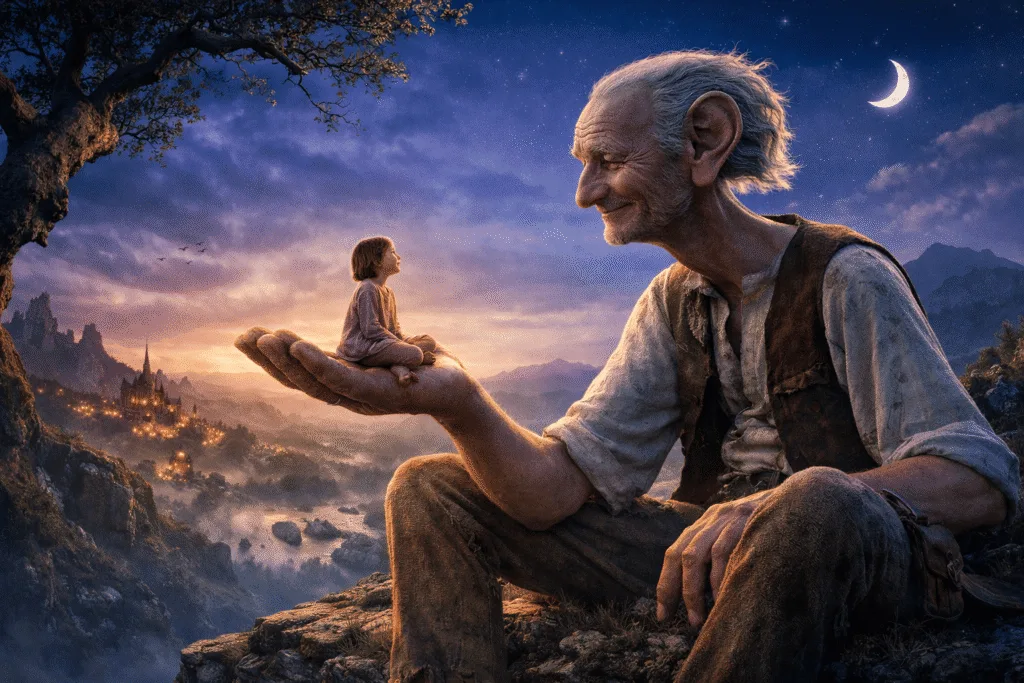
Steven Spielberg linked his childhood fears and experiences of bullying to his approach to The BFG, his 2016 adaptation of Roald Dahl’s children’s book. In interviews around its release, he described loneliness and the friendship between two outsiders as central to his interest in the story.
Spielberg said he had read the book to his children and associated its depiction of bullying with his own childhood. He described storytelling as a way of confronting frightening experiences: “The stories always vanquish the fear.”
His recollections included watching a large tree outside his bedroom window and imagining threatening shapes in its silhouette. He also described imagining clouds as gigantic fists and faces. “There was just something about bigness that scared me when I was a kid.”
Spielberg recalled a similar reaction to the statue at the Lincoln Memorial during a childhood visit to Washington, DC. Initially frightened by its scale, he remembered feeling safe and protected after looking up at its face.
A friendship at the center of the adaptation
The BFG stars Ruby Barnhill as Sophie, an orphan who sees a giant outside her London orphanage at night. The 24-foot giant, played by Mark Rylance, takes her to Giant Country, where she discovers that he is gentle despite his intimidating appearance.
Unlike the larger giants who eat children, the BFG collects dreams and delivers them to sleeping children. Sophie and the giant become friends and seek the Queen’s help to stop the other giants.
Melissa Mathison, who also wrote E.T. the Extra-Terrestrial, adapted Dahl’s book. Spielberg said her screenplay captured a relationship between an older figure with an innocent outlook and a young girl with an old soul.
The film followed historical dramas including War Horse, Lincoln and Bridge of Spies. Spielberg described the fantasy as an opportunity to use his imagination without the constraints of depicting historical events.
Combining live action and digital performances
The production combined Barnhill’s live-action performance with a digital giant. Visual-effects company Wētā FX says it used performance capture, keyframe animation and dialogue reference to apply the detail of Rylance’s performance to the character.
Spielberg said a process called Simulcam allowed the crew to view prerecorded virtual performances alongside live-action camera images on a monitor. He said this helped filmmakers frame shots and cue actions while seeing how the digital elements would fit into a scene.
Rylance described working with Barnhill during filming and standing on a high scissor lift to establish the correct eyeline on her giant-sized set. Cinematographer Janusz Kaminski described separate capture spaces, strategically placed monitors and elevated platforms that helped the actors coordinate their performances across the characters’ different scales.