
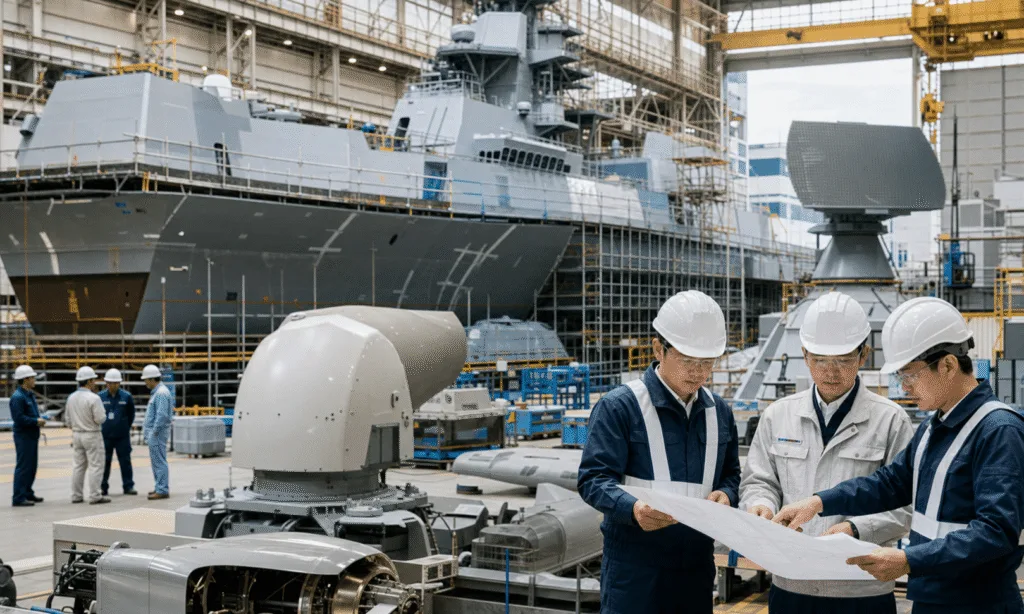
Japan revised its defense export rules on April 21, 2026, expanding the range of equipment eligible for overseas transfer. Three days earlier, Mitsubishi Heavy Industries announced a contract to build three upgraded Mogami-class frigates for Australia.
The revision removed restrictions limiting domestically produced finished equipment to five categories: rescue, transport, warning, surveillance and minesweeping. Individual transfers remain subject to review, with recipient-country restrictions and controls after export for weapons.
In its April 18 announcement, MHI said Australia had selected the upgraded Mogami-class design as its preferred platform in August 2025 before entering contract negotiations. The company said construction would begin at its Nagasaki Shipyard & Machinery Works, with the first completed frigate scheduled for handover by December 2029.
The export push comes amid higher global military expenditure. The Stockholm International Peace Research Institute calculated that spending reached $2.887 trillion in 2025, up 2.9% in real terms and marking the 11th consecutive annual increase. Growth was slower than the 9.7% recorded in 2024.
Radar deliveries and prospective transfers
Japanese companies have already delivered surveillance equipment overseas. Mitsubishi Electric announced on April 30, 2024, that it had delivered a mobile air-surveillance radar system to the Philippine Air Force that March. The company said the delivery followed a fixed radar system supplied in October 2023, under an order placed in August 2020.
Other potential transfers were described as prospects. In mid-April, two Japanese government officials said exports of used frigates to the Philippines were likely to be among the first deals approved under the planned rule changes. They also identified missile-defense systems as a possible subsequent transfer.
Masahiko Arai, senior vice president at Mitsubishi Electric’s defense unit, said demand for finished systems was strongest in Asia. He identified Europe, Australia and the United States as markets for components and joint product development.
Production and profitability
The overseas expansion follows longstanding concerns about the industry’s commercial foundations. A February 2026 briefing by Japan’s Ministry of Economy, Trade and Industry and Ministry of Defense said that, until around fiscal 2022, lower profit margins than civilian business and limited growth prospects had made defense work less attractive. The ministries linked withdrawals from defense business to a weakening industrial base.
Some manufacturers have announced plans to expand. Toshiba said in April that it planned to hire about 500 people over the following three years and was constructing testing and manufacturing facilities. The company also said it had established a department to handle defense exports.
Arai said Mitsubishi Electric’s defense unit had been adding staff in London and Singapore to support overseas sales. He expected the unit’s overall sales, including domestic and international business, to increase by 50% to 600 billion yen ($3.8 billion) by 2031. That forecast covers the whole unit, rather than export revenue alone.
South Korea’s approach to local production
South Korean exporters provide an example of incorporating manufacturing abroad into defense agreements. Hanwha Aerospace announced on September 3, 2025, that it had signed an agreement with Poland’s WB Group to establish a joint venture producing CGR-080 guided missiles for Poland’s HOMAR-K multiple launch rocket system.
Hanwha said the planned venture would include phased technology transfer and workforce training. The agreement provides a specific example of local-production commitments, without establishing broader claims about Japanese and South Korean suppliers’ relative prices, quality or delivery speeds.