
Fortune ranks Dell among the world’s “most admired companies,” an impressive badge for a firm long associated with commoditized PCs. The company sits tenth on Fortune’s list of most innovative companies and 34th on the Fortune 500, not bad for a business that started with one college student taking apart computers in his spare time.
Michael Dell: Curiosity First, Business Second
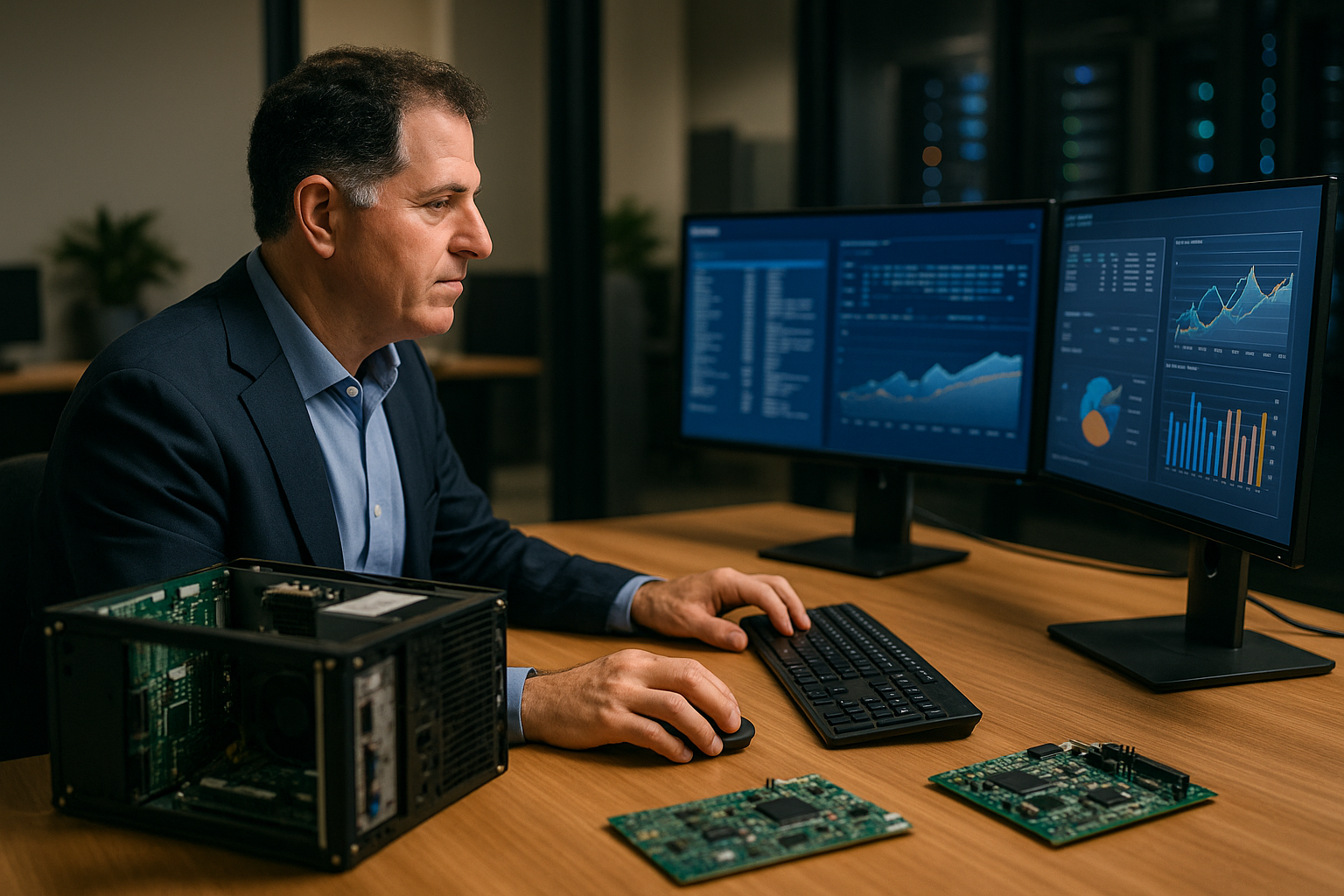
Dell’s origin story is inseparable from its founder, Michael Dell. Raised in an upper-middle-class family, he was drawn early to both technology and business. He spent his free time disassembling computers just to see how they worked, driven by a curiosity that would later define the company’s culture.
Even though his parents were financially comfortable, Michael wanted to earn and invest his own money. At 12, he washed dishes at a Chinese restaurant and put his wages into stocks and gold. In high school, he sold newspaper subscriptions, using data to identify promising prospects and target them more effectively. By 16, he had earned the equivalent of $61,000 in commission and bought another computer to pull apart and study.
Following his father’s wishes, Michael enrolled in pre-med at college. But his heart was still in computing. In 1984, he channeled the money he’d made from investments and commissions into a small computer venture that allowed him to merge his interests in technology and business.
From Dorm Room Hustle to PC’s Limited
Michael began by buying IBM PCs at cost, upgrading them with additional memory and disk drives, and selling them for around 10% less than retail. With just $1,000 of his own money, he registered his business as PC’s Limited.
His mentality was simple: “How could you improve it? How could you make it do more things?” That constant hunt for better performance and efficiency quickly earned him a loyal base of customers on campus.
Although he had promised his parents he’d focus on medicine, the numbers told a different story. By 1985, his side business was generating about $232,000 a year in today’s dollars. His parents pushed him to stop and stay in school, but Michael knew he’d found a real market.
He dropped out during his freshman year, rented office space near campus, and went all-in. That same year, he designed the Turbo PC, which became a hit and put PC’s Limited firmly on the map.
Reinventing PC Sales and Customer Support
From the beginning, the firm relied on direct sales by phone, emphasizing customer experience and operational efficiency. PC’s Limited offered risk-free returns and a toll-free technical support line—services that were novel in the PC world at the time.
The marketing strategy was simple but effective: small ads in computer magazines targeted at business buyers. In 1988, at just 23 years old, Michael rebranded the company as Dell Computer Corporation and took it public.
By 1991, Dell was doing $676 million in annual revenue. Its machines were not only cheaper but faster. A competitor’s PC could cost $3,995; Dell’s comparable model was around $1,995. That value proposition attracted customers who were eager to get more performance for less money. Meanwhile, Michael obsessively examined the supply chain and operations to keep costs low, cementing Dell’s core USP: efficiency.
Betting Early on the Internet
Dell’s curiosity kept pushing the company into new territory. In 1996, long before e-commerce was the norm, Dell began selling computers online. The move was less about reacting to the moment and more about predicting where customer behavior was headed.
The bet paid off. Dell rapidly became a standout example of online hardware sales, at one point pulling in around $18 million a day via the web. Other PC makers, noticing the success, followed the same path and ramped up their own online strategies.
Turbulence, Reinvention, and Dell 2.0
The story wasn’t a straight line up. Michael stepped down as CEO in 2004, and the company’s performance slid. Dell’s stock lagged, the 2007 financial crisis hit hard, and the firm laid off hundreds of employees.
Eventually, Michael returned to the CEO role and launched a broad reinvention he called Dell 2.0. Rather than chasing the smartphone boom, Dell focused on acquisitions to broaden its services and double down on what it believed PCs were still uniquely good at.
“[Smartphones] don’t do everything that needs to be done,” Michael has argued, pointing to areas like 3D printing, virtual-reality computing, and robotics—all heavily reliant on PCs.
To restore efficiency, he pushed lean production practices and pared back headcount, cutting thousands of roles, including many executives. It was painful but effective: Dell regained its footing and re-centered operations around productivity grounded in the PC.
Today, Dell generates about $88 billion in annual revenue (2023), with the bulk coming from its Client Solutions Group at roughly $49 billion. While the company is working through a revenue downturn of about 13% year over year, it’s also seeing 40% growth in AI-related orders and expects that segment to become a major driver.
To keep its B2B base strong, Dell leans heavily on data-driven marketing, direct-to-consumer channels, customization options, and a clear investment in brand identity and long-term client relationships.
Lessons from Dell: Curiosity, Failure, and Lean Operations
1. Be Relentlessly Curious—and Willing to Take Risks
“Each day that you’re moving toward your dreams without compromising who you are, you’re winning,” Michael Dell has said. Curiosity is baked into Dell’s DNA, from Michael’s teenage experiments with old computers to the company’s push into channels like online sales when the concept was still new.
But curiosity on its own isn’t what sets Dell apart—it’s the willingness to take risks on what curiosity uncovers. Trying new things means some ideas will fail, and Dell has seen its fair share of missteps and rough patches.
For Michael, that’s not a bug; it’s a feature of strong leadership. “The best leaders assess and identify their mistakes quickly and work to transform those faults into an opportunity to improve their people, products and services,” he says. Leaders who understand that failure is part of growth are more likely to build cultures where experimentation is encouraged and course corrections are expected.
At Dell, curiosity drives exploration, while risk tolerance and honest learning from failure keep the company moving forward instead of retreating at the first sign of trouble.
2. Let Failure Surface Mistakes—and Then Fix Them
Dell’s history includes strategic blind spots, and one of the biggest was its reliance on a pure direct-to-consumer model for too long. The company also underinvested in R&D for years, focusing instead on operational excellence and selling existing technology more efficiently and cheaply than rivals.
That worked—until it didn’t. In the mid-2000s, analysts criticized Dell for lagging on innovation while competitors like Apple gained ground with fresh designs and new categories. Dell’s famously lean, horizontal structure kept operating margins low, but it also limited the company’s ability to break into higher-end, more lucrative segments.
The consequences showed up in the stock price and in sluggish sales. Dell’s answer was not to abandon its strengths but to rebalance. The company stepped up its R&D spending and made innovation a more central part of its strategy while still holding onto its operational discipline.
The key insight from Dell’s journey is that failure should clarify what is broken, not trigger panic. The company has repeatedly used setbacks as a signal to adjust, rather than overcorrecting and losing focus. That blend of accountability, steady direction, and targeted pivots is a powerful lesson for any growing business.
3. Use Lean Operations to Ride Out Economic Shocks
When Michael Dell came back to the CEO role, he saw economic turbulence ahead. The 2007–2008 crisis soon proved him right. Dell wasn’t immune to the downturn, but Michael responded with a leaner model under the Dell 2.0 banner.
He cut layers of management, including many vice presidents and senior leaders, calling out excessive bureaucracy. On the product side, Dell shifted away from a heavily “configure to order” model and toward more standardized manufacturing, which reduced complexity and resource usage.
Economic turmoil tends to expose overhiring, bloated processes, and operational waste. For Dell, the answer was to streamline. The leaner setup improved agility—something the company now frequently emphasizes in its messaging, especially for enterprise and B2B solutions.
A lean operating model doesn’t just save money; it makes it easier to adjust when markets move, which is critical in fast-changing tech categories.
4. Strong, Focused Leadership Compounds Over Time
Michael Dell is a textbook example of a founder whose vision is deeply intertwined with the company’s success. When he left the CEO role in 2004, Dell’s customer mix shifted, prices softened, and the business stumbled. Restructurings came and went, but sales and sentiment stayed weak until he returned in 2007.
As founder, Michael understands the business at a level most outside executives simply can’t match. He is known for staying humble and optimistic, building trust inside the organization, and pairing those traits with a sharp operational focus.
Effective leaders like Michael outline clear indicators of success, stay close to the details, and trust their long-term vision enough to keep making calculated bets. Today, he remains heavily involved in Dell’s direction and continues to provide the kind of consistent leadership that helps employees, partners, and customers orient around a shared future.
5. Stay Laser-Focused on Market Shifts—Without Losing Yourself
Michael Dell argues that the strongest companies stay “attuned to what’s going on and understand how the environment is evolving and what you need to do to stay relevant but increase your relevance.”
Dell has had to relearn this lesson more than once. In the late ’90s and early 2000s, its direct sales model delivered rich customer insights and strong margins. But as more buyers wanted to shop in electronics and retail stores, Dell’s lack of presence in those channels left it behind. The company responded by opening mall kiosks and retail outlets to reconnect with those customers.
More recently, Dell has dealt with new competition from smartphones and tablets. Instead of chasing every new device category, the company has doubled down on PCs and adjacent infrastructure, while adapting its offerings and go-to-market strategy to reflect changing user behavior and enterprise needs.
The broader takeaway: track consumer and market trends closely, but don’t let them dictate your identity. Dell uses market shifts to refine its focus, not to abandon it. That approach builds internal trust, keeps resources aligned, and still leaves room to pivot when the data says it’s time.