

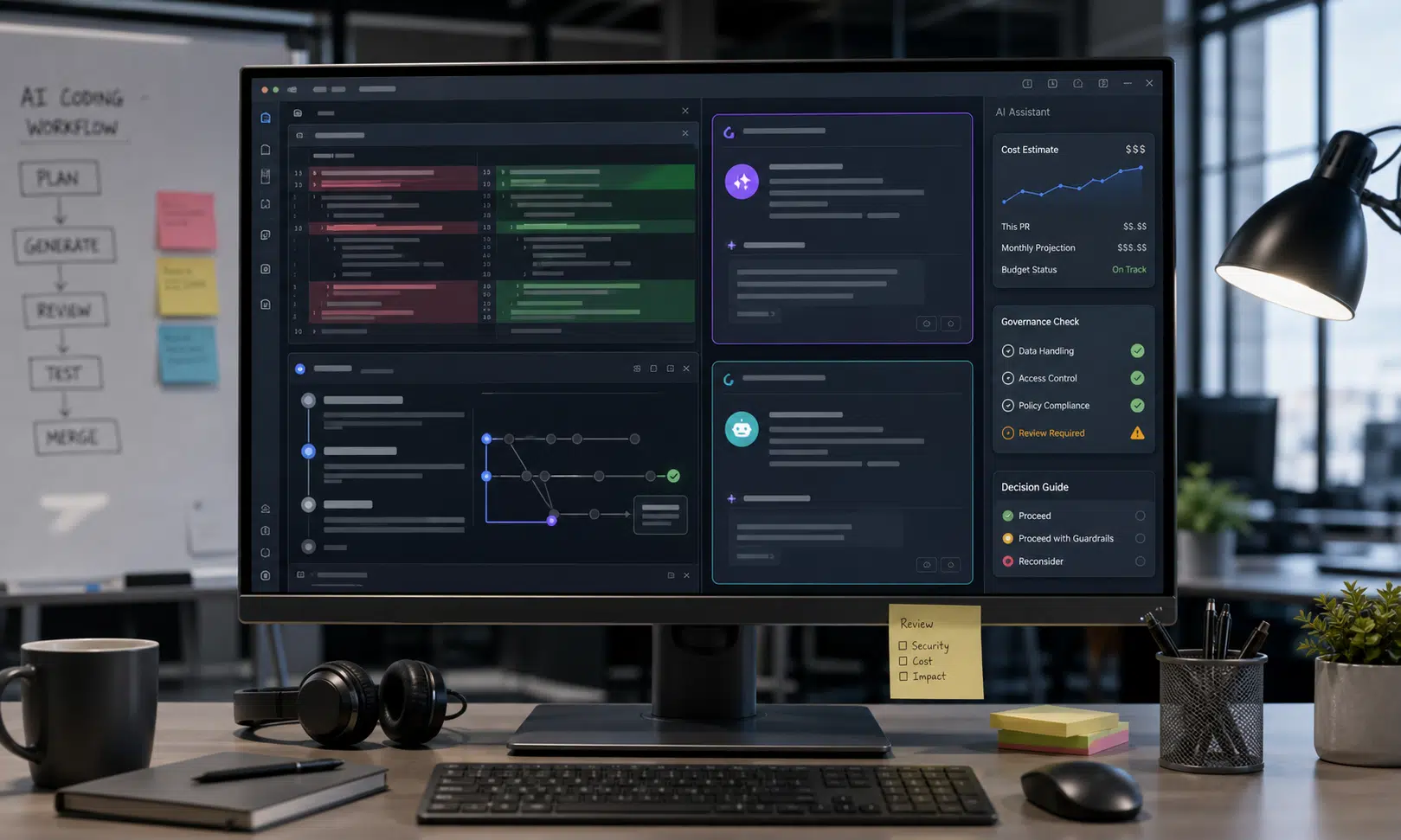

Microsoft’s Claude Code pullback is a warning for AI coding tool buyers
Microsoft is reportedly preparing to scale back most Claude Code licenses inside parts of the company and move many employees toward GitHub Copilot CLI instead. For buyers evaluating AI coding assistants, the important part is not only that Microsoft appears to be favoring its own tool. It is what the move says about how fast enterprise AI coding decisions can change once cost, product strategy, security, and internal workflow control collide.
The reported change affects Microsoft’s Experiences + Devices organization, the group connected to products such as Windows, Microsoft 365, Outlook, Teams, and Surface. Employees had been given access to Claude Code after Microsoft began opening it up internally in December. The tool appears to have gained traction with engineers and with non-engineers who were encouraged to experiment with coding and prototyping.
Now, that internal experiment is said to be narrowing. Microsoft is reportedly pushing many developers toward Copilot CLI, a command-line version of GitHub Copilot intended to work outside development environments such as Visual Studio Code. The transition is expected to happen ahead of a late-June cutoff, which also lines up with the end of Microsoft’s fiscal year.
That timing matters. AI coding tools are no longer a small discretionary expense inside large software organizations. If thousands of workers adopt a paid assistant and use it every day, license costs quickly become visible. At the same time, tool choice becomes a strategy question: should a company pay for the tool its developers prefer, or standardize on the tool it owns, controls, and can shape?
For Microsoft, the answer appears to be Copilot CLI. For everyone else, the lesson is more practical: do not evaluate AI coding assistants only by how impressive they feel during a pilot. Evaluate whether the tool can survive procurement pressure, security review, model availability changes, developer resistance, and platform politics.
What reportedly changed inside Microsoft
Microsoft first made Claude Code available to thousands of internal users as part of a broader push to get more employees experimenting with code. That included not only professional developers, but also project managers, designers, and other staff who could use an AI coding agent to prototype ideas.
By the account in the source material, Claude Code became popular over roughly six months of use. That popularity created a problem for Microsoft because it undercut momentum behind GitHub Copilot CLI, a product Microsoft can influence directly through GitHub.
The stated internal rationale is convergence. Microsoft wants one main agentic command-line coding interface across the Experiences + Devices group. A single preferred tool can simplify support, security expectations, feedback loops, and integration with Microsoft’s own repositories and engineering systems.
The less formal but commercially important explanation is cost. The reported June 30 cutoff coincides with Microsoft’s fiscal year-end. Removing a large number of external Claude Code licenses would be a straightforward way to reduce operating expense as the next fiscal year begins.
Those two explanations are not mutually exclusive. In enterprise software, they often reinforce each other. A company may genuinely prefer a standard internal tool for security and product reasons, while also welcoming the budget relief that comes from canceling an overlapping subscription.
Claude Code vs. Copilot CLI: the practical comparison
The reported Microsoft shift is useful because it highlights a real buyer tradeoff. Claude Code appears to have won meaningful internal enthusiasm. Copilot CLI appears to have stronger strategic value for Microsoft because it belongs to the GitHub ecosystem and can be shaped around Microsoft’s own needs.
That is the same tension many engineering leaders face when choosing AI coding tools. The best-liked tool in a developer pilot may not be the tool the organization can standardize on. The most controllable platform may not be the one individual developers reach for first.
| Decision area | Claude Code | GitHub Copilot CLI | Buyer takeaway |
|---|---|---|---|
| Developer adoption | Reportedly popular with many Microsoft users during the internal trial. | Being positioned as the preferred internal command-line tool for the affected Microsoft group. | Pilot enthusiasm is valuable, but it may not decide the enterprise standard. |
| Strategic control | Built by Anthropic, even if Claude models may be available through other Microsoft channels. | Part of GitHub Copilot, which Microsoft can influence more directly. | Large companies may favor tools they can steer, integrate, and govern. |
| Workflow fit | Used by engineers and by non-engineers experimenting with prototypes. | Intended as an agentic command-line interface outside traditional IDE surfaces. | Buyers should test both expert engineering workflows and lighter prototyping use cases. |
| Cost exposure | External licenses can become material when adoption spreads across thousands of users. | May fit better into an existing Microsoft and GitHub commercial strategy. | Budget ownership should be settled before broad rollout. |
| Model access | Direct Claude Code access is separate from simply using Claude models elsewhere. | Reportedly expected to provide access to Anthropic, OpenAI, and internal Microsoft models. | Do not confuse the coding product with the underlying model menu. |

AI Engineering by Chip Huyen
AI Engineering gives technical leaders a practical foundation for understanding how model-powered systems behave beyond demos. It is a useful companion when comparing coding assistants on evaluation, agent behavior, latency, context handling, and production risk.
As an Amazon Associate I earn from qualifying purchases.
For buyers, the cleanest way to frame the choice is this: Claude Code may be attractive when the priority is developer preference and strong agentic coding behavior, while Copilot CLI may be attractive when the priority is GitHub alignment, enterprise standardization, and direct platform integration. The right answer depends on who will use the tool, who will pay for it, and how much governance the organization needs.
Why the move may be harder than a license change
Canceling licenses is administratively simple. Changing developer behavior is not.
The reported transition away from Claude Code could be uncomfortable because Microsoft had encouraged employees to use both Claude Code and GitHub Copilot, compare them, and provide feedback. If many engineers came to prefer Claude Code, moving them to Copilot CLI means Microsoft is asking users to trade a familiar workflow for a strategic internal standard.
That is where AI coding tools differ from many older developer tools. A formatter, test runner, or build tool can be mandated with relatively little emotional attachment. An AI coding agent becomes part of how a developer thinks through a task. It affects planning, debugging, refactoring, terminal work, and sometimes the confidence to attempt changes in unfamiliar code.
The same applies to non-engineers. If designers or product managers used Claude Code to prototype features, switching tools may interrupt a fragile new workflow. People who are new to coding tend to be especially sensitive to changes in interface behavior, error recovery, and explanation quality.
That does not mean standardization is wrong. It means buyers should treat AI coding assistant migration as a change-management project, not a procurement cleanup.
A serious migration plan should include:
- A clear cutoff schedule, with enough overlap for users to move active work.
- Documented differences in commands, permissions, repository access, and model behavior.
- Internal examples that show how common tasks should be done in the new tool.
- A feedback path that engineers believe will reach the product team.
- Explicit guidance for non-engineers who were using the old tool for prototypes.
Model access is not the same as product access
One subtle point in Microsoft’s reported shift is that Anthropic models are still expected to remain available through Copilot CLI, alongside OpenAI models and internal Microsoft models. That distinction matters for buyers.
A coding assistant is not only a model. It is a product surface, a permissions model, a command runner, a context manager, a set of repository integrations, a prompt and tool orchestration layer, and a support contract. Two products can expose the same underlying model and still feel very different in daily use.
That is why a company cannot settle the Claude Code versus Copilot CLI question by asking whether Claude models are available somewhere in the stack. Developers care about how the tool edits files, explains plans, handles tests, recovers from failed commands, reads large repositories, and manages risky operations. Security teams care about where code context goes, how approvals work, and what audit trails exist. Finance teams care about license structure and usage growth.
If Claude models remain accessible through Copilot CLI, that may soften the transition for Microsoft engineers. It does not automatically reproduce the Claude Code experience.
What this says about Microsoft’s AI coding strategy
The pressure now falls on GitHub and Microsoft to make Copilot CLI strong enough that internal developers do not feel they are losing capability. The source material describes Microsoft leaders as working closely with GitHub and encouraging engineers to file feedback and bug reports before Claude Code access is removed.
That feedback loop is commercially important. Microsoft has a large internal engineering base, and forcing more daily use of Copilot CLI gives GitHub a dense stream of real-world complaints, edge cases, and workflow needs. If the product improves quickly, Microsoft can turn an uncomfortable transition into an internal advantage.
The move also fits a broader pattern. Microsoft has promoted GitHub Copilot heavily across its engineering organization, while also expanding access to multiple model providers through its cloud and AI products. It can value Anthropic models in Microsoft 365 or Microsoft Foundry while still preferring GitHub Copilot as the standard coding assistant for its own engineering workflows.
A reported claim that Microsoft quickly became one of Anthropic’s top customers earlier this year and counted some Anthropic model sales toward Azure sales quotas has not been independently verified. What is clear from the source material is narrower: Microsoft’s relationship with Anthropic extends beyond Claude Code, and the reported license pullback is not presented as a cancellation of Microsoft’s broader Anthropic model access.
That distinction is easy to miss. A company can reduce spending on one product while continuing to use the same vendor’s models in another channel.

Accelerate
Accelerate is a strong fit for teams that want to judge AI coding tools by measurable delivery outcomes, not just pilot enthusiasm. It can help frame the productivity, governance, and change-management questions behind a Copilot CLI or Claude Code rollout.
As an Amazon Associate I earn from qualifying purchases.
Buyer criteria: how to choose an AI coding CLI without copying Microsoft blindly
Microsoft’s incentives are unusual. It owns GitHub. It has its own cloud platform, internal models, enterprise security expectations, and a direct interest in making Copilot better. Most buyers should not simply imitate Microsoft’s tool choice.
Instead, use the reported shift as a checklist for your own decision.
1. Test the actual workflow, not the brand
A command-line coding assistant should be tested inside real repositories, with real permissions, and on tasks that reflect normal work. Demo prompts are not enough. Ask experienced engineers to run migrations, write tests, debug failures, update documentation, and work through unfamiliar code. Ask less technical users to prototype the kinds of small internal tools or UI changes they are likely to attempt.
Measure where the assistant saves time, where it creates review burden, and where users abandon it.
2. Separate model quality from product quality
Claude, OpenAI, and internal models may each perform differently depending on the task. But the product wrapper determines how useful those models become in a repository. A strong model inside a weak workflow can still frustrate developers. A slightly weaker model inside a better-integrated tool may win in regulated or highly standardized environments.
Your evaluation should compare the whole product: context handling, command execution, file editing, review ergonomics, policy controls, and support.
3. Decide who owns the budget before adoption spreads
The Microsoft example shows what can happen when a tool becomes popular enough to matter financially. If central engineering, security, and finance teams are not aligned before rollout, the company may later have to unwind a tool users like.
Before expanding access, decide whether licenses are paid by individual teams, a central platform group, or a companywide software budget. Also decide what level of usage growth triggers a renegotiation or standardization review.
4. Check whether the vendor roadmap matters to you
Microsoft appears to value Copilot CLI partly because it can shape the product with GitHub around Microsoft repositories, workflows, and security needs. Most companies will not have that level of influence.
If your organization is large enough to influence a vendor roadmap, that may justify choosing a tool that is slightly behind today but improving in your direction. If you are a smaller buyer, current product quality and support responsiveness may matter more than promises.
5. Plan for switching costs
AI coding tools create switching costs quickly. Users build habits around prompts, permission flows, terminal behavior, and failure recovery. Internal documentation may begin to reference one assistant. Teams may create scripts or conventions around it.
Before standardizing, ask what it would cost to leave the tool in six months. If that question is hard to answer, the rollout is probably moving faster than the governance plan.
When Claude Code may be the better fit
Based on the source material, Claude Code’s strength inside Microsoft was adoption. It reportedly found users among professional developers and among employees experimenting with code for the first time. That points to a buyer profile where Claude Code may deserve a serious look.
Claude Code may be a better fit when:
- Developer preference is a primary decision factor.
- The organization wants a strong agentic coding experience quickly.
- Non-engineers will use the tool for prototypes or lightweight automation.
- The company is comfortable buying a specialized coding product outside its main Microsoft or GitHub contract.
- The team values direct access to Anthropic’s coding workflow rather than only access to Claude models through another product.
The risk is not that the tool is weak. The risk is that successful adoption can expose budget and standardization questions later. Buyers should make sure they know how Claude Code will be licensed, governed, supported, and reviewed before it becomes part of daily work.
When Copilot CLI may be the better fit
Copilot CLI may be more attractive for companies already centered on GitHub and Microsoft tooling, especially if they want a standard assistant that fits existing enterprise agreements and security review processes.
Copilot CLI may be a better fit when:
- The company already uses GitHub Copilot broadly.
- Leadership wants one preferred coding assistant rather than several team-level choices.
- Security and repository policy integration matter more than individual tool preference.
- The organization wants access to multiple model families through one coding interface.
- Procurement strongly favors consolidation inside existing Microsoft or GitHub relationships.
The risk is user acceptance. If developers believe another assistant is better for everyday work, standardizing on Copilot CLI may require stronger internal enablement, faster product feedback loops, and visible improvements.
The broader Microsoft context
The source material also included several other Microsoft updates, and together they show a company tightening operations while pushing AI deeper into its products.
Windows 11 is reportedly testing a low-latency profile designed to make app launches, menus, flyouts, and similar interactions feel faster by briefly increasing CPU frequencies. The idea is compared to behavior already familiar on phones and other operating systems, though the change has drawn debate over whether it is a real responsiveness improvement or a benchmark-like trick.
Microsoft’s Israel general manager, Alon Haimovich, is reportedly leaving after four years, with separate reporting tying the departure to an internal investigation involving Microsoft Israel’s work with the Israel Ministry of Defense. The source also notes that Microsoft previously blocked some Israeli military access to cloud and AI services after reporting about surveillance use.
Discord is adding a Nitro Rewards program that includes an Xbox Game Pass starter edition for Nitro subscribers. The package is described as offering access to more than 50 downloadable games across PC and Xbox, along with a limited amount of Xbox Cloud Gaming streaming each month and hardware discounts.
The source also says Forza Horizon 6 leaked and was cracked before release, though the exact leak path remains unclear. Playground Games reportedly denied that the incident came from a Steam preload issue.
Another item describes old communications from Microsoft’s early OpenAI negotiations, where executives worried about the reputational downside of not funding OpenAI and seeing it move toward Amazon. The broader point is that Microsoft’s AI partnerships have always carried cloud-platform consequences, a theme that still matters as OpenAI gains more freedom to work with AWS.
On gaming, Microsoft appears to be moving toward a more consistent Xbox interface across consoles, PC, handhelds, and cloud gaming. It is also expected to share more about the next-generation Xbox effort known as Project Helix later this year. Separately, references in the Xbox PC app reportedly point to possible China expansion for Game Pass and to a Disc2Digital-style feature.
LinkedIn, which Microsoft owns, is reportedly cutting about 5 percent of headcount, or roughly 875 roles. Microsoft characterized the cuts as part of regular business planning.
In security, Microsoft says its MDASH multi-model agent has helped find vulnerabilities in its own products, with 16 CVEs addressed in a recent Patch Tuesday cycle. Windows Update is also expected to gain a cloud-initiated driver recovery feature that can roll back faulty drivers through Windows Update.
Finally, Microsoft Edge is getting deeper Copilot features that can pull information from across open tabs, letting users ask questions, compare products, or summarize pages based on what is already open in the browser.
Verdict: the best AI coding CLI is the one your organization can actually keep
The reported Microsoft decision is not a simple verdict that Copilot CLI is better than Claude Code. It is a reminder that enterprise tool decisions are rarely based on developer preference alone.
Claude Code appears to have earned real internal enthusiasm. Copilot CLI appears to fit Microsoft’s strategic needs more closely. That is exactly the kind of split buyers should expect in their own evaluations.
For a small engineering team, the right move may be to choose the assistant that produces the best work fastest and creates the least review friction. For a large enterprise, the right move may be to standardize on the assistant that can be governed, audited, funded, and integrated across thousands of users.
The mistake is pretending those are the same question.
Before buying or renewing an AI coding CLI, run a pilot that includes real repositories, real users, real security constraints, and real budget ownership. Then decide not only which tool developers like today, but which tool the organization can support six months from now.