FLSmidth reported a 36% year-on-year increase in third-quarter 2026 order intake on Nov. 11, with two large orders supporting its Products business. The results followed higher orders at Epiroc, including a contract for a copper mine expansion in Botswana, while Caterpillar reported higher sales and revenues.
Copper projects feature prominently in Epiroc’s outlook, alongside demand to replace existing fleets. The company figures cover different measures: Epiroc and FLSmidth reported order growth, while Caterpillar’s headline increase concerned sales and revenues.
Orders and sales rise across suppliers
FLSmidth said its order intake grew 32% organically compared with the third quarter of 2025. Its adjusted EBITA margin increased to 16.3% from 15.3%, and the company raised its full-year 2026 adjusted EBITA margin guidance to approximately 16.5%.
Epiroc reported group orders of about SEK 17.5 billion for the third quarter, up 15% from a year earlier, including organic growth of 12%. Mining customers accounted for 83% of orders received, compared with 78% in the corresponding quarter of 2025.
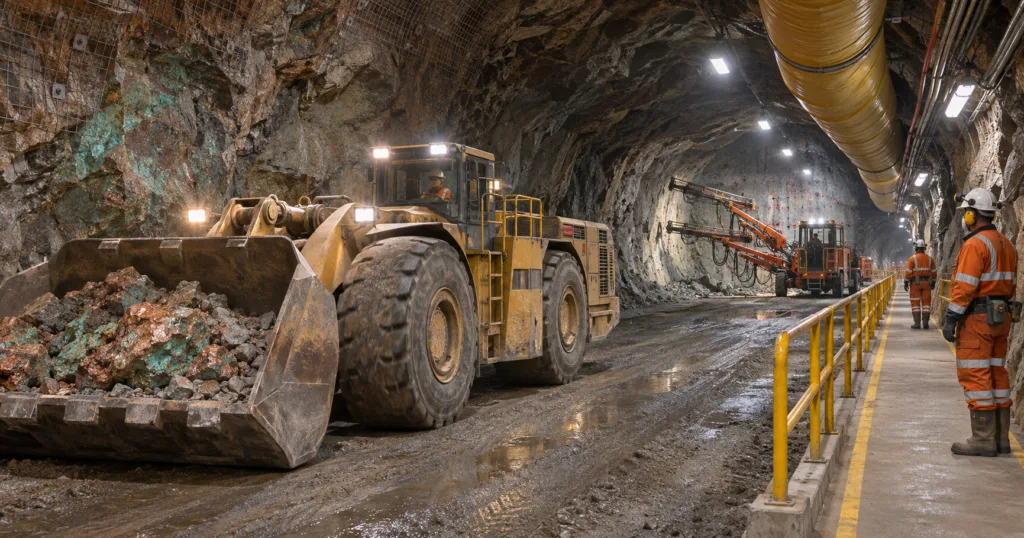
The Swedish supplier said large equipment orders totaled SEK 790 million, up from SEK 470 million. That included a SEK 610 million order from MMG for the expansion of the Khoemacau Copper Mine in Botswana, which Epiroc described as its second-largest equipment order.
Epiroc President and CEO Helena Hedblom said underground equipment demand was strong during the quarter. The company also reported strengthening interest in its diesel-electric equipment following product launches.
Caterpillar reported third-quarter sales and revenues of $20.7 billion, up 17% from $17.6 billion a year earlier. Sales in its Resource Industries segment increased 15%, while Power & Energy sales rose 18%. Chairman and CEO Joe Creed pointed to strong order rates and a record backlog.
Copper forecasts highlight investment needs
Copper is used in wiring, batteries and data centers, making it a material needed for electrification and computing infrastructure.
BloombergNEF’s Transition Metals Outlook 2026 estimates that $332 billion of investment in new copper mines is needed to address a projected supply shortfall beginning in 2028.
BloombergNEF also puts the average time needed to bring a new mine into operation at 17 years. It identifies declining ore quality and underinvestment in exploration as further challenges to increasing supply.
Mine investment faces cost and staffing pressures
McKinsey’s State of the Industry 2026 puts mining capital expenditure in 2025 approximately 25% below its 2012 peak. Its outlook anticipates higher annual spending by 2035.
| Year | Capital expenditure | Period status |
|---|---|---|
| 2012 | $259 billion | Historical |
| 2025 | $194 billion | Historical |
| 2035 | $248 billion | Projection |
McKinsey estimates that mining and processing will require $2.2 trillion in capital expenditure between 2025 and 2035, with copper accounting for 35%.
The consultancy also identifies rising project costs. Across ten gold projects it tracked, capital expenditure estimates increased between 25% and 194% from 2020 to 2025, with four more than doubling. McKinsey describes the broader mining market as increasingly divided, with performance differing across commodities.
Staffing is another projected requirement. McKinsey estimates that mining will need about 250,000 additional full-time workers globally by 2035, alongside the capital required to develop and operate projects.
Replacement and service support demand
Hedblom said Epiroc’s demand mix remained roughly evenly divided between fleet replacement and expansion. Replacement work gives suppliers a source of orders alongside new projects and mine expansions.
Epiroc reported 13% organic growth in service orders, supported by midlife upgrades. It also highlighted growth in digital solutions for automation and safety. Aftermarket activities accounted for 67% of group revenues during the quarter.
Hedblom cautioned that large fleet upgrades can make service orders uneven between quarters. That limits how directly one quarter’s growth can be carried forward, even when underlying activity remains strong.
For the fourth quarter of 2026 and first quarter of 2027, Hedblom described a strong tender pipeline weighted toward copper. It covered new mines, expansions and replacement fleets. Underground demand had already supported the quarter’s orders, while surface equipment tenders remained in the pipeline.
She said project approval does not immediately produce a booked equipment order: contract negotiations can take months, and Epiroc records an order when it receives a firm purchase order.