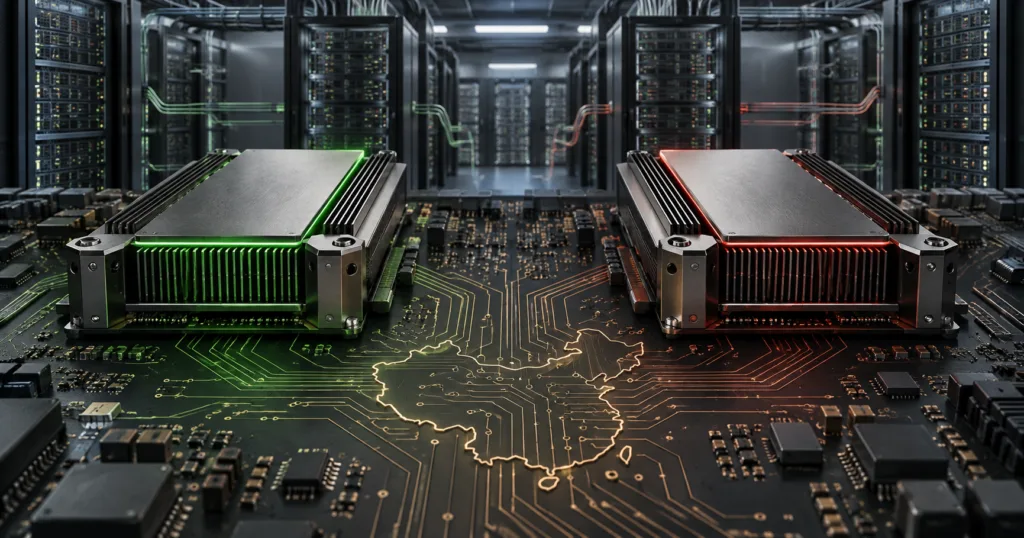
Nvidia’s share of China’s data-centre AI-chip market fell to 34% in the first half of 2026, according to IDC figures cited by Reuters in an October 13 report. The same figures put Huawei’s share at 28%, as domestic chipmakers increased shipments.
Reuters reported that IDC recorded 678,000 Nvidia AI-accelerator shipments in China between January and June, down 44% from a year earlier. Huawei’s shipments were put at 572,000, compared with more than 300,000 in the corresponding period a year earlier.
Reuters attributed pressure on Nvidia’s supplies to U.S. chip export controls, which it said restricted China’s access to the company’s most powerful products and narrowed the range available for sale.
Reuters also reported criticism from Nvidia chief executive Jensen Huang, who has argued that Washington’s restrictions forced the company to cede China’s AI-chip market to Huawei. Huang valued that market at $50 billion, according to Reuters.
Nvidia did not respond to Reuters’ request for comment, the news agency said.
Domestic suppliers gain ground
Beyond Huawei, IDC’s market-share figures, as reported by Reuters, placed Alibaba’s chip-design unit T-Head ahead of Cambricon, Baidu’s Kunlunxin and Hygon:
| Chipmaker | Reported market share |
|---|---|
| T-Head | 7% |
| Cambricon | 5% |
| Kunlunxin | 4% |
| Hygon | 3% |
Nine of the 11 Chinese chipmakers tracked by IDC increased shipments from a year earlier, Reuters reported.
The Nvidia figures had a material limitation: Reuters said IDC did not specify which products contributed to the company’s reported share, including whether the count covered B200 and B300 chips. The report therefore did not establish a product-level breakdown of Nvidia’s shipments.
Non-GPU accelerators overtake GPUs by volume
IDC put total Chinese AI-accelerator shipments at 2.008 million units for the first half, according to Reuters. Its figures indicated a shift in the types of chips being shipped.
Shipments of graphics processing units, or GPUs, fell 26% to 991,000 units, Reuters reported, citing IDC. The research firm attributed the decline to limited supplies eligible for sale in mainland China.
Other AI accelerators rose nearly 80% to 1.016 million units, exceeding GPU shipments by volume in IDC’s figures. Reuters described this category as including processors designed for specific AI tasks, such as running trained models.
Huawei, T-Head, Kunlunxin and Cambricon accounted for 95% of that non-GPU segment, according to IDC figures cited by Reuters. IDC identified government agencies, internet companies and telecoms providers among its adopters.
IDC also described competition as shifting beyond individual chip performance toward system-level capabilities, including how effectively processors operate together in larger computing clusters, Reuters reported.
For 2026 as a whole, IDC forecast 19% growth in China’s total accelerator shipments alongside a 9% decline in GPU shipments, according to Reuters.