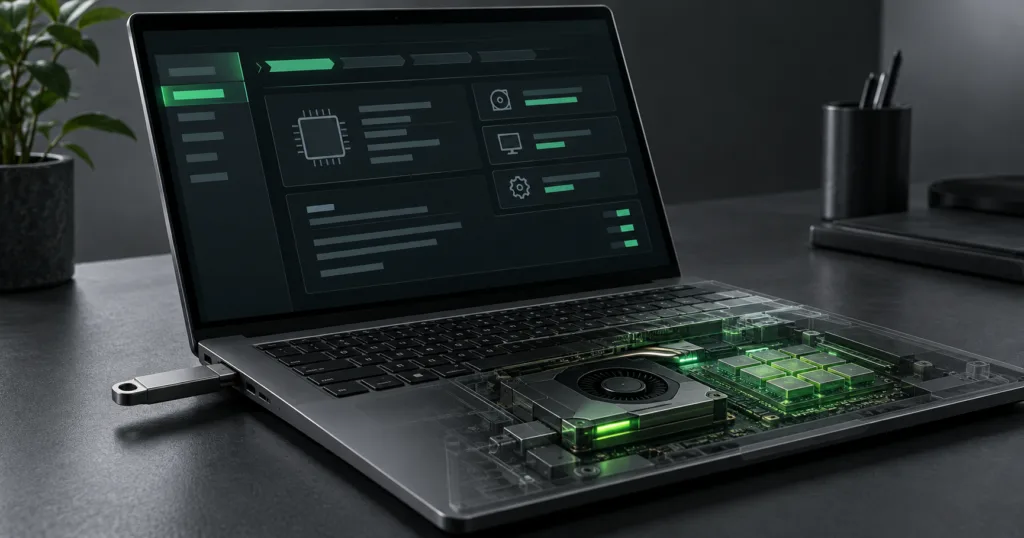
The open-source nv-uefi-unlocker project describes a USB-boot method for removing tensor-compute restrictions on Nvidia GeForce GPUs before Windows or Linux loads. Developer physicsdolphin reports a 65% increase in FP16 matrix-multiplication performance on an RTX 4060 laptop GPU, while the project lists support for RTX 20, 30 and 40-series hardware with model-specific qualifications.
The project says the tool operates before Nvidia’s driver starts and requires neither a video BIOS flash nor a patched graphics driver. The change is temporary: its documentation says power loss clears the modified state, requiring the procedure to be repeated at boot.
Reported gains depend on the card and test
The RTX 4060 laptop result describes one developer-tested configuration. It does not establish a 65% improvement across all supported GPUs or applications. The reported benefit concerns FP16 tensor math, and the project identifies power and thermal limits as factors that can constrain the performance available after the change.
The developer also reported an RTX 2070 desktop result of approximately 34 TFLOPS before the modification and around 62 TFLOPS afterward in an FP16 matrix-multiplication test at a matrix size of 8192. Those measurements concern a different GPU and test configuration from the RTX 4060 laptop result.
The project’s collected results compare individual cards before and after the change using the same test within each report. Workloads differ between reports, so the figures do not provide a consistent ranking of GPU performance across cards. They also do not establish an equivalent improvement in complete AI applications.
A firmware-stage approach for Windows and Linux
The project describes its method as using the community V67 payload through Nvidia’s signed Booter firmware. It says this opens write access to protected speed-selector registers, allowing changes to the tensor execution rate. Read-back verification checks the resulting register values.
The project’s documentation says enforced per-card ROM hash checks have not been implemented, although those checks form part of its stated safety rules.
The release is described as containing scripts and project-built binaries without bundled Nvidia firmware. The project says its preparation script downloads Nvidia’s public 610.43.03 driver packages, verifies the inputs and generates the necessary firmware files locally.
Its documented USB arrangement combines those generated files with the BOOTX64.EFI executable on a FAT32 drive. The boot application runs before the operating system and then transfers control to the Windows or Linux loader. The documented confirmation window is 30 seconds, with the spacebar used to approve execution.
The approach brings the modification into a UEFI boot environment, extending work previously associated mainly with Linux modules and experimental Windows ports. It still adds a firmware-stage operation to the boot process, rather than applying a permanent change to the graphics card.
nv-uefi-unlocker identifies Zagitta’s gpu-unlock as a porting source and names the RTX 40-focused gpu-unlock-ada and earlier Windows EFI work among its foundations. Those connections describe the project’s development lineage; they do not establish that every supported card has undergone the same testing.
Family support does not mean every model is tested
The project’s compatibility descriptions distinguish broad chip-family coverage from evidence for individual devices. It labels RTX 30-series support as compatible and extends its RTX 40-series support claim to desktops and laptops. Its RTX 20-series listing includes known issues affecting some models.
The following table summarizes those project-stated support categories and their qualifications.
| GPU family | Project support claim | Qualification |
|---|---|---|
| RTX 20 series | Supported Turing family | Some models have known issues; Windows requires GSP firmware mode and a restart. |
| RTX 30 series | Supported Ampere GA10x family | Family coverage does not establish testing of every card; RTX 3050 verification is incomplete. |
| RTX 40 series | Desktop and laptop support | Evidence varies by model and configuration. |
| GTX 16 series | Theoretical compatibility | Hardware verification remains pending. |
| Pre-Turing GPUs, GA100 and RTX 50 series | Unsupported | Outside the project’s supported hardware families. |
The collected Windows reports include RTX 3080 cards, including LHR variants, RTX 3060 Ti and RTX 3060 12GB models, alongside RTX 3080 Ti Laptop and RTX 3070 Laptop GPUs. The RTX 40-series entries include desktop RTX 4090, RTX 4080, RTX 4070 Ti Super, RTX 4070 Super and RTX 4070 cards.
The records also include RTX 4060 Ti cards with 8GB and 16GB of memory, plus RTX 4060 Laptop and RTX 4050 Laptop GPUs. Inclusion in these records describes reported testing on particular systems, rather than a guarantee for every board or laptop bearing the same GPU name.
Boot settings and power management remain constraints
The project specifies UEFI boot mode and says Secure Boot must either be disabled or configured to trust a self-signed EFI application. A developer team member said on Reddit that the tool cannot bypass a game’s Secure Boot requirement.
For RTX 20-series systems running Windows, the documented prerequisite is a bundled script that enables GSP firmware mode in Nvidia’s driver, followed by a restart. The project treats this as an additional driver configuration requirement for Turing hardware.
On laptops, the documentation says the discrete Nvidia GPU must be powered when the tool starts and recommends dGPU-only or MUX display mode. It also warns that Linux runtime power management can turn an idle GPU off, clearing the modified state even after a successful boot-stage operation.
The project’s FAQ discusses workarounds for that power-management behavior, but it does not guarantee persistence through Thunderbolt external-GPU connections. A successful firmware-stage result therefore does not establish that the modification remains active after every operating-system handoff or power-state change.
The developer says the tool can be combined with nvoc power-limit modifications, while warning that combined operation can exceed factory power and thermal envelopes. Those changes are separate from the tensor-rate modification and introduce additional operating conditions.
Zagitta, whose gpu-unlock project underpins part of the work, says Windows maintenance is outside that project’s plans and directs Windows users to a separate port. Zagitta also warns about unofficial Windows installers.