At the SC26 supercomputing conference in November 2026, Nvidia data center CPU chief Ian Finder called it “absurd” to suggest the company had foreseen the rise of AI agents when it began developing Vera. He credited Nvidia’s experience pairing processors with accelerators and what he called “design intuition” with shaping the Vera CPU. Finder said high memory bandwidth could become more important as data centers run more agent environments on each processor.
Nvidia described Vera as purpose-built for agentic AI in its March 2026 launch announcement. AMD later questioned whether Nvidia could have designed a processor specifically for a workload that gained prominence during the years it took to develop the chip. AMD’s criticism also extended to Arm’s AGI CPU.
AMD’s chief CPU architect, Mike Clark, said the company had expected CPUs to retain a role in AI software and described the scale of agentic computing as a surprise during Zen 6 development. Madhu Rangarajan, AMD’s corporate vice president of server products, said agent workflows span a range of tasks and argued that data centers need a mix of CPU designs to handle them.
Finder put the start of Vera’s design work about four years before the interview. He recalled early signs of tool calling, in which an AI model asks another piece of software to carry out a task. He pointed to the head node, the host that coordinates work in an accelerated system. “We certainly knew what we needed from a head node, and we knew the overall shape of this problem,” Finder said.
How Grace shaped Vera’s design
Grace, Nvidia’s first data center CPU, gave the company a starting point for designing a host processor alongside its accelerators. Finder said that approach carried over to Vera. He framed the design question around what the host needed to do to keep an accelerator supplied with work.
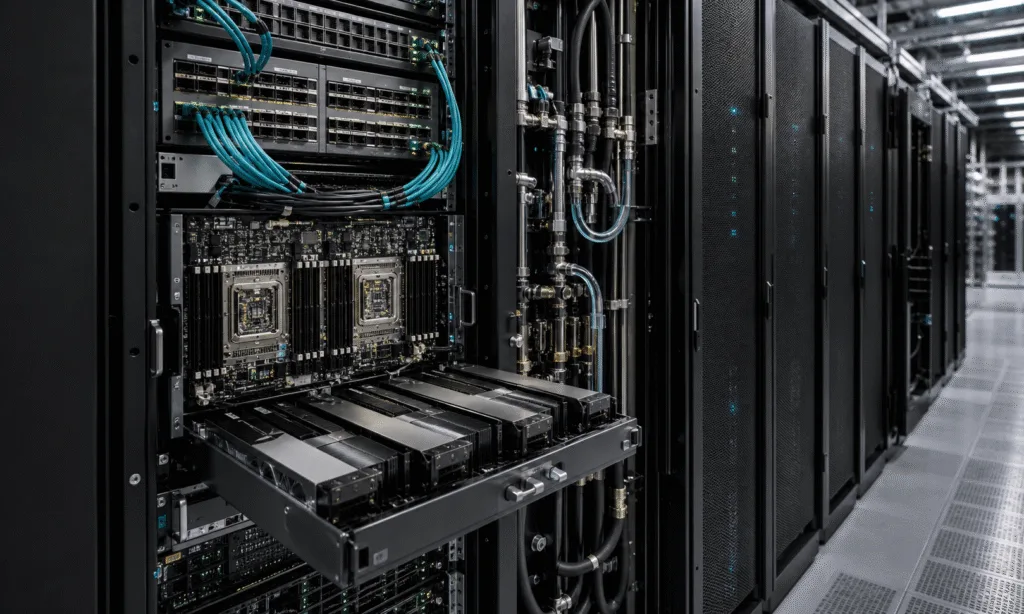
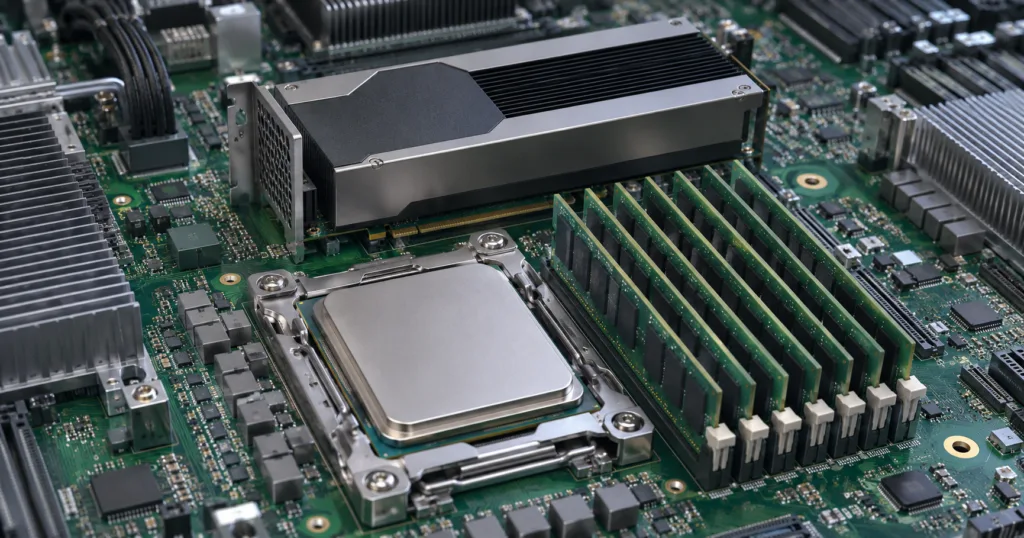
The Vera Rubin Superchip pairs one Vera CPU with two Rubin GPUs. Nvidia says the NVLink-C2C connection lets software address CPU and GPU memory in a single address space. The company has also described standalone Vera servers in single- and dual-socket configurations for workloads that run on the host, including agent sandboxes.
Nvidia used its Scalable Coherency Fabric in Grace’s memory system and carried the approach into Vera with a second generation of the fabric, which connects the CPU cores, caches and memory. Vera also introduced Nvidia’s Olympus CPU core. Finder described the project as a “clean sheet of paper” that gave the team room to design the core and memory system around the needs of an accelerated server.
Vera’s performance targets
Finder said the design called for strong performance on individual threads and the ability to run many tasks concurrently. He emphasized instructions per clock, or IPC, as a way to improve single-threaded performance. IPC measures how many instructions a core completes in a clock cycle. A higher IPC lets a core complete more instructions at the same clock frequency.
Nvidia specifies 88 Olympus cores and support for 176 hardware threads. Its design, called spatial multithreading, divides core resources between the two threads that can run on each core. Nvidia says the arrangement is intended to limit contention for those resources when both threads are active.
Finder said the team wanted low memory latency even when other tasks were accessing memory. It also sought high bandwidth for moving data. Latency under load measures how long a request takes when the memory system is busy. Bandwidth measures how much data the system can transfer over time. Both affect how the memory system handles work from multiple active tasks.
Nvidia’s data center CPU roadmap lists Rosa, based on the Rigel core, as the generation after Vera.
Where AI agents use the host CPU
Finder used a coding agent to illustrate how work can move between the accelerator and the host. A model running on a GPU might ask a tool to find a source file and use the contents to decide what to do next. It might make several such requests before asking the host to compile a change or run a test suite. In Finder’s example, those later steps place more demand on the CPU than the file lookups do.
The tools can run inside a sandbox, an isolated environment where the agent can work with project files and execute code. The CPU can be busy with a build or test while the agent waits for the result. When that step finishes, the result can go back to the model, which can then decide whether to make another change or call another tool. The time each processor spends on the task can vary with what the model requests.
Finder said the GPU can handle other work while the coding agent’s build or test runs on the CPU. He expects a similar approach on the host. When one environment is waiting for a model response, the host can use CPU time for work from another environment. Several agents sharing a server may be at different stages of their tasks, with one running a test while another is ready to read files.
Why Nvidia expects memory bandwidth to matter
Finder’s forecast assumes that operators can schedule enough of these isolated environments to keep a CPU socket busy. “What’s going to happen is we’re going to pack multiple environments together, and we’re going to subscribe the socket,” Finder said. In that setup, a single physical processor would take on work from multiple environments, filling gaps that can arise when any one environment is waiting for its next task.
Daytona and E2B, which build sandboxes for AI agents, have worked on shortening the time it takes to start those environments. Starting a sandbox within milliseconds is a goal of that work. Fast startup can help a server begin handling a tool request when it arrives, and shutting down an environment can free capacity for other work. Those capabilities help determine how many environments the host can serve as requests come and go.
Nvidia rates Vera’s CPU memory bandwidth at up to 1.2 TB/s and lists up to 512 GB/s for Grace. Nvidia also specifies up to 1.5 TB of CPU memory for Vera. Capacity matters when many environments need to hold data in memory, including during pauses in their CPU work. Bandwidth comes into play when active environments make overlapping requests to that shared memory system.
As software gets better at scheduling concurrent work, Finder said he expects Vera’s bandwidth to matter more. How much bandwidth a server needs would depend on the work those environments are doing and how often their tasks need to move data.