

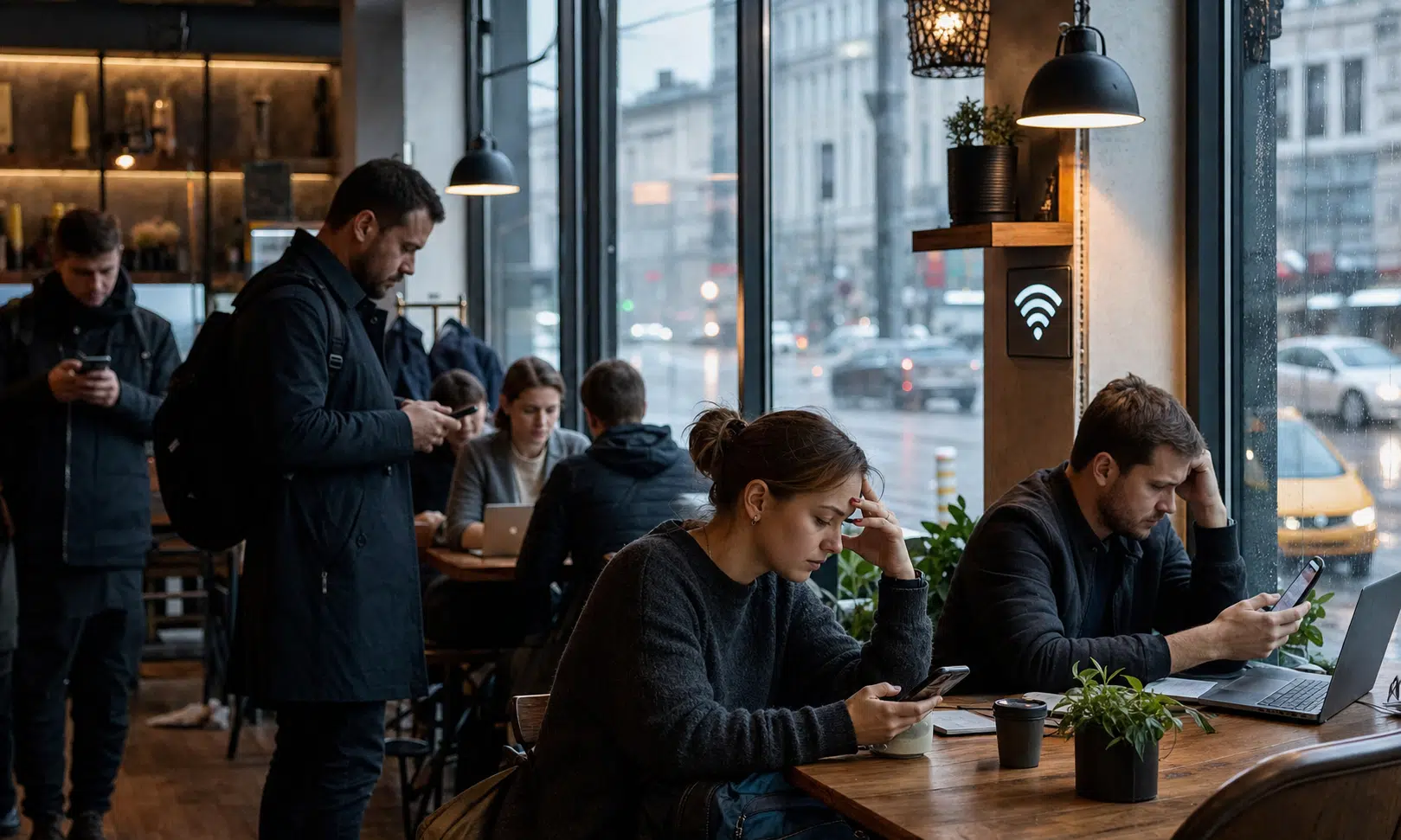

Mobile internet outages in Moscow are no longer feeling like isolated disruptions. For many residents, they have become another sign that Russia’s digital space is being tightened, filtered, and redirected toward platforms the state can control.
On a recent Tuesday morning, people in central Moscow found they could not use mobile data to check social media, access banking services, call a taxi, or carry out other routine tasks on their phones. Some gathered in cafes and fast food restaurants where Wi-Fi still worked, waiting for service to return.
By mid-afternoon, mobile access had come back. The official explanation followed a familiar pattern: the restrictions were needed for security.
Russian telecom providers and banks had already warned people to expect disruptions around the May 9 Victory Day Parade, an event taking place under heightened security and with a reduced public profile. But the outages have also fed a wider concern inside Russia: that temporary security measures are becoming part of a broader system for limiting access to the open internet.
Why Officials Say Mobile Internet Is Being Restricted
Russian authorities have linked mobile network restrictions to the threat of Ukrainian drone attacks, saying internet connectivity can help drones navigate or communicate. As Ukraine has used longer-range drones to strike deeper inside Russia, the Kremlin has presented tighter controls as a defensive measure.
That explanation has not convinced everyone.
One Moscow-area teacher, identified only by his first name because of the risks of speaking openly in Russia, said many people around him do not trust the stated reasons. The problem, he said, is not only the loss of service but the sense that official explanations do not match daily reality.
The distrust matters because mobile internet has become a basic layer of urban life. When it drops, people lose access not just to entertainment or social platforms, but also to payments, banking, maps, delivery apps, ride-hailing, messaging, and work tools.
The result is practical disruption first and political suspicion second. A person who cannot pay for something, reach a workplace chat, or order a taxi does not experience the outage as an abstract security measure. They experience it as the state reaching into a normal day and switching off essential services.
The VPN Crackdown Behind the Outages
The outages have coincided with a sharper campaign against virtual private networks, or VPNs. VPNs are widely used in Russia to get around blocked services and reach foreign platforms that are otherwise difficult or impossible to access normally.
Without a VPN, many users struggle to reach major international platforms, including Instagram and other foreign services restricted or degraded inside the country. Telegram, which remains widely used by citizens and state institutions alike, has also become less reliable for some users without circumvention tools.
VPN use itself is not broadly illegal in Russia, but the state has steadily increased pressure on the tools that make it possible. Internet providers have been required to detect VPN traffic and restrict access when they identify it. Russian officials have also discussed additional measures, including potential penalties or fees tied to heavy international data use.

GL.iNet Beryl AX Travel VPN Router
A travel VPN router can route phones, laptops, and tablets through one configured connection instead of setting up every device separately. It is most useful for trusted Wi-Fi environments and does not guarantee access during state-level blocking.
As an Amazon Associate I earn from qualifying purchases.
For ordinary users, the effect is uneven. Some VPNs work one day and fail the next. Others slow down or become unreliable. Many users keep several services available so they can switch when one is blocked or overloaded.
That constant switching has become part of internet life for people who want access to information beyond state-approved channels. It is also one reason Russia’s attempt to control digital access remains difficult: every new block encourages a new workaround.
The Push Toward a State-Approved Internet
The Kremlin’s long-term goal is often described as a “sovereign internet,” a digital environment shaped by Russian laws, Russian platforms, and Russian state priorities. In practice, that means restricting access to outside services while encouraging or requiring people to use domestic alternatives.
A newer feature of this approach is the idea of a whitelist: a set of approved websites and services that should remain available even when broader internet traffic is blocked. The whitelist model changes the internet from an open system into something closer to a permission-based network.
Instead of asking which sites should be blocked, the state can decide which services are allowed to keep functioning during restrictions.
That distinction is important. A blacklist blocks specific targets. A whitelist can make everything else unreliable by default.
For users, the difference may show up in small but significant ways:
- banking apps may work while foreign platforms fail;
- state-linked services may remain reachable while independent media does not;
- approved messaging or payment tools may be favored over outside alternatives;
- ordinary web browsing may become unpredictable unless routed through a working VPN.
Even Kremlin-Aligned Tech Figures Are Warning About Damage
The backlash has not come only from opposition voices or digital rights groups. Some concerns have emerged from inside Russia’s own technology sector.
Natalya Kaspersky, a prominent technology executive with ties to official advisory bodies, has warned that the government’s restrictions are damaging the functioning of the internet and creating public anger. She has argued that attempts to block VPN traffic are also catching legitimate services, including banking platforms, in the same net.
That is one of the central technical problems with broad internet filtering. Traffic does not always sort neatly into “allowed” and “forbidden” categories. Blocking tools can disrupt services that were never the intended target, especially when users, apps, and platforms constantly change how they route data.
A campaign designed to prevent people from reaching blocked content can end up making everyday services unreliable. For people already skeptical of official explanations, those side effects make the policy look less like targeted security and more like careless control.
Why VPN Use Is So Widespread in Russia
VPN use has become common enough that even young users are familiar with it. The Moscow-area teacher said many students already know how to use VPNs because they begin using smartphones early and quickly learn which apps need workarounds.
The tools are also relatively easy to find and inexpensive enough that some users pay for several at once. That creates a cat-and-mouse system: regulators block one service, users move to another, and providers adapt.
Russian officials have described VPN use in increasingly political terms. Some have portrayed it not as a privacy or access tool, but as a way for citizens to consume hostile information. That framing turns a technical workaround into a loyalty question.
For buyers of privacy tools and secure browsing services, Russia is also a reminder of a practical point: not all VPNs are designed for high-censorship environments. Some are built mainly for streaming access or basic privacy on public Wi-Fi. Others focus more heavily on censorship resistance, obfuscation, and reliability under network pressure.
That distinction matters in countries where filtering is aggressive. Users need tools that can survive blocking attempts, rotate protocols, and protect identity without creating obvious traffic patterns. Even then, no consumer tool can guarantee uninterrupted access when a state is actively targeting circumvention.
A Digital Iron Curtain, or Something More Uneven?
Critics outside Russia have often compared the country’s internet controls to a “digital Iron Curtain.” Others compare the system to China’s Great Firewall. The comparison captures the ambition, but Russia’s system is messier and more uneven.
China built a deeply integrated censorship system over many years. Russia’s controls have intensified quickly, especially since the full-scale invasion of Ukraine began, and many citizens were already used to a more open internet before the current restrictions hardened.
That history makes public acceptance more complicated. People who remember easy access to foreign platforms may be less willing to treat today’s restrictions as normal. They may also be more technically prepared to bypass them.
At the same time, uneven enforcement can still be effective. If access to independent information becomes slow, unreliable, or technically difficult, many people will stop trying. The most determined users may keep finding ways around the restrictions, while others remain inside the information environment the state prefers.
That split is central to Russia’s internet future. The goal may not be to stop every user from reaching every blocked source. It may be enough to make open access inconvenient, risky, or unreliable for the majority.
What the Outages Reveal About Control and Trust
The Moscow outages show how digital control can move from the political sphere into ordinary life. A restriction that begins with a stated security purpose can affect errands, payments, work, school, and family communication.
That creates a trust problem the Kremlin cannot solve with technical filtering alone. If people believe outages are truly temporary and narrowly tied to security risks, they may tolerate them. If they believe the restrictions are part of a larger effort to control information, each outage becomes evidence of something bigger.
The pressure on VPNs deepens that suspicion. People who use circumvention tools already know the state is trying to shape what they can see. When mobile internet outages arrive at the same time, the two issues start to look connected, even when officials describe them separately.
For now, many Russians are adapting rather than openly resisting. They keep backup VPNs, look for working Wi-Fi, switch apps, and share technical advice. But adaptation should not be mistaken for acceptance.
The more the state narrows the internet, the more it teaches users to treat access itself as unstable. That may serve short-term control, but it also makes official explanations harder to believe the next time the network goes dark.