

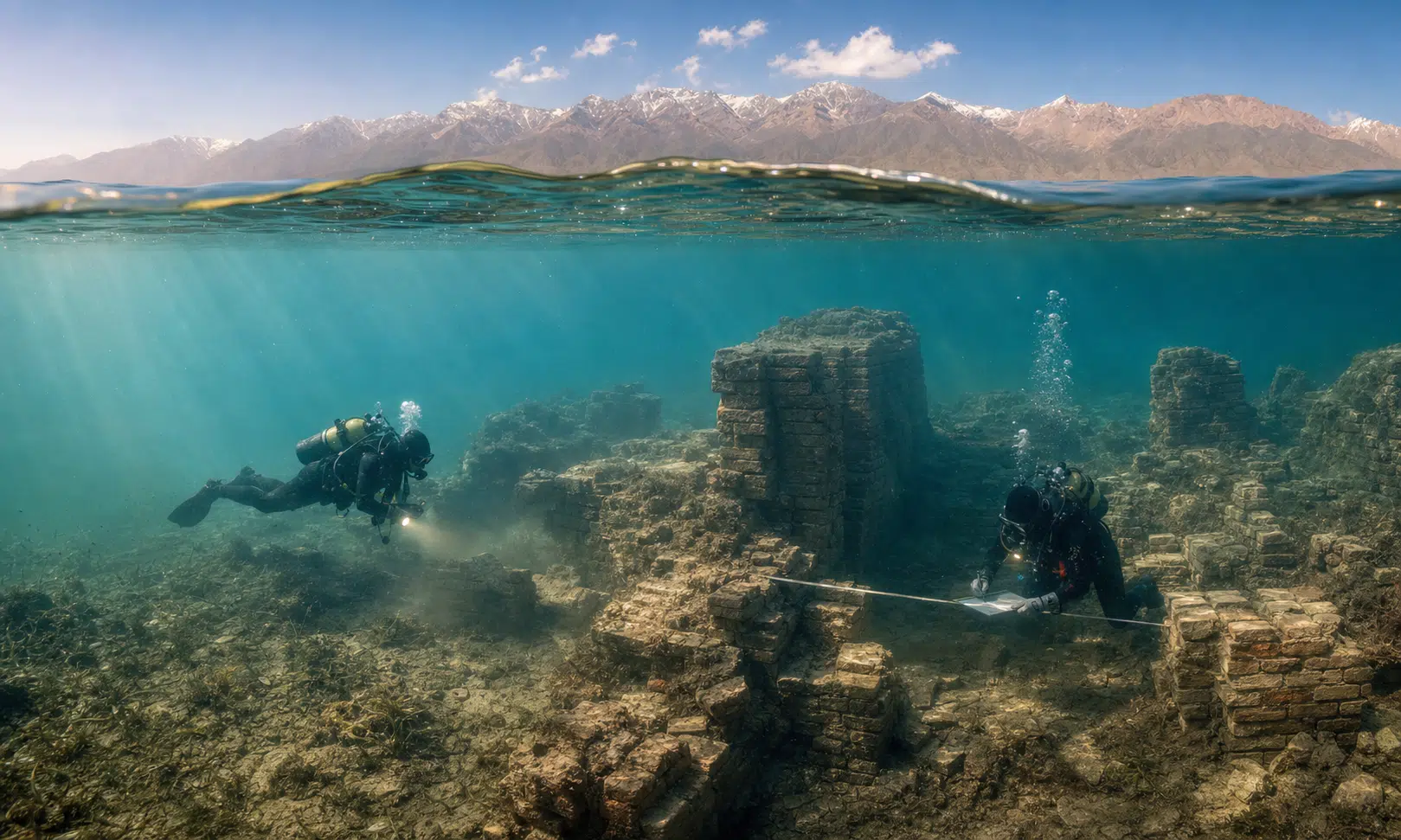

Archaeologists working in the shallow waters of Lake Issyk-Kul in Kyrgyzstan have reported the remains of a submerged medieval settlement that may once have been part of the Silk Road world.
The site, near the lake’s northwestern shore, has been described in reports from the research team as a former city or large trading center. Divers have documented walls, collapsed structures, timber, ceramic finds, and a Muslim burial ground now lying beneath several feet of water.
That is why the discovery has drawn comparisons to an “Atlantis-like” city. The more useful way to read the find, however, is not as a legend suddenly proved true, but as a rare underwater record of a town that may have been caught between commerce, religion, earthquakes, and changing lake levels.
Verdict: Why This Discovery Matters
For readers deciding whether this is just another exaggerated archaeology headline, the answer is fairly clear: the framing may be dramatic, but the underlying find appears meaningful.
The strongest case is the combination of built structures, burial evidence, and the site’s location near known Central Asian trade routes. Taken together, those details point to a settled community rather than a few isolated objects washed into the lake.
What remains less settled is the full timeline. Researchers have proposed a medieval settlement that declined or sank after seismic activity in the 15th century, but some details still depend on laboratory dating and further publication. A firm timeline has not been publicly confirmed.
| Question | What is currently supported | What still needs caution |
|---|---|---|
| Was there a settlement? | Survey reports describe walls, buildings, ceramics, timber, and street-like remains. | The full city plan is still being reconstructed. |
| Was it tied to trade? | The location fits the broader Silk Road geography of the Issyk-Kul region. | The exact economic role of the town needs more evidence. |
| Was there a Muslim community? | Researchers describe a cemetery with burial practices associated with Islam. | Individual graves and dates require careful analysis. |
| Did an earthquake sink it? | The region is seismically active, and researchers connect the decline to a 15th-century event. | The final abandonment date is not yet fixed. |
A Lost Settlement in Shallow Water
The recent survey focused on four underwater zones along the northwestern edge of Lake Issyk-Kul. The work took place in relatively shallow water, roughly 3 to 13 feet deep, which makes the site accessible to divers but also vulnerable to waves, silt movement, and erosion.
Researchers reported fired brick walls, collapsed building remains, wooden beams, ceramics, and traces of larger public structures. Some finds suggest everyday activity, such as food processing. Others point to more formal urban life, possibly including religious, educational, or bathing spaces.
The work was led by Maksim Menshikov, an underwater archaeologist associated with the Institute of Archaeology of the Russian Academy of Sciences. His team has worked on submerged medieval sites in the region, using divers, underwater recording, and drone footage to map structures that would be hard to interpret from the surface alone.
Earlier research from the same area had already identified brick buildings, kiln complexes, and dense cultural layers along this shore. The latest survey appears to add more evidence of a larger settlement pattern, though some claims about newly mapped structures and burial areas remain best treated as preliminary until more detailed publication is available.
Lake Issyk-Kul itself helps explain why such a site could survive underwater. It is a closed-basin lake, meaning water flows in but does not drain out through a river. Over centuries, changes in shoreline, sediment, and seismic activity could leave former lakeside buildings submerged rather than erased.
Signs of a Silk Road Trading Center
One of the most important questions is whether the site was simply a local settlement or part of a wider commercial network.
The research team has described the area as a sizable city or trading center, but that interpretation should still be read as the team’s working conclusion rather than a fully settled fact. The physical evidence does support the possibility: brick construction, public buildings, a millstone, and dense occupation layers all point to a place with more than temporary use.
Lake Issyk-Kul sat near routes that connected mountain valleys, steppe communities, and larger Central Asian trade corridors. The region’s position makes a lakeside settlement plausible as a stopping point for merchants, officials, craftspeople, and religious communities.
The Silk Roads: A New History of the World
Peter Frankopan’s The Silk Roads is a broad history of the trade networks, empires, religions, and cities that shaped Central Asia. It is a useful next read for understanding why a lakeside settlement near Issyk-Kul could matter beyond one local discovery.
As an Amazon Associate I earn from qualifying purchases.
For readers comparing Silk Road history books, maps, or documentaries, the key takeaway is that the discovery is most useful as a case study in regional trade. It shows how commerce was not limited to a single road or a few famous cities. It moved through lake basins, mountain passes, agricultural towns, and mixed communities that are still being mapped.
The Cemetery Beneath the Lake
The reported cemetery is one of the site’s most sensitive and important features.
Divers documented what researchers describe as a planned Muslim burial ground. Reports say the cemetery may cover a large area, and that remains from at least one man and one woman were recovered for study, but those details have not been independently verified in the available public material.
The burial descriptions, including body position and orientation toward the qibla, are also best presented cautiously. Researchers have connected the burials with Islamic funerary practice in the 13th and 14th centuries, but the exact dating and interpretation depend on further analysis.
What is clear is that a cemetery on the lakebed gives archaeologists a different kind of evidence than walls or pottery alone. Burials can reveal religious practice, community organization, health, diet, ancestry, and migration patterns. In this case, documenting and sampling may help researchers study everyday life in a medieval Silk Road community, though the full results have not yet been confirmed publicly.
Wave action is another reason the work matters now. Shallow underwater sites can erode quickly once graves, bricks, or bones are exposed. Careful documentation can preserve information even when the physical site continues to change.
Dating the City’s Rise and Fall
The next major step is chronology. Researchers have sampled timber and other materials for dating, including tree-ring analysis and radiocarbon methods.
Dendrochronology can sometimes date wood very precisely when the preserved rings can be matched to a known regional sequence. Radiocarbon testing can help establish a broader age range for organic material. Used together, these methods may narrow when buildings were constructed, repaired, abandoned, or submerged.
A firm timeline has not been publicly confirmed. That matters because the most dramatic version of the story says the town sank after a powerful earthquake in the early 1400s. The Issyk-Kul region has a long history of seismic activity, and geological studies support the idea that earthquakes could alter shorelines or trigger landslides. Still, tying this specific settlement to one specific event requires dated evidence from the site itself.
Researchers have also used coring and sediment study to examine mudbrick walls and buried layers. Those samples can show changes in construction, soil chemistry, burning, flooding, and other occupation signals. Public reports describe this work, but the more cautious reading is that it is part of an ongoing reconstruction rather than a finished history.
Religion and Cultural Change Around Issyk-Kul
The site also sits inside a wider story of religious change in Central Asia.
Before Islam became dominant in many parts of the region, communities practiced a mix of traditions, including Turkic sky-centered beliefs, Buddhism, and forms of Christianity. During the medieval period, Islam spread through political, commercial, and urban networks, especially as cities, mosques, schools, and cemeteries became more visible markers of religious life.
The Issyk-Kul settlement may reflect that transition. Researchers have suggested that the community included older cultural layers as well as Islamic burial evidence. Menshikov has also noted the importance of syncretic traditions, where older beliefs and newer Islamic practices could overlap rather than replace one another overnight.
That kind of mixed cultural record is one reason underwater sites are valuable. A settlement preserved beneath lake water can hold evidence from different phases in close physical relationship: homes, workshops, public buildings, graves, and shoreline changes all occupying the same landscape.

Lonely Planet Central Asia
Lonely Planet Central Asia gives practical regional background for readers who want to connect Kyrgyzstan, Issyk-Kul, and neighboring Silk Road landscapes. It is best suited for travel planning and place-based context rather than archaeological analysis.
As an Amazon Associate I earn from qualifying purchases.
Who This Story Is For
This discovery is especially relevant for three kinds of readers.
- History readers who want a grounded Silk Road story beyond the usual famous cities.
- Travel-minded readers interested in Kyrgyzstan, Central Asia, and the landscapes around Lake Issyk-Kul.
- Archaeology readers who want to understand how underwater surveys turn scattered ruins into a readable settlement plan.
It is less useful if read only as a treasure-hunt headline. The real value is not that a lost city sounds like Atlantis. It is that walls, graves, wood, ceramics, and sediment may help researchers reconstruct how a medieval community lived beside the lake, traded across the region, changed its religious practices, and eventually disappeared below the waterline.
The next phase will depend on dating results, conservation work, and detailed publication. Until then, the safest conclusion is also the most interesting one: Lake Issyk-Kul appears to preserve a substantial medieval settlement under shallow water, and researchers are only beginning to turn that submerged landscape into history.