

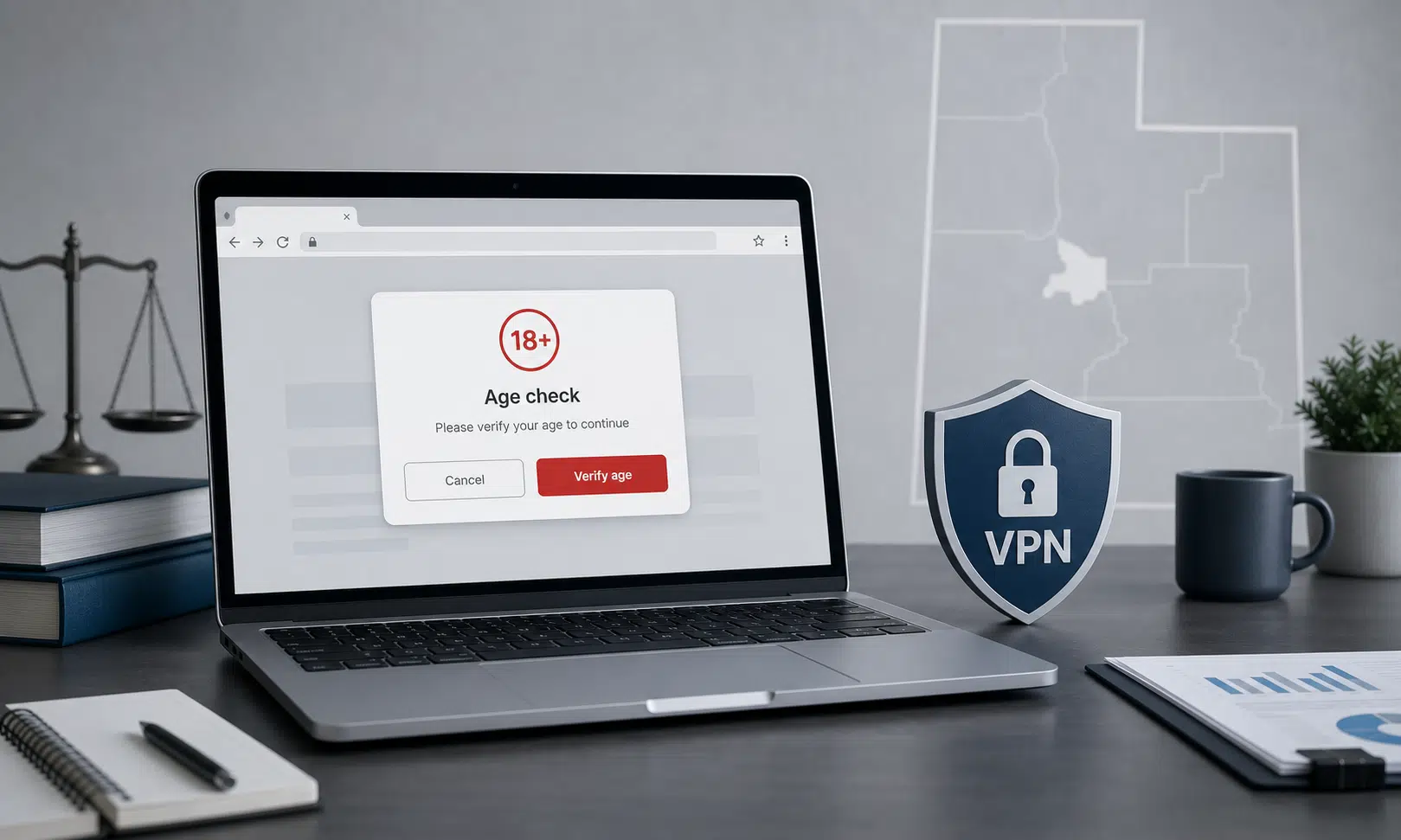

Utah is preparing to enforce one of the most aggressive age-verification rules in the United States, and the most controversial part is not simply the age check itself. It is the way the law treats VPNs, proxies, and other tools people use to mask their location.
The Online Age Verification Amendments, also known as Senate Bill 73, are scheduled to take effect on May 6, 2026. The measure has been reported as signed by Governor Spencer Cox on March 19, 2026, and it is aimed at websites covered by Utah’s rules for age-restricted online content.
Its central idea is direct: a user physically located in Utah is treated as a Utah user even if that person uses a VPN, proxy server, or similar tool to make their connection appear to come from somewhere else. The law also restricts covered websites from providing instructions on using VPNs to get around age checks.
For lawmakers, the goal is to close a loophole in age verification. For website operators, privacy advocates, and VPN companies, the problem is that the law appears to demand a level of location certainty that websites usually do not have.
Why the VPN Requirement Is So Difficult
Most websites do not know a visitor’s physical location. They know what the connection tells them: an IP address, browser signals, account information if the user is logged in, and whatever data the visitor chooses to provide. IP addresses can be useful, but they are not the same thing as physical presence.
Commercial VPNs make that problem harder by routing traffic through shared servers. Some of those servers are easy to identify because they belong to known data centers or appear in VPN and proxy databases. Others are harder to classify, especially when providers rotate addresses or use infrastructure that overlaps with ordinary hosting and residential traffic.
That leaves websites with imperfect tools. IP reputation databases can flag many known VPN endpoints, but they can miss new or obscure ones. Autonomous System Number analysis can help identify traffic from cloud and hosting networks, but it cannot prove why a specific user is there. A private tunnel running through a cloud server may look similar to other traffic from the same provider.
Deep packet inspection is sometimes discussed as a more powerful way to identify VPN traffic, but it is not a normal option for a website operator. DPI happens at the network level, between the user and the destination, and usually requires access controlled by internet service providers or state-level network infrastructure. A website receiving HTTPS traffic from a visitor does not sit in that position.
That technical gap is the heart of the criticism. Utah’s law can define who counts as a Utah visitor, but the website still has to decide how to detect that visitor when the available signals are incomplete.

Norton 360 Deluxe
For readers comparing privacy tools, Norton 360 Deluxe combines device security with a Secure VPN for private browsing on public Wi-Fi and shared networks. It should be framed as a general privacy and security tool, not as a way to bypass state age-verification rules.
What Websites May Do Next
The practical choices for covered websites are not especially clean. Some may require age verification from every visitor, regardless of where that person appears to be located. That would reduce the risk of missing a Utah user, but it would also expand identity checks far beyond Utah.
Others may block traffic from known VPN and proxy ranges. That approach is easier to implement, but it can punish legitimate users who rely on VPNs for privacy, work, travel, or personal safety. It also will not catch every masked connection.
A third option is to block Utah entirely, as some platforms have done in response to other state-level age-verification laws. That reduces legal exposure in one state but creates a fragmented web experience where access depends on local rules and a company’s appetite for compliance risk.
NordVPN has criticized the Utah measure as a compliance trap, arguing that websites are being held responsible for identifying people who are deliberately using tools designed to make that identification difficult. Digital rights groups have raised similar concerns, warning that the pressure could lead to broader verification demands, more VPN blocking, and less private browsing for adults as well as minors.
For site owners, the buyer-aware takeaway is simple: this is not just a policy issue. It affects vendor selection, age-verification workflows, fraud tooling, logging practices, and the user experience for anyone who arrives through privacy-protecting infrastructure.
The Privacy Tradeoff for Users
VPNs are often marketed as a way to hide an IP address, stream content from another region, or reduce tracking on public Wi-Fi. But many people use them for more serious reasons: journalists protecting sources, people escaping abuse, workers handling sensitive information, activists, and users in countries where online activity is monitored.
Utah’s law does not ban VPNs outright. The concern is more indirect. If websites respond by blocking VPN traffic or demanding identity checks from everyone, ordinary privacy tools become harder to use without friction. Less technical users are likely to feel that most, because they often depend on commercial VPN apps rather than custom privacy setups.
The law also lands in a broader international debate. The United Kingdom has debated VPN-related age-verification restrictions, while officials in France have signaled interest in stronger controls around circumvention tools. Wisconsin considered VPN-related provisions in age-verification legislation but later removed them after criticism. Some reports about the exact direction of these proposals remain difficult to independently confirm, so the safer reading is that lawmakers in several jurisdictions are increasingly treating VPNs as part of the age-verification debate.
A Law Written for a Messy Internet
The central tension is unlikely to disappear when Utah’s law takes effect. Legislators want age checks that cannot be bypassed with a location-masking tool. Websites want clear rules they can actually follow. Users want privacy tools that do not automatically make them suspicious.
Those goals do not line up neatly. A website can verify age. It can estimate location. It can block obvious VPN traffic. What it usually cannot do is reliably prove where every visitor is physically sitting when that visitor is using tools designed to obscure that fact.
That makes Utah’s law important beyond one state. It is a test of whether age-verification mandates will move from checking users to policing the privacy tools users bring with them. If other states copy the model, the result could be a web where more people are asked to prove who they are simply because location is no longer trusted.