
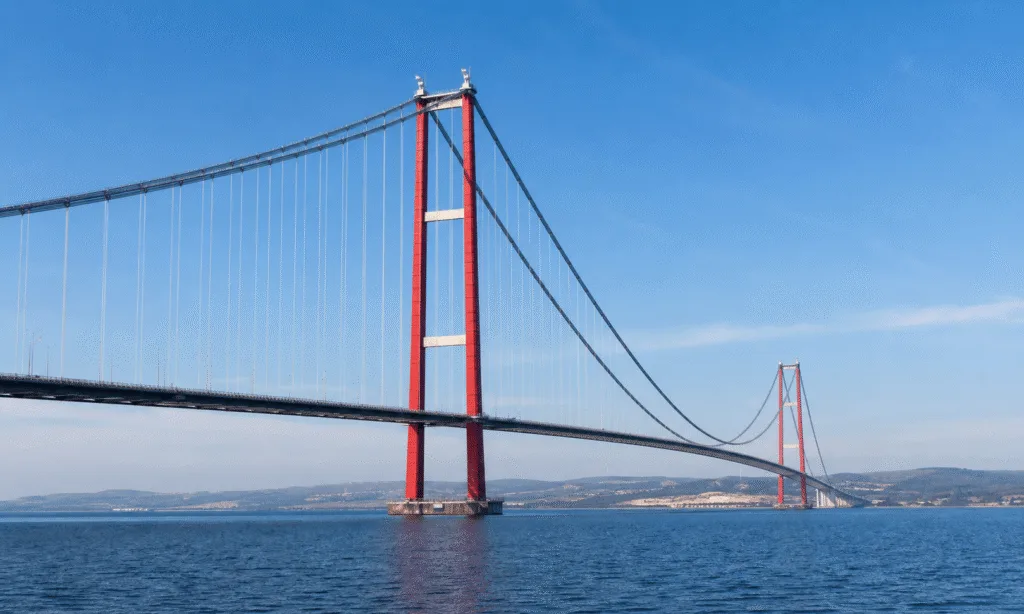
Turkey’s 1915 Çanakkale Bridge has the world’s longest suspension bridge main span, at 2,023 metres. The bridge crosses the Dardanelles in northwestern Turkey, linking the Gallipoli peninsula on the European side with the area near Lapseki on the Asian side.
Construction began in 2017, and the bridge opened on March 18, 2022. Its main span, measured between the two towers, is 32 metres longer than that of the previous record holder, Japan’s Akashi Kaikyo Bridge. The Japanese bridge was completed in 1998 and has a main span of 1,991 metres.
The bridge’s name commemorates the Ottoman naval victory in the Dardanelles on March 18, 1915, during the First World War. At the opening ceremony, Turkish President Recep Tayyip Erdoğan said the 2,023-metre span marked the centenary of the Republic of Turkey in 2023.
From ferries to a motorway crossing
The bridge gave drivers a fixed crossing on a route previously served by ferries between Gelibolu and Lapseki. Erdoğan said at the opening that driving across the bridge would take about six minutes. The time saved on a full journey depends on the route and how long drivers would otherwise wait for a ferry.
The 101-kilometre Malkara–Çanakkale motorway opened alongside the bridge. Erdoğan put the investment in the motorway section inaugurated that day, including the bridge, at about €2.5 billion, equivalent to roughly £2.1 billion at the time.
Italy’s Strait of Messina proposal
Italian project company Stretto di Messina has set out plans for a bridge between Sicily and mainland Calabria. The proposal has been reported to include a single 3,300-metre span. A bridge built with a span of that length would exceed the Çanakkale record.
Stretto di Messina chief executive Pietro Ciucci said the company aimed to return to Italy’s CIPESS committee by the end of June to seek a new decision. Earlier plans for a fixed crossing have been reported to date back decades, with previous versions shelved after political, financial and technical objections. Reported concerns about the proposal include cost, seismic risk, strong currents and potential effects on migratory birds.