

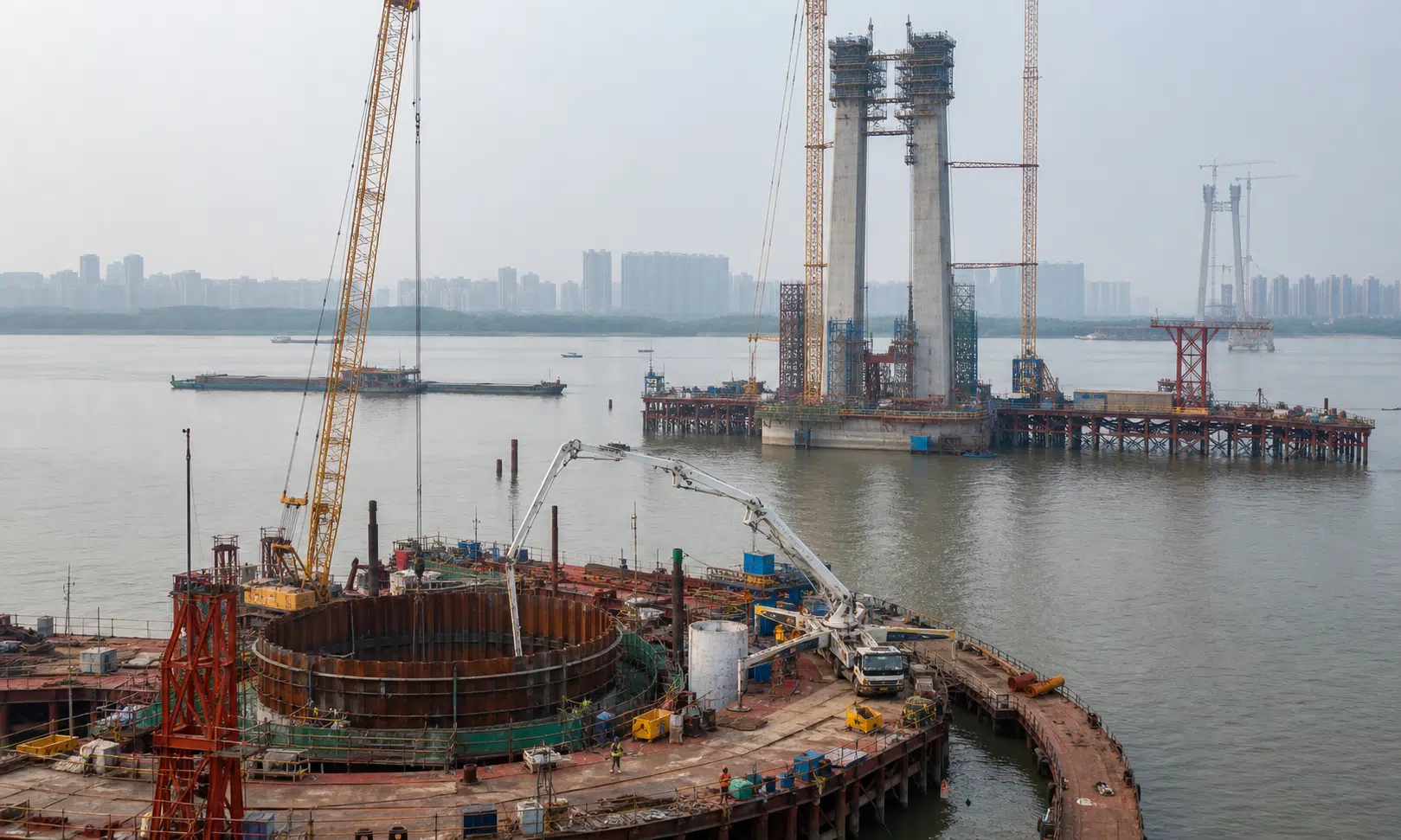

A major foundation stage on China’s Hannan Yangtze River Bridge has drawn attention because of the scale of the caisson being built for the project’s anchorage system.
The bridge, planned for the Wuhan metropolitan area in Hubei province, is designed as a large suspension crossing over the Yangtze River. Public project descriptions identify it as a double-tower, single-span suspension bridge with a 1,600-meter main span, a steel box girder deck, and eight traffic lanes.
The part that attracted attention was not the bridge deck or the towers, but the foundation work for the south anchorage. Project information described a continuous concrete pour lasting 60 hours as part of the construction of a very large caisson, the buried foundation structure that helps support the anchorage of a suspension bridge.
In a finished bridge, much of that work will be out of sight. Drivers see towers, cables, pavement, and the open span over the water. Engineers, however, have to solve the harder problem below and beside the bridge: how to transfer enormous cable forces into the ground without losing alignment, stability, or long-term safety.
What happened at the Hannan Yangtze River Bridge site
The Hannan Yangtze River Bridge is part of a wider expressway crossing project intended to improve connections around Wuhan and neighboring areas. Wuhan is one of China’s most important inland transport and industrial hubs, and the Yangtze remains a central route for navigation, logistics, and regional movement.
The bridge is being built as a suspension bridge, a form commonly used when engineers need to cross a wide waterway while keeping the river channel open. A long main span reduces the need for intermediate supports in the river, which can simplify navigation clearance and limit direct obstruction in the waterway.
The reported 60-hour concrete operation concerned the south anchorage caisson. In bridge construction, a caisson is a large foundation box or cellular structure built to be sunk, seated, or embedded into the ground. It is not a decorative element, and in this context it has nothing to do with a coffin. It is a structural foundation used where ordinary shallow foundations are not suitable.
For the Hannan project, public descriptions give the south anchorage caisson a plan size of 76.4 meters by 76.4 meters and a height of 43 meters. The structure is described as being divided into internal cells, a layout that helps with staged construction, sinking control, and monitoring.
Those figures explain why a single construction phase could require around-the-clock work. Large concrete pours are not simply a matter of putting more trucks on site. The sequence, temperature behavior, layer bonding, supply rhythm, formwork, and monitoring all have to stay within the construction plan.
Key project figures
The project details most useful for understanding the scale of the work can be summarized in a simple table.
| Feature | Reported project detail |
|---|---|
| Bridge name | Hannan Yangtze River Bridge |
| Location | Wuhan area, Hubei province, China |
| Bridge type | Double-tower suspension bridge |
| Main span | 1,600 meters |
| Traffic layout | Eight lanes |
| Deck type | Steel box girder |
| South anchorage caisson plan size | 76.4 meters by 76.4 meters |
| South anchorage caisson height | 43 meters |
| Highlighted foundation stage | Continuous concrete pouring reported at 60 hours |
The numbers are large, but the most important point is how they work together. A 1,600-meter suspension span depends on its towers, cables, deck, and anchorages acting as one system. If the foundation shifts beyond the permitted tolerance, later work on the towers, main cables, and deck becomes more difficult and potentially unsafe.
Why a caisson matters in a suspension bridge
A suspension bridge carries much of its deck load through cables. Those cables pass over the towers and then need to be anchored securely at the ends of the bridge system. The anchorages resist the cable forces and transfer them into the ground.
That makes the foundation under an anchorage one of the most important parts of the structure. It has to deal with permanent loads from the bridge, variable loads from traffic, environmental loads such as wind, and ground conditions that can change with water levels and soil behavior.
A caisson helps by creating a large, controlled foundation mass that can be built in sections and lowered into position. Instead of relying on a small footing near the surface, the structure can extend deeper into more suitable ground and distribute forces through a larger base.
In alluvial areas near major rivers, this matters. Alluvial soil can vary in composition, moisture, density, and bearing capacity. It may include layers of sand, silt, clay, and deposited river material. Those conditions do not make construction impossible, but they require careful foundation design and constant observation during sinking and placement.
The Hannan project’s caisson is described as a cellular structure. Internal cells can help control construction sequence and behavior during sinking. They also give engineers access to monitor and adjust the process as the structure settles toward its intended elevation.

Bridge Engineering Handbook: Substructure Design
For readers who want a deeper technical reference, this bridge engineering volume focuses on substructure topics such as foundations, piers, abutments, and design considerations below the deck.
As an Amazon Associate I earn from qualifying purchases.
Why the concrete pour had to be continuous
The reported 60-hour pour is best understood as a construction control measure, not simply a record-setting exercise. Large concrete elements need continuity because unwanted cold joints, uneven curing, and uncontrolled temperature differences can create weaknesses or cracking risk.
When concrete cures, it generates heat. In a very large pour, the interior can heat and cool differently from the outer zones. If the temperature gradient becomes too large, internal stress can build in the concrete. Engineers manage that risk through mix design, placement sequence, cooling strategy, monitoring, and timing.
A continuous pour also reduces the risk of discontinuities between layers. If one layer begins to set too far before the next is placed, the connection between them may not behave as intended. For ordinary work, that can already be a concern. For a massive anchorage foundation tied to a long-span suspension bridge, the tolerances are much less forgiving.
The logistics are demanding. A site team has to coordinate concrete batching, transport, placement equipment, power, lighting, inspection, worker rotation, safety checks, and quality control without allowing the operation to drift off schedule. Even if the work looks repetitive from outside the site, the construction team is watching many variables at once.
For a foundation like this, useful monitoring can include:
- Concrete temperature during placement and early curing
- Supply rate and placement sequence
- Formwork behavior and stability
- Settlement and inclination of the caisson
- Internal stress and soil pressure readings
- Groundwater level and water pressure around the foundation
Those measurements help the team catch small deviations early. A minor tilt or settlement issue at the foundation stage can become a much larger alignment issue when towers, cables, and deck segments are added later.
The hidden work behind a long-span bridge
Large bridges are often judged by what is visible: the height of the towers, the sweep of the cables, or the length of the main span. The Hannan Yangtze River Bridge shows why the unseen work is just as important.
Before a suspension bridge can carry traffic, engineers must establish the load path from the deck into the cables, from the cables into the towers and anchorages, and from those anchorages into the ground. The foundation is not a supporting detail added at the end. It is one of the first conditions that determines whether the later stages can proceed correctly.
That is why a caisson milestone can matter even before the bridge looks complete to the public. Once the foundation reaches its designed position and passes the required checks, the project can move deeper into the stages that shape the visible bridge: tower completion, temporary catwalks, cable work, deck lifting or assembly, paving, systems installation, testing, and connection to approach roads.
The Hannan crossing is also part of a broader pattern in Chinese infrastructure: long-span bridges over major rivers are being used to connect urban regions, support freight movement, and expand expressway networks. In Wuhan, new crossings over the Yangtze carry added importance because the river divides districts and shapes the movement of people, goods, and vehicles.
Progress on towers and future construction stages
Public project updates in 2026 indicated that the two main towers of the Hannan Yangtze River Bridge had been completed. The north tower has been reported at 230.5 meters and the south tower at 228.5 meters. The height difference is described as a design response to the different conditions on the two banks, allowing the bridge geometry to remain aligned with the engineering plan.
Tower completion changes the character of the work. With the foundation and tower systems advancing, the project can move toward the operations that define a suspension bridge above the river. These typically include installing temporary access systems, preparing cable saddles and anchorage hardware, spinning or erecting main cables, adding suspenders, and assembling the steel deck.
The deck will eventually carry road traffic, but the bridge is not open while these stages remain unfinished. A crossing of this scale still has to pass through structural installation, surfacing, safety systems, load-related checks, and integration with approach roads before vehicles can use it.
Some local reports have pointed to a possible opening target in 2028. That type of schedule should be treated as a project expectation rather than a guarantee. Large river crossings can be affected by weather, river conditions, supply issues, safety reviews, and the results of testing.
What this milestone shows about modern bridge construction
The 60-hour concreting stage became a useful public marker because it makes the scale of the work easy to grasp. But the real engineering story is not only the duration. It is the combination of a large caisson, complex riverbank soil, long-span suspension design, and monitoring-heavy construction.
Modern bridge projects increasingly depend on digital systems that help engineers observe what is happening inside and around structures during construction. Sensors and monitoring platforms can track movement, water levels, pressure, stress, and temperature. Those tools do not replace engineering judgment, but they give project teams more timely information when the structure is still being formed.
For deep foundations, this matters because later corrections become harder and more expensive. If a caisson sinks unevenly, if groundwater behavior is misunderstood, or if concrete curing is poorly controlled, the problem can carry forward into the upper structure. Monitoring is a way to keep construction within the design envelope before those problems become visible.
The Hannan Yangtze River Bridge is therefore not just a story about pouring concrete for a long time. It is a reminder that the public face of infrastructure rests on a chain of less visible decisions. A suspension bridge with a 1,600-meter main span depends on the precision of foundations that most future drivers will never see.

All-Weather Field Notebook
A weather-resistant field notebook is useful for site observations, inspection notes, measurements, and daily construction records when work happens outdoors around water, dust, and changing weather.
As an Amazon Associate I earn from qualifying purchases.
Why the Yangtze crossing matters
The Yangtze is Asia’s longest river and one of China’s most important transport corridors. Around Wuhan, it cuts through a major metropolitan and industrial region. Every new crossing has to account for river navigation, urban road networks, flood conditions, bank geology, construction access, and long-term maintenance.
A bridge like Hannan is planned not only as a standalone structure, but as part of a larger transport system. Its value depends on how well it connects to expressways, local roads, logistics routes, and regional development zones. That is why project descriptions place it within the Wuhan metropolitan ring expressway network.
For readers outside civil engineering, the most useful takeaway is simple: the dramatic part of a bridge project is not always the visible span. Sometimes the most important milestone happens in a foundation pit, during a long concrete operation, while sensors track whether a huge buried structure is behaving exactly as designed.
If the remaining stages proceed as planned, the Hannan Yangtze River Bridge will add another high-capacity crossing to the Wuhan region. For now, its foundation work offers a clear example of the engineering behind long-span bridges: slow, measured, heavily monitored, and built around the parts of the structure that will eventually disappear beneath the finished road.