

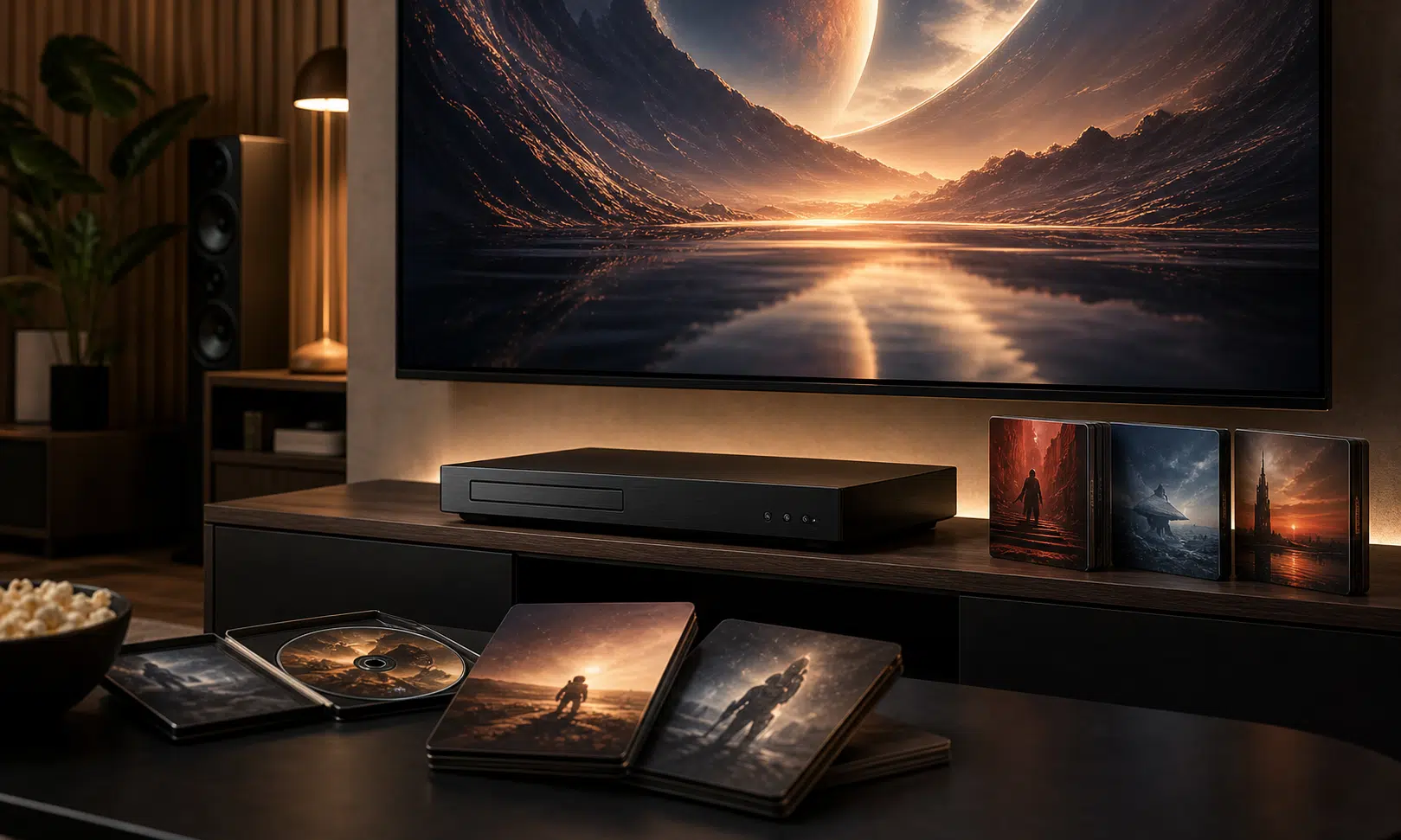

Physical media is not about to overtake streaming. That fight has already been settled for most households. But 4K Blu-ray is carving out a more interesting position: not as the default way people watch movies, but as the premium, own-it-forever option for viewers who care about quality, packaging, and control.
That is the more useful way to read the latest wave of optimism around Blu-ray. Key Production Group, a company better known for physical music and packaging manufacturing across vinyl, cassette, and CD, also works with Blu-ray, Blu-ray Audio, and DVD. Kath Summersgill, the company’s Joint Group Head of Sales, says the group has seen Blu-ray sales rise by more than 10,000 percent over roughly the past eight to 10 years, with Blu-ray Audio singled out as a particularly strong area.
That company-level figure should not be treated as a market-wide measurement. A sharp rise from a small base can produce a huge percentage increase, and it does not mean Blu-ray is suddenly a mainstream format again. But it does point to something real in the market: some parts of physical media are finding buyers precisely because they offer something streaming does not.
Streaming made physical media smaller, not pointless
The broad shift away from discs is easy to understand. Streaming is convenient, immediate, and available across phones, tablets, TVs, laptops, and game consoles. For most people, the monthly subscription model replaced the old habit of building shelves of DVDs and Blu-rays.
But convenience has trade-offs. Streaming libraries change. Movies move between services, disappear from catalogs, or become available only through another subscription or rental storefront. Digital purchases can also feel less permanent than the word “buy” suggests, because access still depends on platform rules, licensing, accounts, and regional availability.
That uncertainty is one of the clearest reasons physical media still has a case. A disc does not depend on a streaming license, a broadband connection, or a platform keeping a particular title in its catalog. For collectors, home theater enthusiasts, and viewers who rewatch the same films often, that matters.
Summersgill frames Blu-ray in a similar way to vinyl: not a replacement for streaming, but a format that can live alongside it. Vinyl did not win because it was more convenient than Spotify. It endured because it became tactile, collectible, and emotionally different from a stream. Blu-ray has a similar pitch for movies and music video: it is something a buyer can own, keep, replay, and display.
The best argument for 4K Blu-ray is still quality
For buyers with serious TVs and sound systems, 4K Blu-ray also has a technical advantage that streaming struggles to match consistently. A disc can deliver high-bitrate video and lossless or less-compressed audio without relying on a home internet connection at the moment of playback.
That does not mean every viewer will notice the difference. Plenty of streaming 4K HDR movies look good, especially on smaller screens or more casual setups. But the gap becomes easier to see on larger TVs, projectors, and more capable speaker systems, where compression artifacts, banding, weaker black detail, or lower-quality audio can stand out.
This is where 4K Blu-ray remains most persuasive as a buyer decision. If someone has already spent money on an OLED TV, a capable mini-LED set, a projector, a Dolby Atmos soundbar, or an AV receiver and speaker package, discs can make that hardware feel less compromised.

Panasonic DP-UB820-K 4K Ultra HD Blu-ray Player
The Panasonic DP-UB820-K is a strong fit for viewers who want disc playback with broad HDR support, including Dolby Vision and HDR10+. It is best suited to home theater setups where a higher-quality disc source can make the most of a capable TV and audio system.
As an Amazon Associate I earn from qualifying purchases.
A dedicated 4K Blu-ray player is not a mass-market purchase anymore, but it is still a practical one for home theater owners who want reliable playback, Dolby Vision support where available, and access to disc-based extras. The appeal is narrower than it was during the DVD boom, but it is also more focused.
Collectors are helping keep the format interesting
The other major force behind Blu-ray’s durability is collecting. Standard plastic cases are only part of the story. Steelbooks, limited editions, premium packaging, booklet inserts, restored artwork, and boutique label releases have turned many discs into objects people want to own beyond the movie itself.
That matters because physical media is no longer competing only on access. Streaming already solved access for a huge number of casual viewers. Discs compete better when they offer permanence, presentation, and the best available version of a film.
Boutique distributors and labels play a major role here. Companies such as The Criterion Collection, Arrow Video, Kino Lorber, Shout Factory, Boutique Home Video, and the BFI have built audiences around restorations, special features, and careful curation. For film fans, those releases can feel closer to a collector’s edition book or vinyl box set than a disposable commodity.
The same logic explains why packaging experiments work in music. Summersgill pointed to a vinyl release handled by Key Production Group that had 72 variants, with packaging kept the same while the vinyl color changed. The lesson is simple: for some buyers, variation and physical presentation are part of the product.
Blu-ray and 4K Blu-ray benefit from that collector behavior. A steelbook version of a favorite film, a restored classic with extras, or a limited-run edition can justify a purchase even when the movie is technically available to stream somewhere else.
Physical media is becoming more selective
The future of Blu-ray probably does not look like a return to the shelves of the 2000s, when every supermarket, electronics store, and rental chain had rows of discs. The more likely future is smaller and more specialized.
That version of the market is built around several types of buyers:
- Home theater owners who want the best available picture and sound quality.
- Collectors who care about packaging, special editions, and limited releases.
- Film fans who want restored classics, commentary tracks, and bonus features.
- Viewers who want permanent access to favorite movies without relying on streaming catalogs.
- Music fans interested in Blu-ray Audio or concert releases.
That narrower audience can still be valuable. Premium buyers are often willing to pay more for better editions, and boutique labels can serve demand that giant streaming services may not prioritize. The result is a market that looks less like mass retail and more like enthusiast culture.
The risk is hardware. A disc collection is only useful if players remain available, affordable, and compatible with the formats buyers care about. Anyone investing in 4K Blu-ray has to think about the playback chain: the player, the TV, HDR support, audio output, and region compatibility for imported discs.
Blu-ray’s survival depends on staying distinct
Blu-ray does not need to beat streaming to survive. It needs to keep being meaningfully different from streaming.
That difference can be technical, as with higher-bitrate video and stronger audio. It can be practical, as with ownership that does not depend on a shifting streaming catalog. It can be emotional, as with shelf-worthy packaging and editions that feel like collectibles. The strongest releases often combine all three.
The timing is also notable. Blu-ray is reaching its 20-year mark, and the format is no longer the new default for home viewing. That could make it feel obsolete. Instead, for a certain kind of viewer, age has clarified its role.
Streaming is where most watching happens. 4K Blu-ray is where some buyers go when they want a film to look its best, sound its best, and remain theirs. That is a smaller business than physical media once was, but it is not a meaningless one. If the format keeps leaning into quality, curation, and collector value, it still has a reason to stay on the shelf.