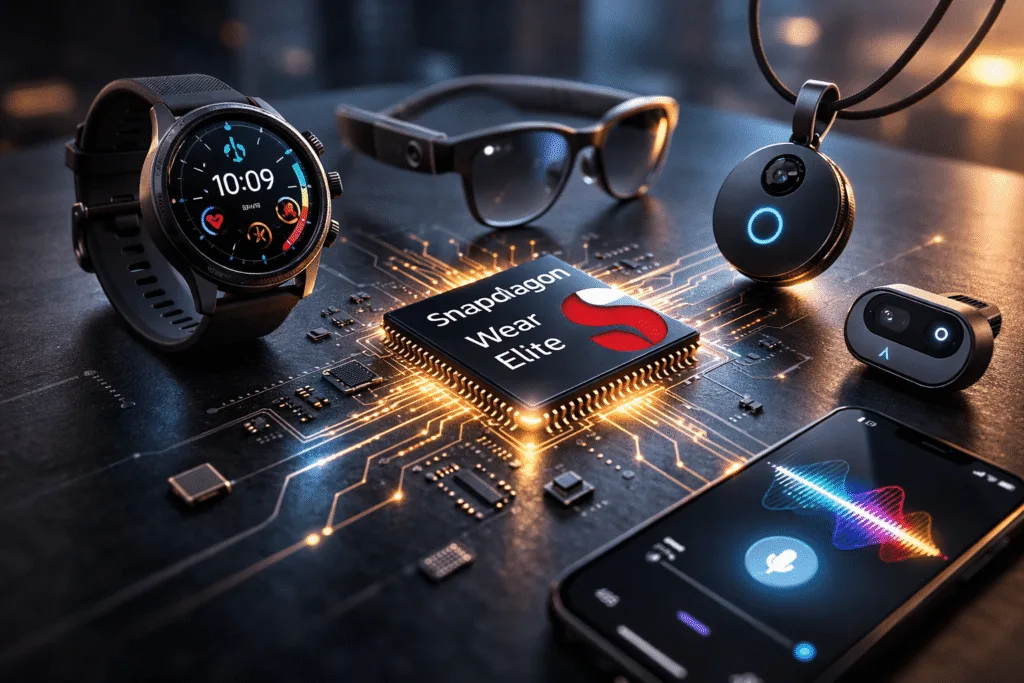
Qualcomm introduced Snapdragon Wear Elite at MWC 2026 in Barcelona, expanding its wearable processor lineup with a platform designed for on-device AI in smartwatches, pins and pendants.
The company describes Elite as a “wrist plus” platform that will sit alongside its existing Snapdragon W5 smartwatch chips rather than replace them.
On-device AI and performance claims
Qualcomm says Wear Elite uses a 3nm manufacturing process and combines two AI processors. Its Hexagon neural processing unit handles more demanding on-device workloads, while a low-power eNPU supports always-on functions such as keyword detection and activity recognition.
The company says the Hexagon NPU can run AI models with up to 2 billion parameters and generate up to 10 tokens per second. These are stated platform capabilities, rather than independently established results from finished consumer devices.
Compared with the Snapdragon W5+ Gen 2, Qualcomm claims up to five times the single-core CPU performance and up to seven times the maximum graphics frame rate. Its GPU supports graphics rendering at 1080p and 60 frames per second; that specification does not describe camera video capture.
For context, Google’s Gemma 3 family includes a 270-million-parameter model. Google describes that model as intended for task-specific fine-tuning and says it is not designed for complex conversational use. Parameter count alone does not establish compatibility with Wear Elite.
Cameras and connected processing
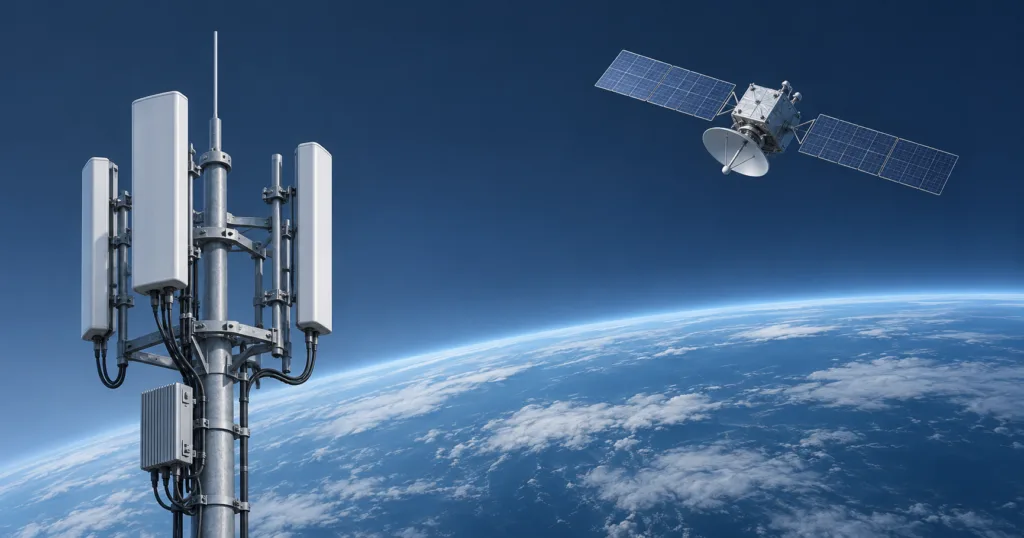
Wear Elite also includes camera support. Qualcomm lists connectivity options including 5G RedCap, Wi-Fi, Bluetooth 6.0, ultra-wideband, GNSS positioning and NB-NTN satellite communications. The platform supports Android, Wear OS and Linux.
Qualcomm’s approach includes dividing AI workloads among wearable devices, connected phones and cloud services. Ziad Asghar, the company’s senior vice president of XR and spatial computing, described an example in which a wearable converts speech to text locally before sending the text to a phone for further processing. The phone could then return text for the wearable to convert into speech.
Context from Humane’s AI Pin
Humane’s AI Pin was an earlier attempt at a pin-shaped AI device. It required a paid LTE subscription that covered access to AI services and cloud storage, illustrating the role connected services played in that product.
On February 18, 2025, HP announced a $116 million agreement to acquire key AI capabilities from Humane, including its Cosmos platform, technical talent and intellectual property. HP said the transaction was expected to close at the end of that month.