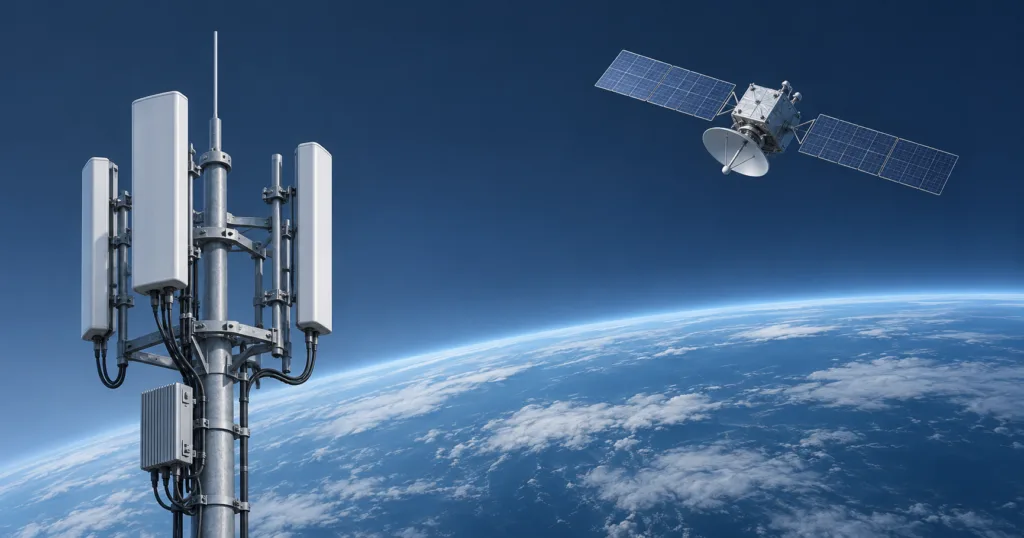
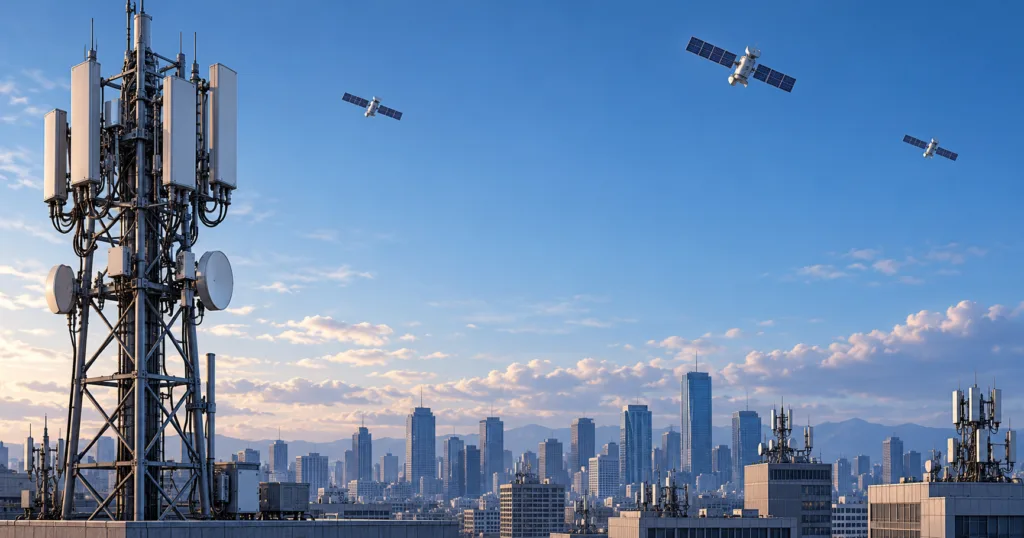
Qualcomm said on November 4, 2026, that SpaceX had selected its Dragonwing Cellular Infrastructure platforms for Starlink Mobile’s planned nationwide terrestrial 5G network in the United States. The multiyear agreement covers tens of thousands of sites, with deployment planned to begin in 2027, the company said.
Qualcomm described the agreement as its largest 5G initiative to date. Financial terms were not disclosed. Qualcomm executive vice president Durga Malladi said the agreement was structured for deployment to accelerate rapidly after it begins.
The ground-based network would complement Starlink’s satellite connectivity. Michael Nicolls, Starlink’s senior vice president, said the collaboration was intended to accelerate development of its base station architecture.
Radio technology and SpaceX’s role
Qualcomm said the base stations would use its Dragonwing QRU100 and QDU100 platforms with Layer 1 software. The QRU100 provides processing for Massive MIMO radio units, while the QDU100 handles Layer 1 signal processing.
Malladi said Qualcomm would supply foundational components and software, while SpaceX would build the equipment and develop higher software layers, including Layers 2 and 3 and functions extending to the network core.
The planned radio units have 64 transmit and 64 receive paths, known as 64T64R, Qualcomm said. Malladi described bringing that Massive MIMO configuration to bands as low as 2 GHz as a Qualcomm innovation. The company says the architecture is designed to improve coverage, capacity and spectrum efficiency.
Qualcomm said its platforms would support multiple frequency bands across successive rollout phases and were designed to improve performance per watt across radio and distributed-unit processing. The deployment focuses on terrestrial 5G; Qualcomm described it as a step toward its broader vision with SpaceX for AI-native 6G infrastructure.
Deployment costs and spectrum
Malladi described the project as a macro-cell network, using large base stations rather than small cells. SpaceX had not announced tower-company partners for the rollout.
Mobile Experts principal analyst Joe Madden estimated that SpaceX would spend at least $100 billion building its combined satellite and terrestrial network, including spectrum. That estimate concerns the wider network, rather than the value of the Qualcomm agreement.
Madden expected SpaceX to build more cheaply than Verizon, AT&T and T-Mobile, partly because it would not need to support legacy equipment. He questioned whether smartphone subscribers alone could justify the investment.
The network plans follow Grain Management’s October 8, 2026, announcement of an agreement to sell its nationwide 800 MHz spectrum portfolio to SpaceX. Grain said the transaction was subject to Federal Communications Commission approval and other customary closing conditions.
A November 2 report, citing two people familiar with the negotiations, described SpaceX–EchoStar talks about acquiring Boost Mobile or accessing its network.