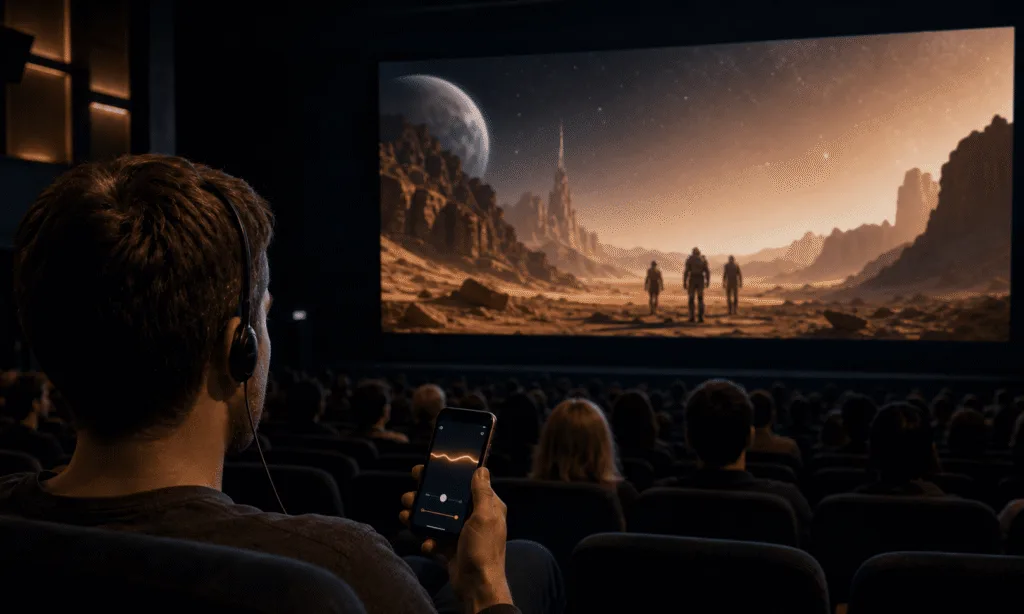
The Mandalorian and Grogu has added a new way for audiences to experience the film in theaters: synchronized director commentary from Jon Favreau through the TheaterEars app.
The option is being presented as The Director’s Experience, a separate audio track timed to the movie as it plays in participating theaters. It does not appear to be a separate cut of the film or a replacement version of the theatrical release. Instead, it works more like a live bonus feature layered over the existing movie, with Favreau offering context while the film runs.
That distinction matters. The rollout gives Star Wars fans another reason to revisit the movie, but there is no public confirmation that Lucasfilm introduced the commentary track as a direct response to box office pressure. The timing may invite that reading, especially after the film’s steep second-weekend decline, but the available information supports a narrower conclusion: a commentary experience has been made available while the movie is still playing theatrically.
A Different Kind of Theatrical Bonus Feature
Director commentary is familiar to film fans, but it is more commonly associated with home media, digital extras, and anniversary editions than with an active theatrical run. In this case, the TheaterEars format lets viewers listen through the app while watching the same film in a theater.
For Lucasfilm, that makes the release unusual without necessarily making it a full creative overhaul. The film itself remains the theatrical Star Wars feature centered on Din Djarin and Grogu, with Favreau serving as director, co-writer, and producer. The added commentary changes the viewing experience, not the story being projected.
For fans who already saw the movie, the appeal is straightforward. Favreau can speak to production choices, story intent, character moments, and the process of moving The Mandalorian from a Disney+ series into a big-screen feature. For viewers who have not gone yet, the commentary may be less of a first-viewing option and more of a niche draw for people interested in the craft behind the film.
That is a more careful framing than calling it a new version in the traditional sense. A director’s cut usually implies new footage, altered pacing, restored scenes, or a different editorial shape. A commentary track can still be valuable, but it sits in a different category.
The Box Office Context Around the Release
The Mandalorian and Grogu opened in theaters on May 22, 2026, marking Star Wars’ first new theatrical film since Star Wars: Episode IX – The Rise of Skywalker in 2019. That alone placed extra weight on the release. For several years, the franchise’s most visible storytelling had been concentrated on Disney+, where The Mandalorian helped define the platform’s early identity after launching in November 2019.
The shift back to theaters was significant because The Mandalorian was built as serialized television. Its audience already knew Din Djarin, Grogu, the post-Empire setting, and the larger web of Disney+ Star Wars stories. A theatrical film had to speak to that existing fan base while also remaining approachable for moviegoers who had not followed every related series.
Reports around the movie’s development have described the feature as emerging after plans for another season of The Mandalorian changed direction. The exact creative path from television season to theatrical film is not something this rewrite can state beyond what has been publicly supported, but the broader challenge is clear: a streaming-driven story had to be reframed as a theatrical event.
The film opened strongly enough to lead the box office, but its second weekend brought a sharp drop. Public box office tracking showed a roughly 70 percent decline in domestic weekend revenue from its first weekend to its second. That kind of fall does not automatically define a film’s final outcome, but it does suggest heavy front-loading, with a large share of interested viewers showing up early.
The release also faced attention from horror titles that were performing unusually well, including Obsession and Backrooms. Obsession in particular became part of the conversation because of its smaller scale and strong word of mouth. Still, claims about studio alarm, embarrassment, or internal course-correction should be treated as interpretation unless directly confirmed by Lucasfilm or Disney.
Why the Commentary Release Stands Out
The commentary option lands at a sensitive moment because The Mandalorian and Grogu is not just another franchise entry. It is a test of whether the most successful Disney+ era of Star Wars can translate back into theatrical urgency.
The Mandalorian became a defining modern Star Wars title partly because it felt accessible. Its early episodes used a direct adventure structure, with Din Djarin and Grogu at the center, while gradually connecting to larger franchise mythology. Over time, the surrounding Disney+ shows built a more connected world, including Ahsoka, The Book of Boba Fett, Obi-Wan Kenobi, Skeleton Crew, The Bad Batch, and other projects.
That interconnected model rewards committed viewers, but theatrical releases face a different burden. A movie needs to feel complete to casual audiences who may recognize Grogu but may not remember every thread from streaming. The commentary experience does not solve that challenge, but it can help dedicated fans understand how Favreau approached the transition.
It also gives the studio another point of conversation around the film without changing the release calendar. Special presentations, premium formats, fan screenings, and bonus experiences have become common tools for extending theatrical attention. A synchronized commentary track fits into that broader pattern, even if it remains uncommon for a new Star Wars movie still in release.
What Comes Next for Star Wars
The bigger question is not whether a commentary track can alter the trajectory of one movie. It is what The Mandalorian and Grogu signals about Star Wars’ next phase in theaters.
Lucasfilm still has other projects on the calendar, including Star Wars: Starfighter, directed by Shawn Levy and led by Ryan Gosling. Ahsoka also remains part of the Disney+ side of the franchise, with another season expected to continue threads from the first season. Those projects will test different parts of the brand: one built around a major film star and another rooted in serialized streaming continuity.
The Mandalorian and Grogu sits between those worlds. It is a theatrical release built from a streaming phenomenon, led by characters who became major Star Wars figures outside the traditional movie cycle. That makes its performance especially useful to watch, even if the commentary release should not be overstated as proof of a behind-the-scenes scramble.
For now, the confirmed development is simple: audiences in participating theaters can experience The Mandalorian and Grogu with Favreau’s synchronized commentary through TheaterEars. For some fans, that will be a worthwhile second viewing. For others, it may be an interesting footnote in a larger conversation about how Star Wars rebuilds its big-screen momentum.