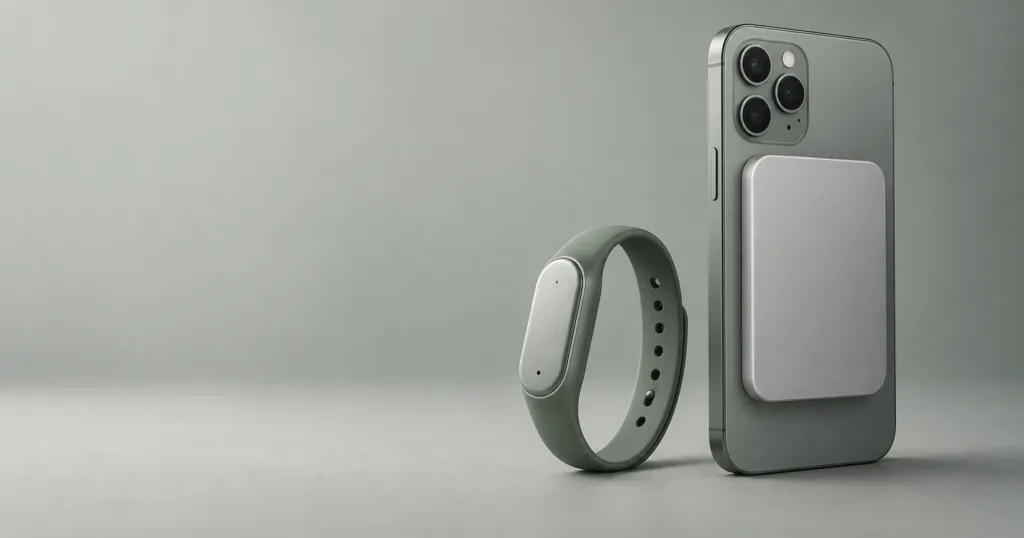
Amazon-owned Bee has introduced the Bee Frontier and Eclipse personal AI devices, according to TechCrunch, which lists hardware prices of $74.99 and $99.99, respectively. Frontier is a wearable, while Eclipse attaches to a smartphone. Both are intended to turn everyday conversations into notes, summaries and follow-up tasks.
TechCrunch describes the announcement as Bee’s first introduction of new products since Amazon acquired the company in 2025. The reported expansion pairs two hardware designs with subscription features connecting Bee to Amazon services and productivity applications.
The publication said Frontier was available through Amazon at the time of its report, with Eclipse expected to follow. It did not provide a firm release date for Eclipse.
Two device formats for conversation capture
According to TechCrunch, Frontier updates Bee’s existing wearable design and can be worn on the wrist or pinned to clothing. Eclipse is described as a credit-card-sized device that attaches magnetically to the back of a smartphone, giving Bee an alternative to its wearable format.
TechCrunch lists the following prices, designs and color options:
| Device | Reported price | Format | Colors |
|---|---|---|---|
| Bee Frontier | $74.99 | Wrist-worn or clipped to clothing | Onyx, Lavender, Sage |
| Bee Eclipse | $99.99 | Magnetic smartphone accessory | Silver, Midnight, Honey, Blush |
The publication places Eclipse alongside personal AI devices such as the Plaud Note and Pocket. Its reported comparison prices are $159 for the Plaud Note, $189 for the Note Pro and $129 for Pocket. Those figures concern the hardware; Bee’s optional subscription is priced separately.
Both Bee models reportedly have a single button for switching the device on or off, along with an indicator light that signals when a conversation is being summarized. For Frontier specifically, TechCrunch lists these specifications:
- IP67 water resistance.
- Battery life of up to seven days.
- USB-C charging.
- Dual microphones with advanced noise filtering.
The battery figure is a reported specification, rather than a result from hands-on testing described by TechCrunch.
Free summaries and a paid integration plan
TechCrunch describes Bee’s intended function as capturing useful details from conversations and turning them into material users can revisit or act on. One example is identifying an agreed date and time during a conversation about plans with friends, then creating a calendar invitation.
Other uses described in the coverage include taking lecture notes and recording the details of a care plan discussed with a doctor. These are proposed applications of the service, rather than demonstrated results establishing how accurately it handles those situations.
According to TechCrunch, all Bee devices offer free conversation summaries and recaps, together with 14 days of memory. The publication lists Bee Pro at $11.99 per month and says the subscription includes unlimited conversation summaries and integrations with Amazon.com, Alexa+ and third-party applications.
Additional reported Pro features include:
- Suggested to-dos.
- Daily memories.
- A personal chat assistant.
- Conversation templates.
The Amazon connections are described as enabling purchases through Amazon and hands-free requests to Alexa for Bee insights, summaries or to-dos. These functions would extend access to the information Bee generates beyond its own apps.
TechCrunch also reports support for Gmail, Google Calendar and Microsoft Outlook. The described productivity functions include drafting emails, arranging meetings and surfacing action items from conversations, linking spoken information with services people already use for scheduling and correspondence.
Users can also upload photos or connect Apple’s HealthKit, according to the publication. The HealthKit connection is described as adding wellness information to the context used for Bee’s insights.
The software offering reportedly includes a redesigned companion mobile app and a desktop app alongside the devices.
Reported privacy controls and optional Alexa capture
TechCrunch describes Bee’s privacy architecture as processing conversation audio in real time and deleting it afterward, rather than retaining raw recordings. This is a description of the reported security design, not an independently established guarantee about its operation.
The publication says conversation transcripts are encrypted using keys generated and controlled by the user’s device. Under that described model, others, including Amazon employees, would be unable to access the transcripts unless the user deliberately shared them.
A separate, optional Alexa connection would allow an Echo device to use Voice ID to recognize when the user is speaking and capture conversations for Bee’s insights, according to TechCrunch. This extends the described conversation-capture function to an Echo device when the user chooses to enable it.
Amazon says users can delete transcripts and summaries at any time, according to TechCrunch. The Alexa connection is described as optional.