
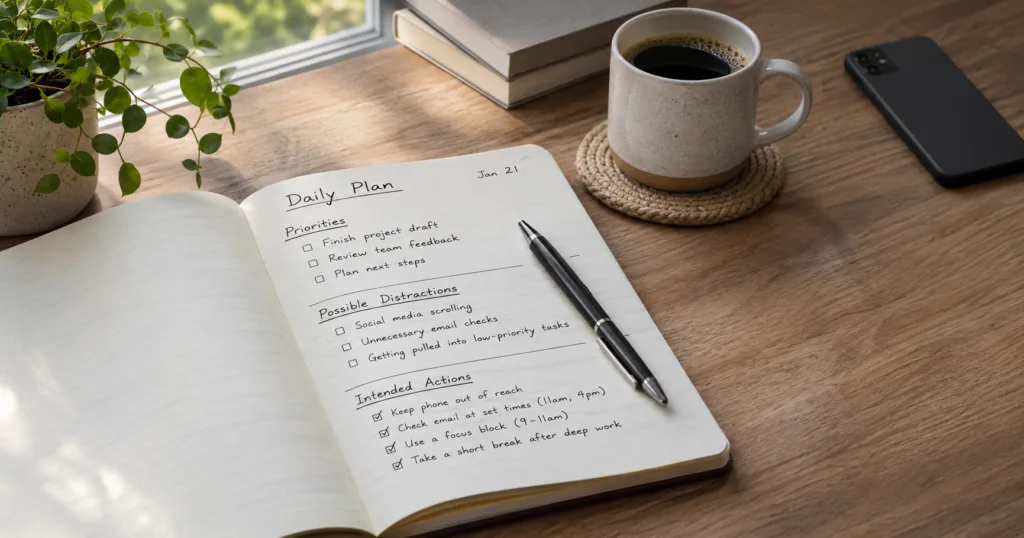
Ben Meer described the Dial-In Protocol on May 31, 2026, as a three-minute morning journaling routine intended to put daily planning before email, news and social media. The proposed exercise asks people to define priorities, anticipate disruptions and write down how they intend to act during the day.
Meer said he had replaced his morning scrolling with the routine for 30 days and found that it helped him make consistent progress on creative projects that had stalled. His account offers a personal assessment of the exercise, without measurements establishing its effect on productivity. He presents it as a way to set intentions before responding to outside demands and opening online feeds.
Meer rates impact at 9.5 out of 10, setup at 9.0 and maintenance at 8.5. These are his own assessments of the routine’s usefulness and the work involved in adopting it.
Three prompts shape the planning exercise
The protocol organizes the writing around three questions, covering focus, potential obstacles and identity. The questions connect the work planned for the day with possible interruptions and the behavior Meer suggests adopting to carry it out.
- “What would make today a win?” The first prompt sets out a daily plan. Meer recommends the 3-3-3 Method, which he credits to Oliver Burkeman: three hours for the most important project, three shorter tasks and three maintenance activities that keep everyday life running. He proposes tackling the three-hour project first, when energy is highest. The three-minute duration he gives for the journaling exercise is separate from the time allocated to completing the planned work.
- “What could derail me?” The second prompt asks people to identify possible obstacles and pair each with a response. Meer describes this as applying inversion, a mental model focused here on anticipating what could undermine the plan. His examples include charging a distracting phone in another room, blocking news or social media during work hours, and deciding on lunch in advance if a heavy meal tends to leave the person sluggish.
- “Who do I need to be to achieve it?” The final prompt concerns intended behavior. Meer suggests writing identity statements suited to the day’s demands. One example reads: “Today I’m someone who ships, not someone who perfects.” His other examples concern focusing on the process rather than the outcome and being prepared for difficult conversations. The statements express the approach someone intends to take toward the work and interactions ahead.
Managing feed access and repeat use
To encourage regular use, Meer recommends attaching the exercise to an existing habit. His example is pouring coffee and then completing the journal entry, using the familiar activity as a cue to begin. This places the writing within an established morning sequence.
Meer also suggests restricting access to email, social media and news until the exercise is complete. He names Opal as an app example and Brick as a physical tool in that context. Meer proposes these tools for managing digital distractions. He describes the writing exercise itself as free, with the named products serving as suggestions for restricting feed access.
For missed sessions, Meer recommends a “2-Day Rule”: avoiding two consecutive days without the exercise. He attributes that rule to Matt D’Avella and James Clear. Under that recommendation, a missed day would be followed by a return to the routine the next day.

