

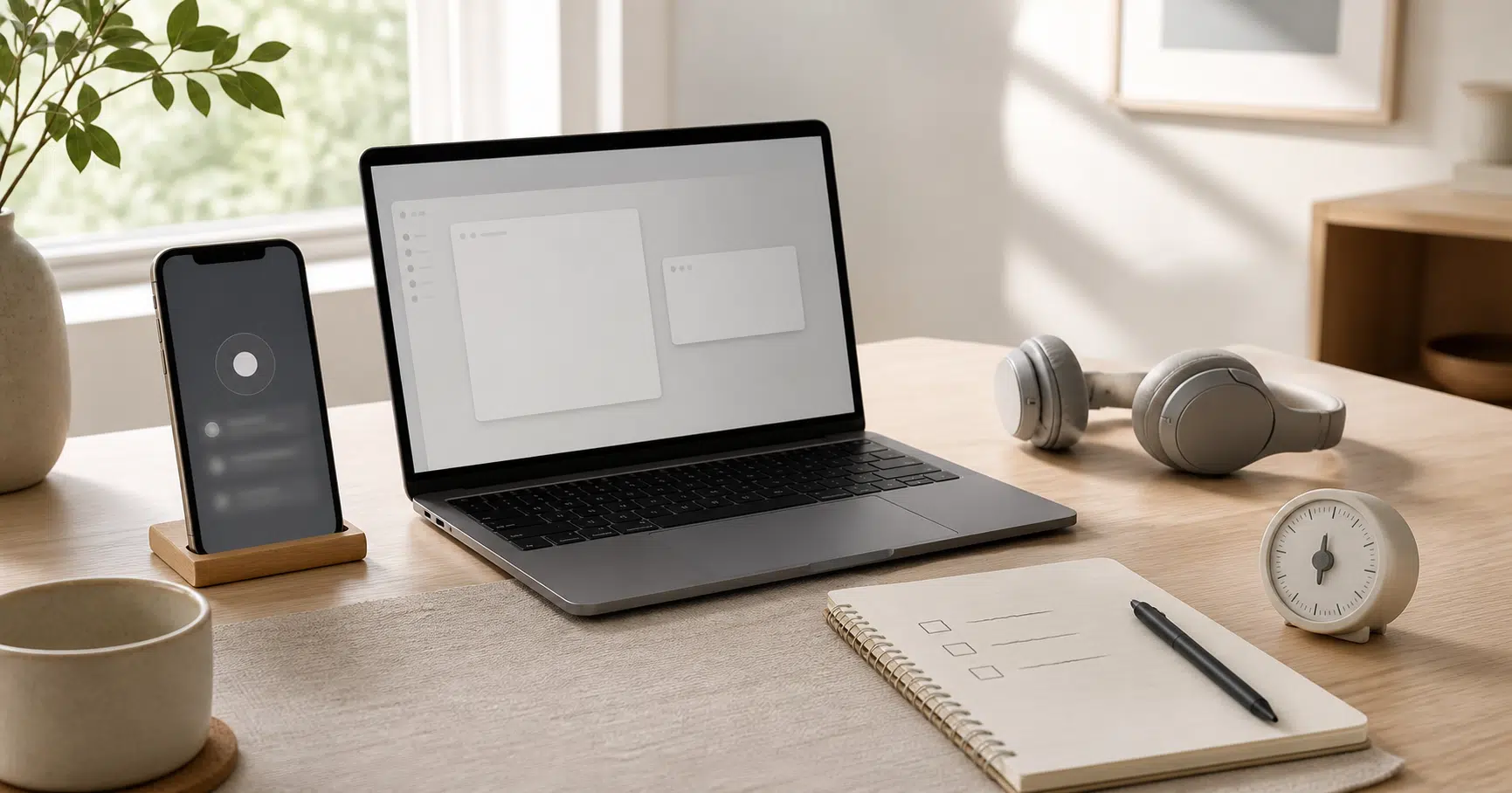

A good focus system does not promise superhuman concentration. It reduces the number of interruptions competing for your attention. This four-layer framework approaches that job through your phone, computer, physical workspace, and mental routine.
The concept is straightforward: configure each layer so that starting focused work requires less negotiation. Most of the setup uses built-in settings or inexpensive accessories, although app blockers, tab managers, and noise-canceling headphones can extend it.
Verdict: useful, flexible, and easy to overbuild
This system is best for people whose work is repeatedly interrupted by notifications, open tabs, clutter, or uncertainty about what to do next. Its biggest advantage is flexibility: you can address one troublesome layer without adopting the entire framework.
The main tradeoff is that productivity tools can become another form of procrastination. A carefully organized desktop will not choose your priorities, and an app blocker will not make an unclear task easier. Start with the most frequent interruption, make one change, and judge it during real work before adding anything else.
- Best for: remote workers, students, writers, and anyone doing concentration-heavy work.
- Less useful for: roles that require immediate responses or constant access to communication channels.
- Cost: potentially free, with optional spending on software or headphones.
Layer one: make the phone less demanding
Airplane Mode and Do Not Disturb are the simplest options for a planned work block, provided you do not need to remain reachable. Grayscale is another setting worth testing if colorful app icons tend to pull you back to the screen, but its effect will vary by person.
If built-in controls are too easy to override, an app blocker such as Opal offers a more structured option. Treat it as an optional purchase rather than a requirement; the free settings already on your phone are the sensible first test.
Sony WH-1000XM5 Headphones
The Sony WH-1000XM5 provides active noise cancellation in an over-ear design. It is most relevant when conversations, traffic, or other unpredictable sounds regularly interrupt focused work.
As an Amazon Associate I earn from qualifying purchases.
Soundcore Space One Headphones
The Soundcore Space One combines active noise cancellation with a wireless over-ear design. Consider it when ordinary headphones do not sufficiently reduce distracting background sound.
As an Amazon Associate I earn from qualifying purchases.
Layer two: contain the desktop clutter
Computer distractions tend to arrive through communication alerts, browser tabs, and files left without a home. During a concentration block, consider silencing Slack or Teams and setting an away message so colleagues know when to expect a response.
A single “To Process” folder can keep loose files off the desktop without forcing you to organize everything immediately. A tab manager such as Workona may also help people juggling several browser-based projects, though closing unnecessary tabs is the cheaper solution.
Layer three: give focused work a physical cue
A dedicated workspace can make the transition into focused work more deliberate. It does not need to be a separate office; one desk position or cleared section can serve the purpose. Keep entertainment elsewhere when possible, then spend a couple of minutes resetting the area after each session.
Noise-canceling headphones may be worth considering in a shared or unpredictable environment. In a quiet room, ordinary headphones—or no headphones—may be enough.
Layer four: use a repeatable starting routine
The mental layer is less about motivation than establishing a reliable opening sequence. One possible routine is:
- Use one minute of 4-4-4-4 box breathing as a transition into the session.
- Write the single most important task on a visible note.
- Work in a 25-minute block, followed by a five-minute break, if that rhythm suits the task.
Before starting, check that notifications are muted, the necessary files are open, the workspace is clear, and the next action is specific. If attention slips, reset those conditions and resume. The system succeeds when it makes returning to the work easier—not when every session is interruption-free.