AI researcher Will DePue says he has identified numerical patterns associated with Nvidia’s Blackwell GPUs in six Chinese AI models from DeepSeek, Moonshot AI, MiniMax and Ant Group. He argues that the patterns indicate access to advanced hardware subject to US export controls. His findings have not been independently verified.
The claim rests on an analysis of published model weights, rather than information about chip shipments or data-center locations. DePue says the patterns point to the hardware used to initialize those weights. That would not, by itself, establish where the processors were located, who owned them or whether their use violated export law.
The proposed fingerprint in model weights
AI models contain billions of numerical values known as weights, which training adjusts. DePue’s method focuses on the random values assigned before training begins and on traces of that initialization that he says can survive in a finished model.
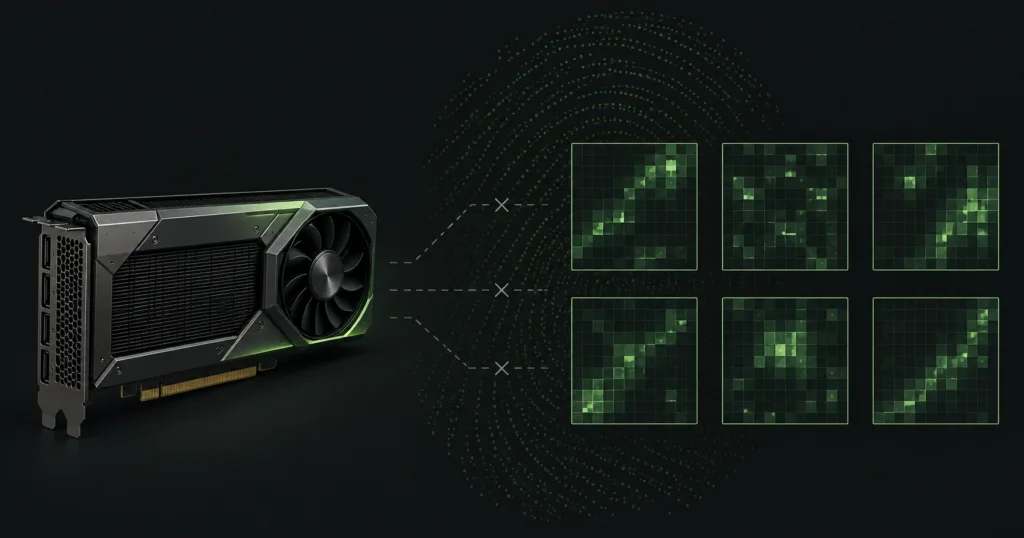
In the process he describes, PyTorch generates initial values from a starting value called a seed. A GPU distributes that work across its compute units. DePue argues that differences in the number of available units can leave recognizable patterns in the resulting numbers.
He associates a pattern based on 132 compute units with Nvidia’s older Hopper generation, including H100 and H800 hardware. His analysis assigns patterns based on 148 or 152 units to Blackwell configurations. These are the hardware mappings proposed in his analysis, rather than independently verified chip identifications.
Training changes the weights repeatedly, but DePue says some values associated with unused words or symbols retain their original initialization. He also claims that statistical traces of the starting values can remain in parts of a model that training has modified.
DePue says he reconstructed initialization patterns for DeepSeek-V4-Flash and Kimi K3 and reproduced them exactly on Blackwell hardware. He also says he published verification code on GitHub and that his method correctly identified all 24 control models with known hardware, including Meta’s Llama 3.1 running on H100 processors.
He says senior researchers at OpenAI and Anthropic independently checked and confirmed his findings. Those claimed checks have not been independently confirmed.
Six models assigned Blackwell signatures
DePue identifies six Chinese models that he says were released since April 2026. He divides them into two groups, linking one pattern to B200 or B300 chips and another to GB200 or GB300 systems.
| Model | Hardware assigned by DePue | Compute-unit pattern claimed |
|---|---|---|
| DeepSeek-V4-Flash | B200 or B300 | 148 |
| MiniMax-M3 | B200 or B300 | 148 |
| DeepSeek-V4-Pro | GB200 or GB300 | 152 |
| Kimi K3 | GB200 or GB300 | 152 |
| Kimi K3.1-Pro | GB200 or GB300 | 152 |
| Ant Group’s Ling-3.1-flash | GB200 or GB300 | 152 |
The table reflects DePue’s classifications, which remain unverified. He says the differences are statistically sufficient to rule out chance as an explanation for the matches.
His analysis assigns Hopper signatures to earlier models, including DeepSeek-V3 and Kimi K2.5. He also reports Hopper patterns in Alibaba’s Qwen3.8 and models from Zhipu, Tencent, Xiaomi and StepFun, while assigning Meituan’s LongCat-2.0 to Huawei hardware.
Estimates of the hardware behind training
For five training runs, DePue estimates a combined requirement of about 12,000 Blackwell GPUs. He equates that computing capacity to roughly 30,000 older H100 processors. The processor counts and performance comparison have not been independently verified.
His estimate for Kimi K3 is approximately 4,500 Blackwell processors operating for about 70 days. He puts the corresponding processor requirement for DeepSeek-V4-Pro at about 3,000.
Using an assumed unit price of about $70,000, DePue places the combined hardware value for the five systems above half a billion dollars. That figure concerns the estimated value of the hardware, rather than a confirmed bill for training the models.
The estimates do not establish that the companies bought those processors or paid the assumed price. DePue’s stated limitations leave ownership and the location of the equipment unresolved.
Limits on training and export-control conclusions
The distinction between initialization and training is central to the claim. DePue considers it very likely that the systems used to initialize the weights also performed the training. The proposed fingerprint, however, concerns initialization hardware and does not independently establish the full training history.
He also considered whether an AMD MI300X configured with artificially reduced compute capacity could produce a similar pattern. DePue says small rounding differences between the chips allowed him to exclude AMD as the explanation for DeepSeek-V4-Flash. The claimed exclusion has not been independently verified. DePue’s statement about ruling out AMD concerns DeepSeek-V4-Flash specifically.
DePue says the weight analysis does not reveal where the GPUs are located or who owns them. Access could involve rented computing capacity at data centers outside China, a possibility that the proposed signatures cannot resolve.
The legal question therefore remains separate from the claimed hardware match. The analysis does not establish a shipment route, physical smuggling or an export-control violation. Even if the proposed fingerprints are confirmed, assessing compliance with US chip export controls would require information beyond the patterns DePue describes.