

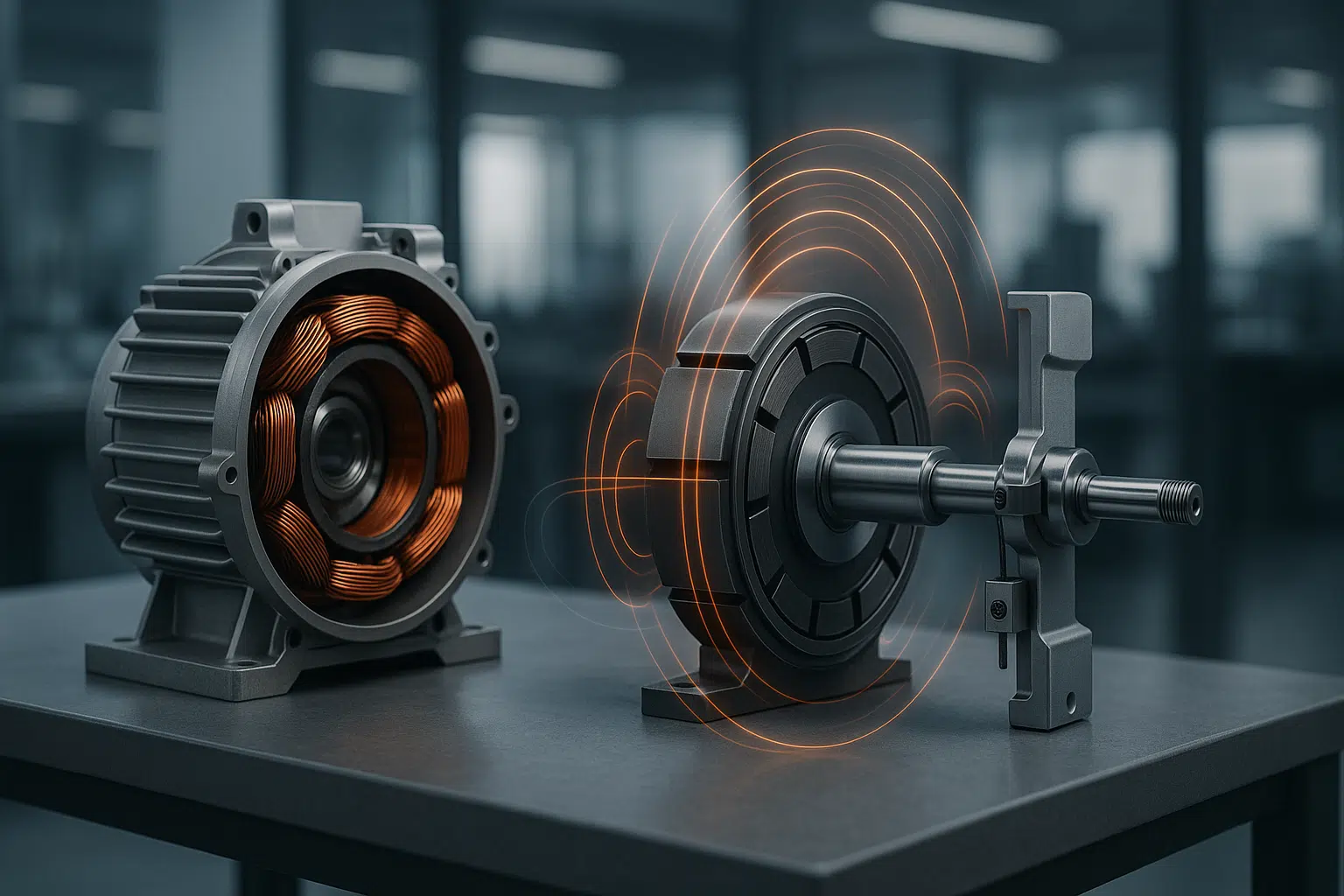

BYD has surfaced four newly published Chinese patent applications that focus on a familiar EV pain point: how to keep a permanent-magnet motor efficient across both stop-and-go driving and sustained high-speed operation.
According to CNIPA-record summaries carried by Chinese financial media, the filings were submitted in May 2024 and later published with the following application numbers: CN121055622A, CN121055630A, CN121055623A, and CN121055631A.
Why variable-flux motors matter
Most EV traction motors rely on variants of the permanent magnet synchronous motor (PMSM). The upside is strong torque density and efficiency at low to mid speeds. The catch shows up as speed climbs: back-EMF increases with rotor speed, and once the generated voltage approaches the inverter’s limits, engineers typically lean on flux-weakening control—often by injecting negative d-axis current to effectively reduce flux linkage. That works, but it can limit torque and add losses/heat.
A variable-flux PMSM (VF-PMSM) aims to reduce how hard you have to “fight” the magnets at high RPM by changing the effective flux in the rotor/magnetic circuit to better match operating conditions.
What BYD’s four filings describe
The new set doesn’t claim production deployment or published test results. Instead, it reads like a toolkit of practical mechanical/structural ways to adjust rotor flux—often by altering the position or geometry of a “flux-adjustment” (调磁) component that can create or modify a flux path.
Here’s the gist of each patent, based on the published abstracts described in the public record:
1) CN121055622A: Adjust flux via circumferential/radial positioning
This application describes a flux-adjustment component intended to sit at at least one axial end of the rotor. Its circumferential and/or radial position is adjustable to regulate magnetic flux through the rotor.
2) CN121055630A: Move a conductive part closer/farther from the rotor
CN121055630A outlines a system using a movable magnetic conductive part (导磁件) plus a drive component that moves it toward or away from the rotor. The concept is to adjust flux by changing the magnetic relationship between the conductive part and rotor—effectively tuning the flux path as operating conditions change.
3) CN121055623A: Axial adjustment to regulate rotor flux
This one focuses on axial movement. The abstract describes a flux-adjustment component positioned at an axial end of the rotor, where its axial position is adjustable—allowing it to move closer to or farther from the rotor along the axis to regulate flux.
4) CN121055631A: Change the “radial facing area” to fine-tune flux
CN121055631A describes a rotor with a magnetically conductive part extending along the axis and protruding beyond the rotor body, paired with a flux-adjustment component that can change the radial facing area between parts. The abstract also explicitly frames this as a way to help a motor combine advantages of constant-torque and constant-power regions while widening high-efficiency operation.
The important caveat: patents aren’t products
These documents indicate active R&D and a clear engineering direction, but they don’t confirm that BYD is already shipping VF-PMSM hardware in volume—or that the designs outperform existing PMSM + control strategies in a production car.
Still, the overall goal is easy to see: by making rotor flux more “tunable,” BYD could potentially reduce reliance on aggressive flux-weakening at high speed and improve efficiency across a wider range of driving conditions—without leaning entirely on bigger batteries to claw back range.