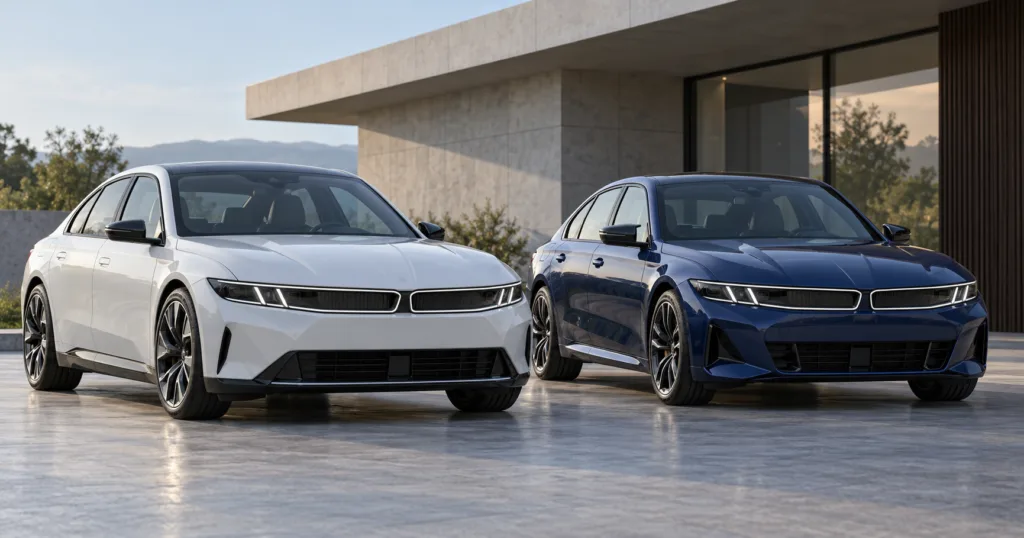
BMW unveiled the eighth-generation 3 Series on September 29, 2026, bringing its Neue Klasse design language and digital cockpit to fully electric and gasoline-powered sedans. The electric i3 uses BMW’s dedicated Neue Klasse architecture, while combustion versions adopt a similar exterior and interior alongside four-cylinder and inline-six engines.
The announcement extends a program BMW introduced in production with the iX3. It also connects the 3 Series to a name the company associates with an earlier expansion into sporting midsize cars. Neue Klasse translates from German as “New Class” and refers both to that historical model family and to BMW’s electric vehicle development program.
BMW previewed the modern sedan’s direction with the Vision Neue Klasse concept at the IAA Mobility show in Munich in September 2023. Its simplified surfaces, combined grille-and-headlight treatment and windshield display signaled changes that have carried into the production range.
The historical connection begins with the BMW 1500, shown in Frankfurt in 1961. BMW credits that car and its successors with helping establish the company’s modern position in the market, although its financial recovery also involved investment and other models.
A shared design across electric and gasoline models
The new 3 Series gives electric and combustion versions a closely related appearance. BMW says the common design applies across powertrains, while differences in their underlying architectures require some variation in dimensions, wheelbases and overhangs. Sharing a visual identity therefore does not mean that the electric and gasoline cars use identical engineering.
At the front, the kidney grille and twin headlights form a single horizontal composition. The lighting extends across much of the car’s width, replacing the more visibly separate treatment of those elements on earlier generations. The familiar grille remains a point of identification, but its relationship with the lamps has changed.
The body uses fewer separate decorative elements, with broad surfaces and defined lines around the wheel arches. At the rear, horizontal lights extend into the shoulders. BMW has retained an interpretation of its L-shaped rear-light signature within the revised arrangement.
These features follow the approach presented by the 2023 concept, which combined a reduced exterior with recognizable BMW details. Its set-back passenger compartment, kidney grille and reverse curve in the rear side-window outline provided continuity while the surrounding shapes changed.
Oliver Heilmer, BMW’s head of design for Neue Klasse, BMW Compact Class and BMW M, said: “The new BMW 3 Series embodies the essence of our brand.” He described the design as combining sporting character with a reduced visual language.
The gasoline models remain part of this rollout. BMW’s September announcement included combustion engines with 48-volt mild-hybrid technology alongside the fully electric i3. The common styling and cabin systems bring Neue Klasse elements to cars with different drive systems, extending the program’s influence beyond the electric architecture itself.
A cockpit built around windshield projection
The interior replaces the familiar instrument layout with BMW Panoramic iDrive. The system brings together Panoramic Vision, a central touchscreen, a redesigned multifunction steering wheel and an optional 3D head-up display. BMW uses these components to distribute information between the lower windshield area and the center of the dashboard.
Panoramic Vision projects content across the lower portion of the windshield, with the central touchscreen remaining a separate control surface. Driving information sits in the driver’s field of view, while additional content can occupy the central and passenger-side areas.
BMW says the arrangement removes the need for a separate instrument display behind the steering wheel. The optional 3D head-up display adds selected navigation and driver-assistance information above the panoramic projection, closer to the driver’s forward sightline.
A 17.9-inch central display provides touch controls and menus. BMW says occupants can move compatible widgets from that screen into Panoramic Vision, allowing the displayed content to be configured. The multifunction steering wheel supplies another means of controlling the interface.
This layout develops the operating concept shown in the Vision Neue Klasse. The 2023 study reduced conventional controls and combined a central display, steering-wheel inputs, voice operation and windshield projection. The production system turns those elements into a coordinated cockpit used across the new 3 Series family.
The change also alters how BMW expresses its longstanding emphasis on driver orientation. Earlier cars placed conventional gauges in a hooded instrument cluster directly ahead of the driver. Panoramic iDrive moves that information toward the windshield and coordinates it with other digital displays. BMW presents the layout as a continuation of driver-focused design.
The 1960s origins of the Neue Klasse
BMW traces the original Neue Klasse to a gap in its postwar range. During the 1950s, it sold small vehicles such as the Isetta alongside much larger and more expensive cars. The company says it needed a midsize model to reach customers between those ends of the lineup.
BMW describes the Isetta as a small car built under license from Italian manufacturer Iso, using a motorcycle-derived single-cylinder engine and a front-opening door. The company also identifies the V8-powered 502 sedan and 507 roadster among its larger offerings. BMW says sales of its large cars fell below expectations, contributing to its financial difficulties.
The company’s future came under review in 1959. BMW says Daimler-Benz submitted a restructuring offer, which small shareholders and the workforce rejected at the annual general meeting on December 9. Herbert Quandt subsequently increased his shareholding and supported the company’s continued independence.
BMW also identifies the 700, introduced in 1959, as an important part of the recovery. Its success preceded the arrival of the 1500. That sequence makes the turnaround broader than a single model launch: investment, the smaller car and the subsequent midsize range all contributed.
The 1500 made its public debut at the Frankfurt Motor Show in September 1961, with production following in 1962. It offered four doors and a 1.5-liter four-cylinder engine in a midsize body. The model occupied a different market position from both the Isetta and BMW’s large luxury cars.
The name developed alongside the range. BMW says Neue Klasse was not initially the official model-series name and began appearing in its advertising from 1964, after the introduction of the 1800 in 1963. It became associated with a family of related cars with different engines and equipment.
BMW lists 339,814 four-door Neue Klasse sedans built through January 1972. The original family was succeeded by the first 5 Series that year. Its relationship to the 3 Series runs through the smaller, technically related two-door 02 models.
The engineering behind the BMW 1500
The 1500 combined a four-cylinder engine with unitary steel-body construction, front disc brakes and independent suspension. Its front wheels used struts, while the rear suspension employed semi-trailing arms. Together, those components formed the technical basis for the sporting midsize range BMW was developing.
Fritz Fiedler led development, with Alexander von Falkenhausen responsible for the engine and Wilhelm Hofmeister overseeing body development. Giovanni Michelotti also contributed to the exterior design. The resulting car departed from the rounded, more elaborate appearance of BMW’s earlier large sedans.
The engine became known as the M10. It was mounted at a 30-degree slant. The 1500 paired its front disc brakes with rear drum brakes. In the 1500, its initial production displacement was approximately 1.5 liters, but the design also supported larger versions. Subsequent Neue Klasse models extended the range through 1.8- and 2.0-liter engines, allowing BMW to offer different performance levels within the same broad vehicle family.
That development continued beyond the original four-door cars. The engine family also powered the smaller two-door models that followed, linking the 1500’s engineering to the later 2002. The relationship involved shared technical foundations as well as a similar combination of practical bodywork and sporting positioning.
Inside the 1500, the instruments sat within a recessed section of the dashboard ahead of the driver. Large windows and a relatively restrained interior accompanied the straightforward exterior. These details formed part of the driver-oriented approach BMW subsequently associated with the Neue Klasse.
The range expanded over the decade, rather than remaining a single 1500 model. BMW introduced the 1600 and 1800, followed by 2.0-liter variants. The 2000 tii, added in 1969, brought mechanical fuel injection to the four-door family.
BMW describes the original range as an economic breakthrough following the start of production in 1962. Preparing to build it required a new production hall in Munich and the hiring of around 3,000 skilled workers. BMW says it also introduced additional quality controls to address manufacturing difficulties as production expanded.
The Hofmeister kink and BMW’s visual identity
One of the clearest connections is the Hofmeister kink, the forward-turning curve at the base of the rearmost side window. On a sedan, it appears where the window outline meets the C-pillar. The feature changes the transition between the glass area and the body below it.
Named after Wilhelm Hofmeister, it appeared on both the BMW 1500 and 3200 CS shown at the 1961 Frankfurt Motor Show. BMW design specialist David Carp says neither the company nor Hofmeister invented the shape. Similar treatments had appeared on vehicles from other manufacturers before BMW adopted it.
Hofmeister helped establish the curve as a recurring BMW feature. Over subsequent generations, designers used different interpretations, changing its size, angle and relationship with the surrounding bodywork. It became one of the details linking otherwise different BMW models.
Its use has been widespread, with exceptions. BMW identifies certain Touring models and the Z3 M Coupé among vehicles that did without the characteristic treatment. Describing it as a feature of every BMW built since 1961 would therefore overstate its consistency.
The 2023 Vision Neue Klasse retained the kink in its side-window outline, alongside a reinterpreted kidney grille and set-back passenger compartment. Those choices carried recognizable elements into a design with simpler surfaces and a different front end.
Carp describes the curve as a visual transition between the windows, roof and pillars and the lower body. He says BMW has no technical requirement to use the shape. Its role as an identifier has allowed different interpretations across vehicle types and generations.
From the 1600-2 and 2002 to the 3 Series
The smaller two-door branch arrived in 1966 as the 1600-2. It drew on the Neue Klasse’s technical foundations but used a more compact body. The designation distinguished it from BMW’s four-door 1600, with the final numeral identifying the two-door configuration.
BMW added the 2002 in 1968, pairing that smaller body with a 2.0-liter four-cylinder engine. The larger engine provided additional performance while retaining the basic format of a compact, practical sedan. BMW credits the model with strengthening the sporting identity associated with its smaller cars.
The 2002 also became important to BMW’s expansion in the United States, where Max Hoffman was its exclusive distributor. BMW says the car emerged from development inside the company, with engineers fitting the larger four-cylinder engine to the two-door model. Hoffman’s distribution role helped bring the finished car to American customers.
BMW’s U.S. exports rose from 4,564 cars in 1967 to 9,172 in 1968, when the 2002 joined the range. Those totals covered the brand’s exports to the United States, illustrating the expansion of its American business during the introduction of the two-door models.
The 02 family subsequently included the 2002 tii, introduced in 1971 with mechanical Kugelfischer fuel injection and an output of 130 horsepower. It extended the smaller range’s performance options, just as higher-output derivatives had expanded the original four-door Neue Klasse family.
The first 3 Series arrived in 1975 as the successor to the 02 range. The four-door Neue Klasse had already led to the 5 Series in 1972, giving the two related branches separate places in BMW’s lineup. The 3 Series continued the compact sporting-car role developed by the two-door models.