

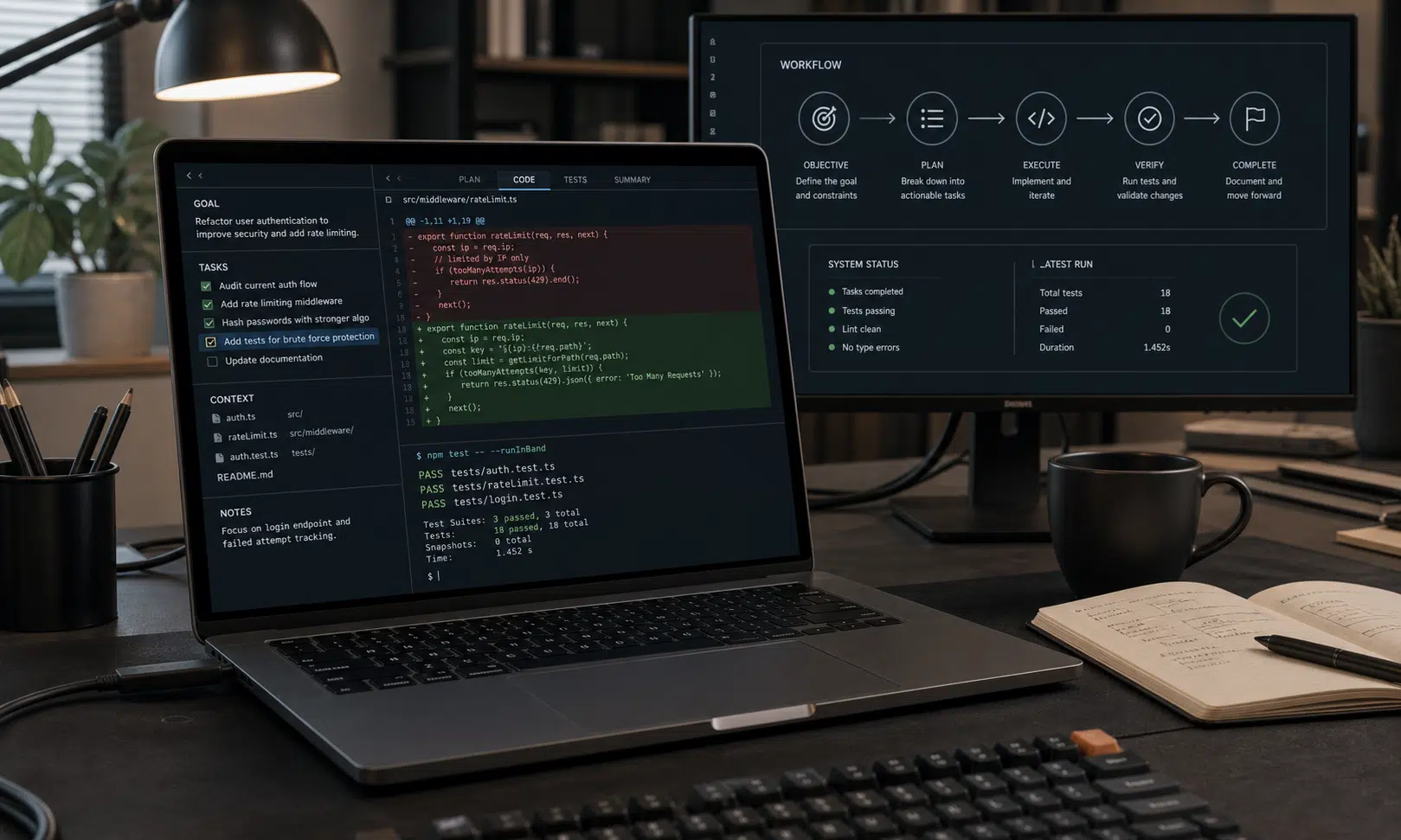

Most AI coding assistants still feel like a back-and-forth chat. You ask for a change, inspect the answer, give another instruction, wait again, and repeat. That works for small fixes, but it becomes tiring when the job needs investigation, implementation, testing, and follow-up.
Codex’s /goal command is aimed at that longer workflow. Instead of treating each message as a separate request, it lets you describe a durable objective for Codex to keep working toward. The point is not magic autonomy. The point is giving the agent a clearer finish line so it can continue through multiple steps without you restating the same intent every few minutes.
This is useful for developers comparing AI coding workflows, because /goal changes the decision from “Can this assistant answer a prompt?” to “Can this assistant carry a scoped engineering task to completion?” That is a different buyer question.
What the Codex /goal Command Does
The /goal command lets you set a persistent objective inside a Codex session. A goal can describe the outcome you want, the constraints Codex should respect, and the evidence that should decide whether the job is finished.
A simple goal might look like this:
/goal Reduce dashboard page load time below 2 seconds
Constraints:
- Keep the existing UI
- Do not change public API behavior
- Run relevant tests before finishing
That is different from asking, “How can I make the dashboard faster?” A question invites advice. A goal invites a workflow: inspect the code, identify likely causes, make changes, test the result, and report what changed.
In practice, a good /goal prompt usually contains three parts:
- A concrete objective
- Constraints that limit what Codex may change
- A completion condition that tells Codex when to stop
Codex may still ask for confirmation before sensitive actions, depending on your environment and settings. Treat /goal as a way to organize multi-step work, not as a reason to ignore normal review, testing, or version control habits.

Refactoring, 2nd Edition by Martin Fowler
For teams using Codex on refactoring tasks, Fowler’s refactoring catalog gives a shared vocabulary for small behavior-preserving changes. It pairs well with goals that require clear constraints, tests, and reviewable code changes.
As an Amazon Associate I earn from qualifying purchases.
Best Use Cases for /goal
/goal makes the most sense when the task has several stages and a visible finish line. It is not ideal for every coding request.
| Task type | Good fit for /goal? | Why |
|---|---|---|
| Performance optimization | Yes | Codex can inspect bottlenecks, make changes, and compare results against a target. |
| Bug investigation | Yes | The work may require reading several files, forming hypotheses, and validating a fix. |
| Test coverage | Yes | The goal can define coverage targets and boundaries around business logic. |
| Large refactor | Sometimes | Useful when the scope is narrow and behavior must be preserved. |
| One-line edit | No | A normal prompt is faster and easier to review. |
| Quick explanation | No | There is no need for persistent task state. |
Strong examples include:
- Reduce homepage load time while preserving the current design.
- Investigate a suspected memory leak in an analytics module.
- Add focused unit tests for an authentication helper without changing business logic.
- Refactor a payment module while keeping the public API unchanged.
Weak examples are vague. “Make this code better” gives Codex too much room to interpret the task. A safer version would be: “Refactor user-service.ts for readability while keeping the API unchanged and all tests passing.”
One low-confidence claim in the source article was that Codex may continue making changes without knowing when to stop. A safer way to frame it is this: vague goals increase the chance of unnecessary or poorly scoped edits because the stopping condition is unclear. That is the practical risk developers should care about.
How a Goal-Based Workflow Usually Runs
A /goal workflow is easiest to understand as a loop.
- Define the objective. State the desired result and the limits Codex should respect.
- Let Codex investigate. It may read files, inspect dependencies, review tests, or identify likely causes.
- Review the plan when needed. For risky work, ask Codex to explain the approach before changing files.
- Execute the changes. Codex can edit code, refactor functions, or add tests within the goal’s scope.
- Verify the outcome. Tests, benchmarks, lint checks, or manual inspection should support the final answer.
- Finish, pause, resume, or clear the goal. The exact controls can depend on the Codex version and interface.
A goal is most useful when the verification step is real. “Improve performance” is hard to judge. “Reduce API response time below 150ms in the existing benchmark” gives Codex a target and gives you a way to check the result.
Good vs. Bad Goal Prompts
A bad goal sounds broad and subjective:
/goal Refactor this code and make it betterThe problems are clear. There is no measurable result, no boundary, and no obvious finish line.
A better goal is specific:
/goal Optimize database queries in db.ts
Constraints:
- Keep the schema unchanged
- Preserve existing API behavior
- Add or update tests for changed paths
- Target query execution below 50ms where the benchmark can measure it
This version tells Codex what to change, what not to change, and how success should be judged. If the metric cannot be collected, Codex should label the result as estimated instead of presenting it as confirmed. That is a useful practice, though the exact behavior depends on the task, repository, and available tooling.
Setup and Version Notes
The source article describes enabling /goal by updating Codex and changing a config setting. Because Codex features can move quickly, treat setup instructions as version-sensitive rather than permanent.
A practical setup checklist is:
- Update Codex to a current version.
- Check the installed version before relying on a feature.
- Review the current Codex documentation or command help for the exact feature flag.
- If goals are behind an experimental flag in your build, enable the documented setting for that version.
Some discussions around Codex describe goals as an under-development or experimental feature. That matters for buyer decision support: teams should test it on a branch or non-critical repository before making it part of a production workflow.
Common goal controls may include setting a goal, viewing the active goal, pausing it, resuming it, or clearing it. The exact command support can vary by Codex surface and version, so verify the commands in the environment you actually use.

YubiKey 5 NFC Security Key
A hardware security key can help protect source control, cloud, and password-manager accounts before experimenting with longer-running coding workflows. Check connector type and service compatibility before choosing a model.
As an Amazon Associate I earn from qualifying purchases.
Safety Practices Before Letting Codex Work Longer
Persistent coding workflows are more useful when the workspace is prepared. Before starting a long-running goal, create conditions that make review and rollback simple.
- Start from a clean Git state when possible.
- Create a separate branch for the experiment.
- Commit the baseline before running broad changes.
- Avoid running autonomous coding tasks against production systems.
- Do not expose secrets, credentials, or sensitive local directories unnecessarily.
- Ask Codex to state uncertainty when measurements are incomplete.
These are not special rules for /goal. They are standard engineering hygiene. The difference is that longer-running agent work can touch more files, so the cost of a messy starting point is higher.
Who Should Use /goal?
/goal is best for developers who already know how to define engineering outcomes. If you can describe the target behavior, constraints, tests, and unacceptable changes, /goal can reduce the amount of manual steering required.
It is less useful for beginners who only have a vague sense that something should be “cleaner” or “better.” In that case, a normal Codex prompt asking for diagnosis or options may be safer before setting a persistent objective.
For teams comparing AI coding tools, the key question is not whether /goal exists. The better question is whether the workflow produces reviewable changes, respects project boundaries, and gives enough evidence that the work is done. Persistent goals are valuable only when they make the development loop clearer.
Verdict
Codex /goal is a practical feature for multi-step coding work: debugging, refactoring, optimization, and test coverage tasks where the finish line can be described. It is not a replacement for good prompts, clean Git habits, or human review.
Use it when the task is specific enough to delegate. Skip it when the job is a quick edit, a short explanation, or a vague request for improvement. The strongest /goal prompts read less like wishes and more like engineering tickets: objective, constraints, evidence, and stop condition.