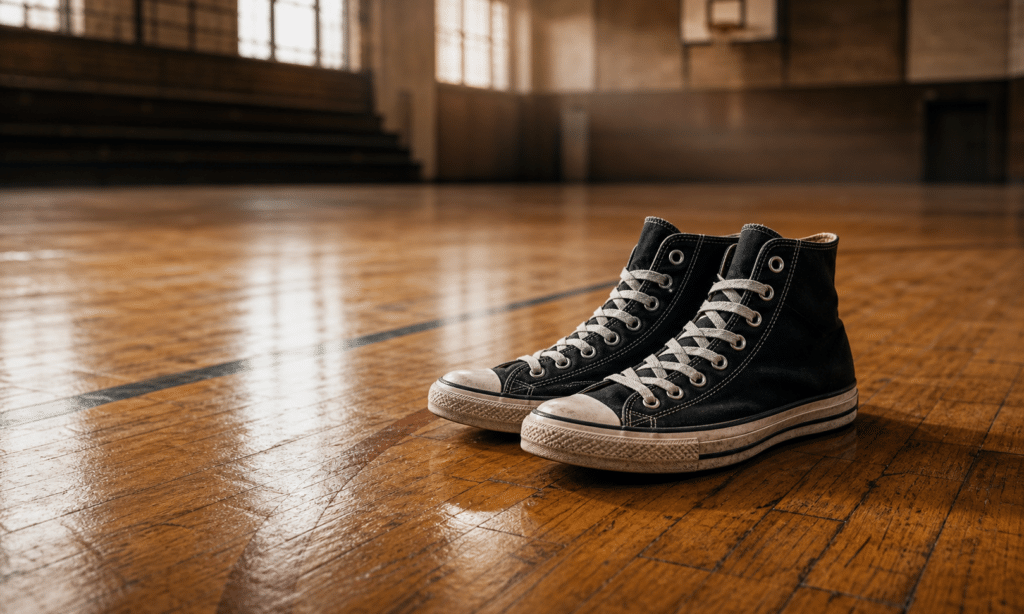
Converse is one of the rare sneaker names that can be understood almost instantly. A canvas upper, a rubber toe cap, a circular ankle patch, a star: the parts are simple, but the image is loaded with more than a century of sport, music, film and street style.
The story is often told as if it began with an accident. According to brand lore, Marquis Mills Converse was inspired to make safer rubber-soled footwear after a fall. Whether or not that version can be treated as hard history, the confirmed beginning is clear enough: in 1908, he founded the Converse Rubber Shoe Company in Massachusetts. The business first focused on practical rubber footwear, including winterized shoes and boots, before moving toward athletic designs.
What made Converse unusual was not just the product. It was the timing. In the early 20th century, sport was becoming more organized, basketball was spreading through schools and gyms, and rubber-soled canvas shoes were beginning to make sense for indoor play. Converse found itself at the intersection of utility and performance before sneakers were seen as fashion objects.
From Rubber Soles to Basketball Courts
By the 1910s, Converse was expanding beyond basic rubber footwear. Canvas shoes with grippy rubber soles were light, flexible and useful on polished gym floors. At the time, that was a technical advantage rather than a style statement. Shoes were judged by whether they helped athletes move, stop and turn.
The All Star line emerged from this basketball context. The shoe that would later become the Chuck Taylor All Star was introduced in the late 1910s as a performance basketball shoe. Early versions were built around practical features: a non-skid sole, a canvas upper and ankle support suited to the sport’s stop-start rhythm.
Basketball gave Converse its first durable identity. Before the brand became a staple of rock stages, skate parks and fashion collaborations, it was associated with gyms, teams and athletes. The shoe’s plain construction helped it travel across those settings later, but its original credibility came from the court.
The Chuck Taylor Connection
Charles “Chuck” Taylor became central to the Converse story in the early 1920s. He was a basketball player and salesman who worked with Converse and helped promote the All Star through the sport’s growing network of teams, schools and clinics.
Some versions of the story present Taylor as the single force behind the shoe’s success. A more careful reading is that he became the face and tireless advocate of a product that already had strong practical value. He helped connect the shoe to players, coaches and basketball culture at a time when personal endorsement was still a young idea in sports marketing.
Taylor’s name was later added to the All Star ankle patch, turning the shoe into one of the earliest famous examples of an athlete-associated sneaker. That detail matters. Today, signature shoes are part of the business model of sportswear. Converse helped establish the pattern long before modern sneaker culture had a name.

Classic Chuck Taylor All Star High Top
A standard Chuck Taylor All Star high top fits naturally here because the article is explaining the canvas upper, rubber toe cap, foxing stripe and ankle patch that made the shoe instantly recognizable.
As an Amazon Associate I earn from qualifying purchases.
The Chuck Taylor All Star became recognizable because it stayed visually consistent. The high canvas upper, rubber toe cap, foxing stripe and ankle patch created a design language that people could identify from a distance. Small changes arrived over time, but the basic silhouette remained stubbornly familiar.
A Sneaker Built for a Growing Sport
In the 1930s, Converse was tied closely to competitive basketball. The brand supplied shoes for major stages of the sport, including international competition. White high-top Chucks with red and blue detailing became part of the basketball image of the period, reinforcing the shoe’s association with serious play rather than casual dress.
As basketball grew in the United States, Converse benefited from being visible where the sport was visible. Teams wore the shoes. Coaches knew them. Young players saw them. For decades, the All Star was not retro; it was current equipment.
By the mid-20th century, Converse had become one of the dominant names in basketball footwear. Exact market-share figures vary by source and should be treated carefully, but the broader point is well established: before the rise of modern running and basketball technologies, Converse held a powerful position in American athletic shoes.
The brand also expanded beyond one model. The Jack Purcell, originally associated with badminton and created outside Converse before later becoming part of its catalog, gave the company another enduring silhouette. Its low profile and distinctive “smile” toe made it different from the All Star, but it shared the same quality that made Converse durable: it looked simple enough to survive changing trends.
From Utility to Pop Culture
The most interesting part of Converse history is what happened after the shoes no longer belonged only to athletes. As performance footwear became more technical, Converse became more cultural.
Canvas Chucks were inexpensive, accessible and easy to wear into the ground. That made them useful to people who did not want polished fashion. Musicians, students, skaters, artists and film characters could wear them without looking styled by a brand department. The shoes seemed to carry attitude precisely because they did not look overdesigned.
Converse appeared across different corners of popular culture. They were associated with rock and punk scenes, seen in film, and adopted by generations that liked their plainness. Nirvana and the wider grunge era helped strengthen the connection between Chucks and a rougher, anti-gloss image. Earlier cultural figures had also worn Converse, but the 1990s made the shoes feel especially connected to alternative music and youth identity.
Film helped too. When a familiar sneaker appears on-screen, it can become part of a character’s visual shorthand. Converse could suggest youth, rebellion, ordinariness, thrift, or creative independence depending on the context. Few shoes can move that easily between meanings.
The Pressure of Modern Sneaker Technology
By the late 20th century, the athletic footwear market had changed. Nike, Adidas, Reebok, ASICS and other competitors pushed cushioning, air units, gel systems, synthetic uppers and increasingly specialized performance design. Against that wave, the classic canvas Chuck Taylor looked less like advanced sports equipment and more like a heritage object.
That shift could have ended the brand’s relevance. Instead, it changed the role Converse played. The All Star was no longer expected to compete with the newest basketball shoes on technical grounds. It became a style object with a sports past.
Converse struggled as a business before Nike acquired it in 2003. The acquisition placed the brand inside the world’s most powerful sportswear company, but Nike did not erase the most recognizable Converse models. The smarter move was to preserve the visual identity while giving the company more room to develop materials, distribution and collaborations.

Chuck 70 High Top
The Chuck 70 keeps the familiar Converse shape while leaning into a more substantial build and modern underfoot comfort. It suits readers interested in the old-school look without choosing the most basic canvas version.
As an Amazon Associate I earn from qualifying purchases.
That balance is important. Converse works because it still looks like Converse. Too much modernization can make the shoe lose its reason for being; too little can make it feel frozen. The post-2003 era has largely revolved around managing that tension.
Collaborations Turn the Shoe Into a Canvas
One reason Converse has remained relevant is that its shoes invite reinterpretation. The flat canvas panels, rubber details and familiar silhouette make the Chuck Taylor and related models unusually adaptable. Designers can add print, texture, color, distressing or graphic elements without losing the underlying shape.
Collaborations became a major part of the modern Converse story. Comme des Garçons PLAY gave the Chuck Taylor a new fashion audience with its heart-and-eyes graphic. Missoni brought knit textures and patterned surfaces to the shoe. Maison Margiela used paint and wear as part of the design language, turning aging into a visual effect rather than a flaw.
Artists and musicians have also used Converse as a personal platform. Tyler, the Creator’s GOLF le FLEUR* work with the brand brought color, floral graphics and a softer take on skate and street references. Limited projects from artists and designers have pushed Converse beyond basic retail footwear and into collectible territory.
Some of those releases are made to be worn daily. Others sit closer to art objects. The important point is that the base shoe can carry both. A plain black Chuck Taylor and a high-concept designer edition still belong to the same visual family.
Why Converse Still Works
Converse has survived because it never depended on one meaning. It has been a basketball shoe, a military-adjacent practical shoe, a student shoe, a rock shoe, a skate shoe, a fashion collaboration and a blank canvas. That flexibility is the brand’s real strength.
The materials are modest. The design is not complicated. But the simplicity lets different groups project their own identity onto the shoe. A pair of Chucks can look clean, beaten-up, nostalgic, rebellious or carefully styled depending on who is wearing them and how.
The brand’s history also explains why nostalgia alone is not enough. Converse remains recognizable because the core models have been protected, but it remains commercially alive because they keep being reworked. New materials, artist projects, seasonal colors and fashion partnerships give the old shapes new reasons to appear.

Comme des Garcons PLAY x Converse Chuck 70 Low
A Comme des Garcons PLAY x Converse Chuck 70 shows how the same basic canvas shape can become a fashion collaboration without losing its Converse identity.
As an Amazon Associate I earn from qualifying purchases.
That is the unusual achievement. Converse did not simply preserve an old basketball shoe. It allowed the shoe to keep changing context without losing its outline. More than a century after the company began making rubber footwear, the star still carries a clear message: simple design can last when people keep finding new ways to make it their own.