

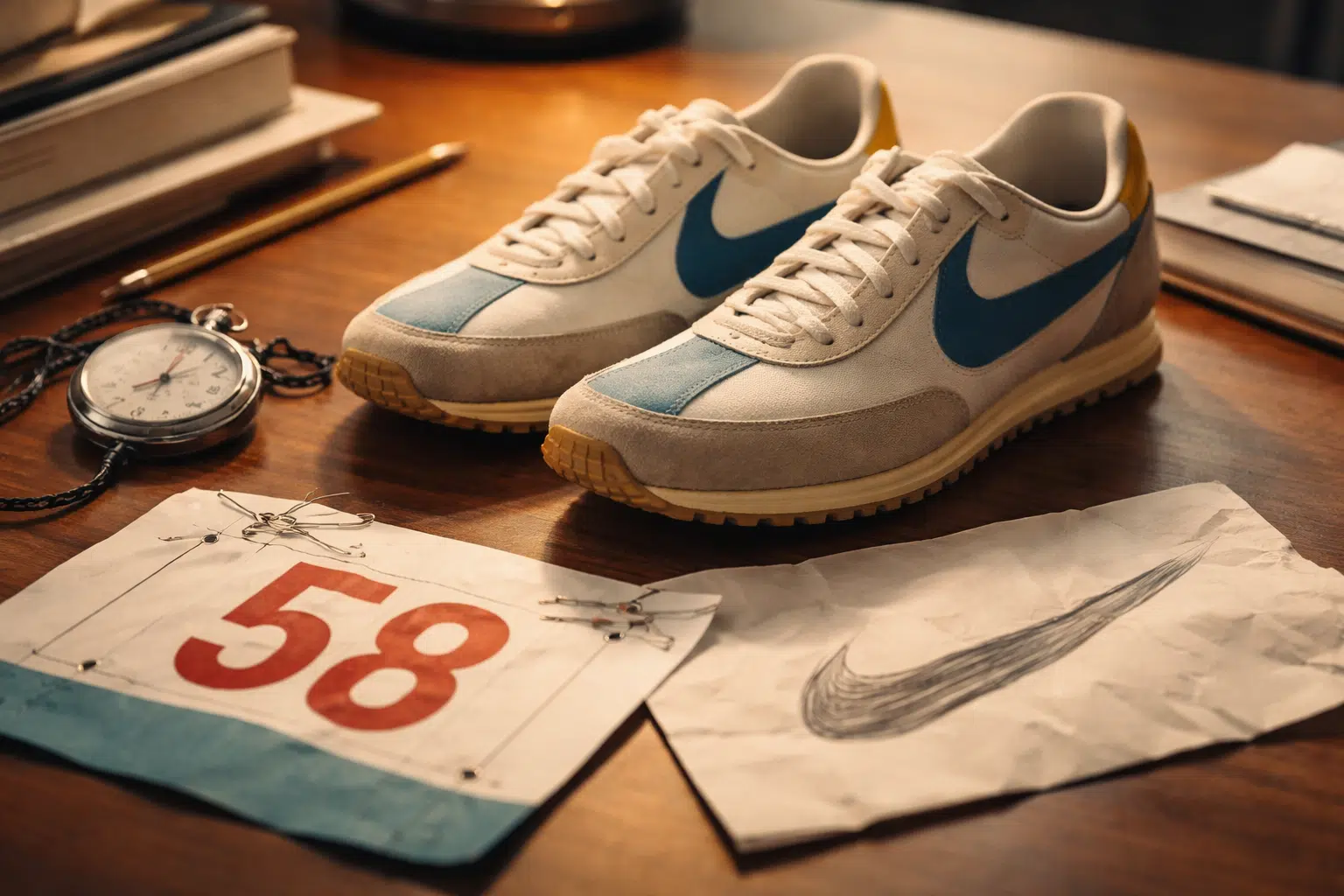

Nike’s origin story isn’t a neat “startup-to-empire” fairy tale. It’s messy, cash-strapped, and stubborn in the way real companies are built.
In January 1964, University of Oregon middle-distance runner Phil Knight and his coach, Bill Bowerman, launched Blue Ribbon Sports (BRS) with about $1,200. The early plan was simple: import well-made, lower-cost running shoes from Japan—Onitsuka Tiger (now ASICS)—and sell them in the U.S., one pair at a time.
Knight did exactly that. He sold shoes out of his car at track meets, keeping the operation alive while working a day job as an accountant.
Bowerman, meanwhile, obsessed over what runners actually needed. He tweaked uppers, experimented with fit and feel, and chased lighter traction. His most famous hack came from a kitchen appliance: early “waffle” sole prototypes made by experimenting with rubber in a waffle iron—an idea that would later shape Nike’s running identity.
From Blue Ribbon Sports to Nike
By 1971, BRS needed a new future—and a new name. The company officially became Nike, Inc., taking its name from the Greek goddess of victory. That same era introduced two pieces of brand DNA that would become instantly recognizable: the Swoosh and Nike’s early running silhouettes.
The Swoosh was created by Carolyn Davidson, then a graphic design student, for $35. It was a tiny spend that turned into one of the most valuable marks in modern business.
The moment Nike started to look inevitable
Nike’s early product momentum showed up on a big stage in 1972. At the U.S. Olympic Trials in Eugene, Oregon, Nike’s early “Moon Shoe” and waffle-sole experiments made appearances around the track scene—proof the young brand could compete in performance, not just price.
From there, Nike’s growth became harder to ignore. By the early 1980s, Nike had surged into the top tier of athletic footwear in the U.S., with market share often cited as approaching the 50% range in that period—an extraordinary leap for a company that started as a trunk-sale hustle.
Success didn’t remove the chaos—it upgraded it
As Nike scaled, the problems got bigger too.
- Legal battles became part of doing business, including high-profile disputes tied to early suppliers and partners.
- Quality and production pressures increased as demand spiked.
- Trade fights landed at the company’s doorstep—Knight later described a major U.S. customs/tariff shock tied to how import duties were calculated under the “American Selling Price” approach.
Through it all, Nike kept moving. A line often attributed to Knight captures the company’s posture as it grew from underdog to giant: it’s fine to be the biggest player—just don’t act like it.
The Jordan era rewrote sports marketing
Nike’s most famous bet came in 1984, when it signed rookie Michael Jordan. The deal was bold, and the brand built around it was even bolder: Jordan wasn’t just a spokesperson—he became the center of a signature line.
The first Air Jordan sneakers released to the public in 1985, and the ripple effects were massive. Nike didn’t just sell a shoe. It sold a story, a persona, and a culture.
As Knight put it in a 1992 interview: you can’t explain much in 60 seconds—but if you show Michael Jordan, you don’t have to.
From sneaker startup to global machine
Nike expanded far beyond running: basketball, apparel, global retail, and relentless marketing partnerships. In 2003, Nike acquired Converse for about $305 million, bringing a legacy sneaker brand under the same roof.
Today, Nike remains the world’s largest supplier of athletic shoes and apparel, with fiscal 2025 revenue reported at $46.3 billion. The scale is massive—but the playbook still looks familiar: performance credibility, cultural storytelling, and marketing that turns products into symbols.
Lessons from Nike’s rise
Lesson 1: Build a brand, not just a product
Nike doesn’t only sell running shoes. It sells ambition—ads, athletes, and identity wrapped around performance.
Lesson 2: Your first version won’t be the one that wins
Nike’s early years were full of fixes, experiments, and imperfect runs. Progress came from iteration, not perfection.
Lesson 3: Weird works—if it’s real
Knight wasn’t a stereotypical charismatic CEO. Nike’s culture made room for different personalities, as long as the work got done.
Lesson 4: Chaos is a feature, not a bug
Cash crunches, supplier issues, lawsuits, and trade threats didn’t disappear. Nike learned to operate while everything was on fire.
Lesson 5: Story beats specs
Bowerman built better shoes. Knight built meaning around them. Together, they turned function into mythology.
Lesson 6: Bet on the idea everyone doubts
Knight wrote advice to himself that still reads like Nike’s operating system: let people call it crazy—just keep going. Don’t stop.