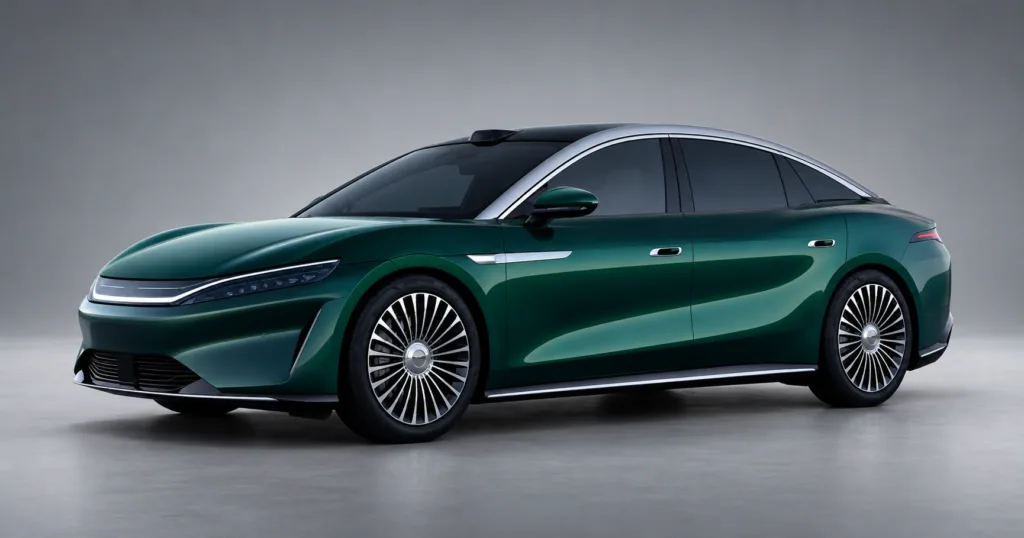
Ferrari’s shares fell in Milan and New York on Tuesday, May 26, 2026, after the unveiling of the Luce, its first fully electric car and first five-seater. The model’s design drew criticism over its departure from the company’s traditional sports cars.
Ferrari’s Milan-listed shares closed down 8.4%. Its New York-listed shares were down 5.1% at 15:50 GMT that day, an intraday reading rather than a closing figure.
Unveiled in Rome, the four-door Luce was developed with LoveFrom, the design studio founded by former Apple design chief Jony Ive. Its starting price was about $640,000. Ferrari chief executive Benedetto Vigna said the car was the result of five years of work.
Pierre-Olivier Essig, head of research at AIR Capital, criticised the design and questioned Ferrari’s direction in a client note. “We are lost in translation with Ferrari’s new strategy,” he wrote.
Ferrari described the Luce’s design as “simplified and rationalised in service of the driving experience”.
Four motors and long-term battery support
The Luce uses four electric motors and a 122 kWh battery pack. Ferrari says it can accelerate from a standstill to 100 km/h (62 mph) in 2.5 seconds.
Ferrari’s 2025 annual report says strategic electric components, including battery packs, e-axles, inverters and motors, are designed, engineered and built in-house. The company says battery cells are sourced from partners, distinguishing them from the packs it assembles.
Ferrari has also promised to support the Luce’s battery pack for decades. The company says the car amplifies sound from its electric motors.
Petrol and hybrids remain in Ferrari’s plans
The Luce joins a range that Ferrari plans to continue offering with petrol and hybrid powertrains. Its 2025 strategic plan targeted a 2030 model lineup of approximately 40% combustion-engine cars, 40% hybrids and 20% fully electric cars. Those percentages describe the models offered, rather than their share of vehicle sales.
Porsche had also adjusted its electric vehicle plans. In a 2025 strategy announcement, it said some electric models would arrive later and development of a planned electric vehicle platform would be rescheduled. A proposed SUV above the Cayenne, previously intended to be fully electric, would initially launch with combustion-engine and plug-in hybrid versions. Porsche attributed the changes to market conditions and slower growth in demand for high-end battery-electric vehicles.