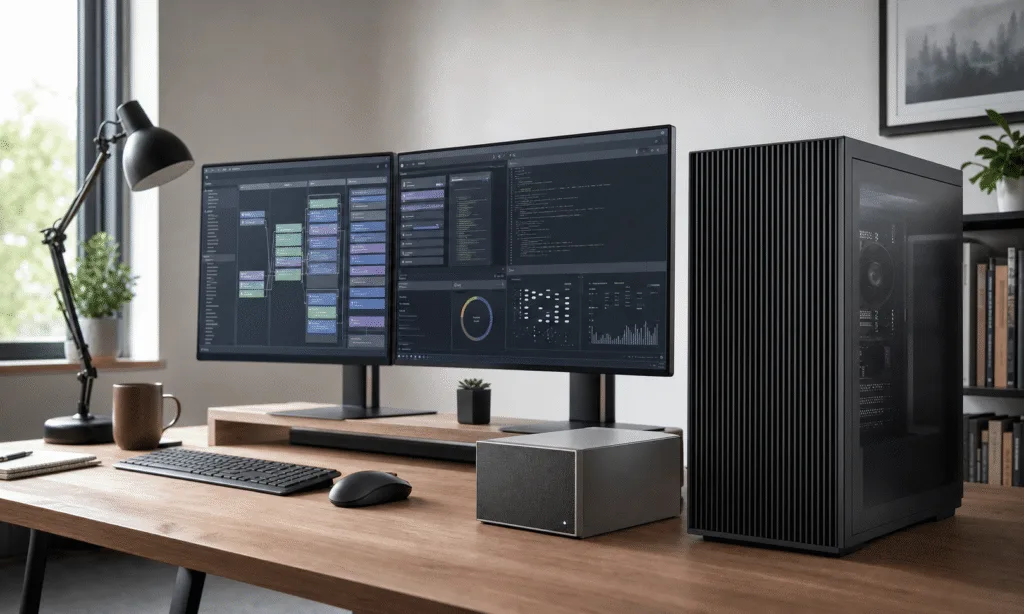
NVIDIA is positioning Hermes Agent, developed by Nous Research, for persistent local AI workflows on RTX PCs, RTX PRO workstations and DGX Spark. The proposed setup pairs the agent framework with locally hosted, open-weight language models, including Alibaba’s Qwen 3.6.
Local deployment is one option for Hermes. Nous Research describes support for different model providers, cloud services and user-hosted endpoints. NVIDIA’s proposal focuses on running both the agent and its underlying model locally.
Skills and task orchestration
Nous Research says Hermes creates reusable skills from experience and improves them during use. NVIDIA describes the framework as supporting messaging integrations, access to local files and applications, and continuous operation.
NVIDIA says Hermes assigns individual subtasks to short-lived, isolated sub-agents, each with a focused context and tool set. The company presents this arrangement as a way to organize work and reduce the context requirements of local models.
NVIDIA also says Nous Research curates and stress-tests the skills, tools and plug-ins shipped with Hermes. It claims developer comparisons using identical models show stronger results in Hermes than in other frameworks, attributing the difference to orchestration and persistence.
Qwen 3.6 models and memory requirements
The models NVIDIA highlights include Qwen3.6-35B-A3B and Qwen3.6-27B. Qwen’s specifications describe the former as a mixture-of-experts model with 35 billion total parameters and 3 billion activated parameters. The latter is a dense model with 27 billion parameters.
NVIDIA says the 35B model runs in roughly 20GB of memory while surpassing previous-generation 120-billion-parameter models, for which it cites memory requirements above 70GB. The company also says the 27B model matches the accuracy of Qwen3.5-397B, a roughly 400-billion-parameter model.
Memory requirements vary with model files, quantization, context length and runtime configuration. Qwen’s documentation notes that inference efficiency varies across frameworks and that reducing the context window can address out-of-memory errors.
RTX acceleration and DGX Spark capacity
NVIDIA says RTX Tensor Cores accelerate inference to increase throughput and reduce latency during multistep agent tasks. Available memory varies with the GPU configuration of an RTX PC or RTX PRO workstation.
NVIDIA specifies 128GB of unified memory for DGX Spark and rates the compact standalone system at up to 1 petaflop of AI performance at FP4 precision. The company presents it as suitable for sustained agent workloads and says it can run 120-billion-parameter mixture-of-experts models continuously.
NVIDIA lists llama.cpp, LM Studio and Ollama as runtime options for pairing Hermes with local Qwen 3.6 models. It says Hermes includes LM Studio and Ollama support out of the box. The configuration described requires selecting a model and runtime, with memory capacity and inference speed determining the resources available for local agent tasks.