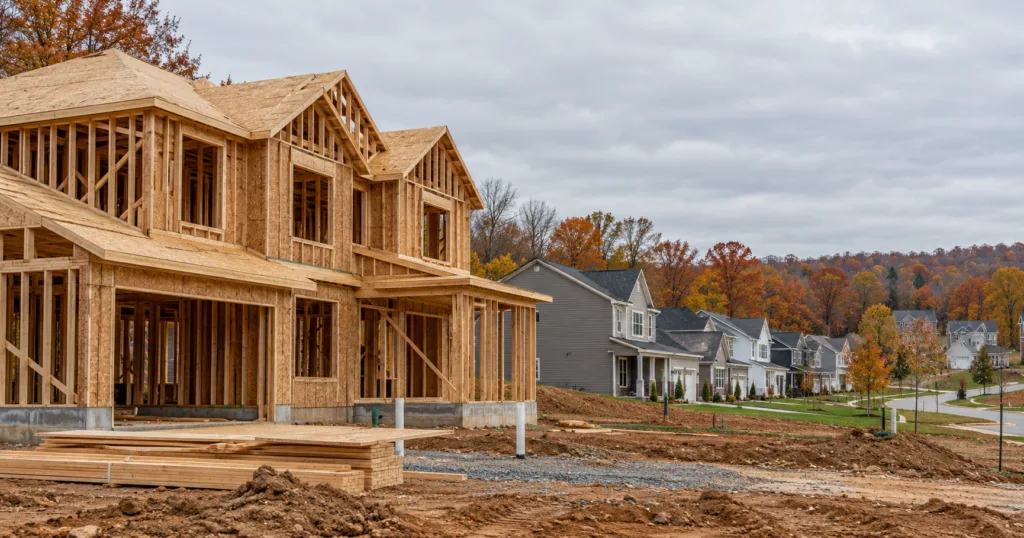
U.S. homebuilder confidence fell to its lowest level since June 2012 in October 2026, the National Association of Home Builders said in its Oct. 19 release. The NAHB/Wells Fargo Housing Market Index dropped three points to 29, while the share of builders reporting price cuts reached 43%.
NAHB Chief Economist Robert Dietz attributed weaker demand to higher mortgage rates, construction costs and lower consumer confidence. He also cited supply constraints and persistent affordability problems. Prospective buyer traffic, he said, was at its weakest since April 2012, excluding the pandemic disruption in April 2020.
Price cuts rise as sales expectations weaken
All three components of the monthly survey declined. The index measures builders’ assessments of single-family home sales and buyer traffic; readings above 50 indicate that more builders consider conditions good than poor.
| Measure | October 2026 index points | Monthly change |
|---|---|---|
| Overall index | 29 | −3 |
| Current sales | 33 | −2 |
| Sales expectations over six months | 32 | −5 |
| Prospective buyer traffic | 18 | −5 |
NAHB said the 43% share cutting prices was the highest recorded during 2020–2026. The average reduction remained 6% for a seventh consecutive month. Sales incentives were used by 65% of builders, marking 19 consecutive months in which at least 60% reported offering them.
Regional three-month averages showed the Midwest with the strongest reading at 40 and the West with the weakest at 26. The Northeast stood at 38 and the South at 30.
The Federal Reserve raised its benchmark interest-rate target by a quarter percentage point on Sept. 16, 2026.
NAHB Chairman Bill Owens said regulatory reform efforts were helping ease some cost pressures, although builders faced higher costs for construction loans, materials and diesel.
Toll Brothers and D.R. Horton report different cancellation trends
Toll Brothers said approximately 25% of its buyers paid entirely in cash during its fiscal third quarter, which ended July 31, 2026. Its luxury first-time buyer business represented approximately 23% of home-sales revenue.
The company reported cancellations equal to 5.4% of signed contracts, down from 7.5% a year earlier. In its Aug. 18 earnings release, Toll Brothers reaffirmed a full-year forecast of approximately $10.5 billion in home-sales revenue.
D.R. Horton reported a cancellation rate of 20% of gross sales orders for its fiscal third quarter, ended June 30, compared with 17% a year earlier. Chief Financial Officer Bill Wheat said difficulty qualifying for mortgages remained the largest reason for cancellations.
Horton reduced its fiscal 2026 consolidated revenue forecast to between $32.5 billion and $33 billion. Management said it expected sales incentives to remain elevated in the fourth quarter, with their level depending on demand, mortgage rates and other market conditions. The company scheduled its fourth-quarter and full-year results for Oct. 29.
Inventory ratios highlight exposure to unsold homes
Speculative homes are started before a buyer signs a contract. An Oct. 19 analysis by housing analyst Dan Oppenheim compared builders’ investment in homes under construction with the value of their sales backlogs, using each company’s latest reported quarter.
| Homebuilder | Construction inventory ÷ backlog value |
|---|---|
| NVR | 0.44× |
| KB Home | 0.84× |
| PulteGroup | 0.84× |
| Toll Brothers | 1.17× |
| D.R. Horton | 1.47× |
| Lennar | 1.68× |
| Meritage Homes | 2.86× |
| Century Communities | 3.09× |
Oppenheim identified Century Communities and Meritage as having particularly high inventory relative to backlog. He said higher mortgage rates and slower September sales could leave builders carrying more speculative homes than intended, potentially putting pressure on fourth-quarter margins as they reduce inventory.
The ratios are a proxy for exposure, rather than a count of unsold properties. Oppenheim noted that backlog reflects expected selling prices, including future construction and profit, while inventory reflects construction costs incurred to date. That difference limits direct comparisons between the two values.