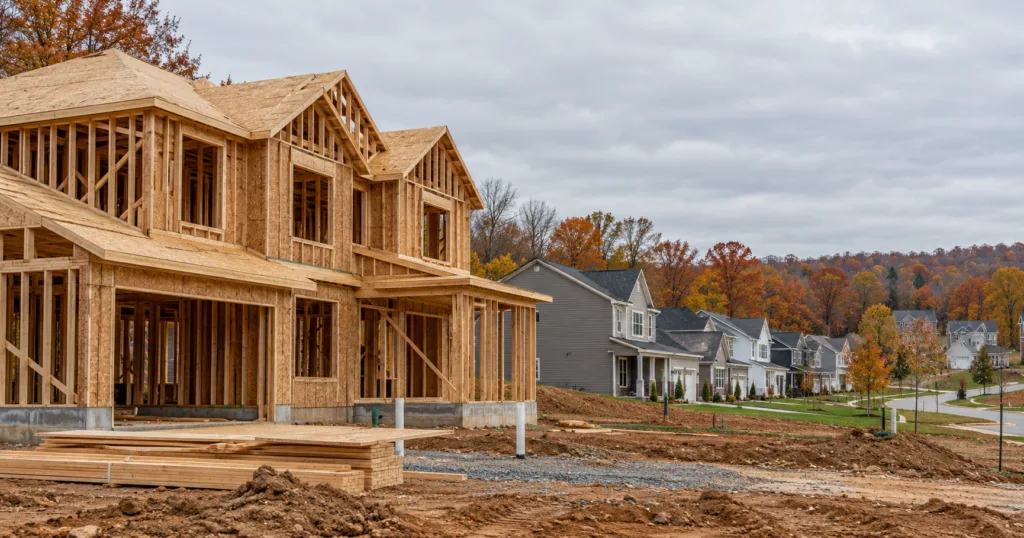
A lower share price can make homebuilder stocks look appealing, but the investment case still comes back to buyers: can they afford the homes being built, and can builders sell those homes without giving up too much profit?
Morgan Stanley’s coverage of six major U.S. builders draws a clear distinction. The bank favors Toll Brothers while taking a cautious view of the industry. For investors comparing the group, customer exposure and earnings resilience matter alongside valuation.
How the six homebuilders compare
Morgan Stanley initiated coverage on October 1, 2026, with one Overweight rating, two Equal Weight ratings and three Underweight ratings. Toll Brothers received the sole positive recommendation and a $159 price target.
| Homebuilder | Ticker | Morgan Stanley rating |
|---|---|---|
| Toll Brothers | TOL | Overweight |
| D.R. Horton | DHI | Equal Weight |
| PulteGroup | PHM | Equal Weight |
| Lennar | LEN | Underweight |
| NVR | NVR | Underweight |
| KB Home | KBH | Underweight |
The spread of ratings matters. Morgan Stanley’s preference for Toll Brothers is a selective investment thesis, with five of the six companies receiving neutral or negative ratings. The $159 target is the bank’s assessment of potential share value, not a guaranteed outcome.
Its reasoning centers on the customer. Morgan Stanley sees Toll Brothers’ more affluent buyers as less sensitive to mortgage financing costs. That could offer some protection if borrowing remains expensive, although it does not make the company immune to a housing slowdown.
Stronger businesses can still face weaker margins
Analyst Adam Kramer credits builders with gaining market share, reducing debt and adopting land-light strategies. In his assessment, those changes have supported cash flow and share buybacks.
The difficulty is translating those improvements into earnings when selling conditions become less favorable. Morgan Stanley flags elevated inventory, declining median new-home prices and affordability constraints as risks to the industry’s outlook.
Its forecasts put numbers on that concern. For 2027, the bank expects roughly flat closings and average home prices, alongside about 50 basis points of gross-margin deterioration. Its earnings estimates for both 2027 and 2028 sit roughly 9% below consensus across the six builders.
Those are forecasts. The investment implication is that stable sales volumes would not necessarily protect profitability. A builder could keep delivering a similar number of homes while retaining less profit from each sale.
Financing connects the buyer’s budget to the builder’s profit
For a prospective homeowner, the purchase price is only part of the calculation. A higher mortgage rate increases the payment on an otherwise identical loan. That can make a home harder to afford without any increase in its asking price.
Builders facing that constraint may have to offer incentives or reduce prices to keep homes moving. Those concessions can help a buyer complete a purchase while putting pressure on the builder’s margin.
This is the tradeoff behind the comparison: an offer that improves affordability for the buyer can weaken the economics for the seller. Investors therefore need to consider how a builder supports demand, alongside how many homes it closes.
Toll Brothers’ customer profile is relevant here. Morgan Stanley’s argument depends on those customers being less exposed to financing pressure. It is a relative advantage within the group, with no promise that demand or earnings will rise.
Lennar has a separate issue to assess
Short seller Hunterbrook alleged on October 2, 2026, that Lennar sold roughly 700 homes worth about $200 million to its Millrose Properties spinoff to help meet quarterly targets.
These are Hunterbrook’s allegations about the transactions and their purpose. For someone evaluating Lennar, they raise a company-specific question about the composition of home sales, alongside the broader affordability and margin concerns.
The decision turns on more than valuation
The useful comparison is between customer sensitivity to rates, the incentives needed to sustain sales, and the profit left after those concessions. Morgan Stanley’s ratings favor Toll Brothers on that first consideration while its forecasts underline the industry’s earnings risk.
A cheaper-looking stock alone does not settle those questions. A stronger investment case would need a credible path to affordable payments and durable margins, whether that comes from lower financing costs or a customer base better able to absorb them.