Mazda SkyActiv engines occupy an unusual place in the modern car market. They are not the loudest, most powerful, or most dramatic engines in the showroom, and that is largely the point. SkyActiv has always been about making gasoline and diesel combustion work harder before adding complexity elsewhere.
That makes the technology interesting for a very specific kind of buyer. If you are shopping for a Mazda3, CX-5, CX-30, CX-50, CX-70, or CX-90, the question is not whether SkyActiv sounds clever on paper. It is whether Mazda’s engineering-first approach still delivers enough real-world value now that hybrids, plug-in hybrids, and EVs have changed what efficient performance looks like.
The short answer is yes, with caveats. SkyActiv remains one of Mazda’s defining technologies because it focuses on usable efficiency, throttle response, packaging, and driving feel rather than headline horsepower. But not every SkyActiv engine has the same reputation, and some of the most interesting versions either never reached the United States or arrived too briefly to matter for most buyers.
What SkyActiv Was Trying To Solve
SkyActiv was Mazda’s answer to a problem every automaker faced: how to make internal-combustion engines cleaner and more efficient without making the car feel dull. Instead of leaning immediately on large batteries or heavy electrification, Mazda focused on improving combustion itself.
The gasoline side of the family, commonly known as SkyActiv-G, used unusually high compression ratios for a production gasoline engine. Depending on market and application, SkyActiv-G engines have been associated with compression ratios in the 13:1 to 14:1 range, which is higher than many conventional gasoline engines. Higher compression can improve thermal efficiency because the engine extracts more useful work from the air-fuel mixture.
The problem is that high compression also raises the risk of knock, the uncontrolled combustion event that can damage an engine and force engineers to pull back timing, power, or efficiency. Mazda’s approach involved changes to piston shape, fuel injection, combustion timing, and exhaust flow to manage that risk.
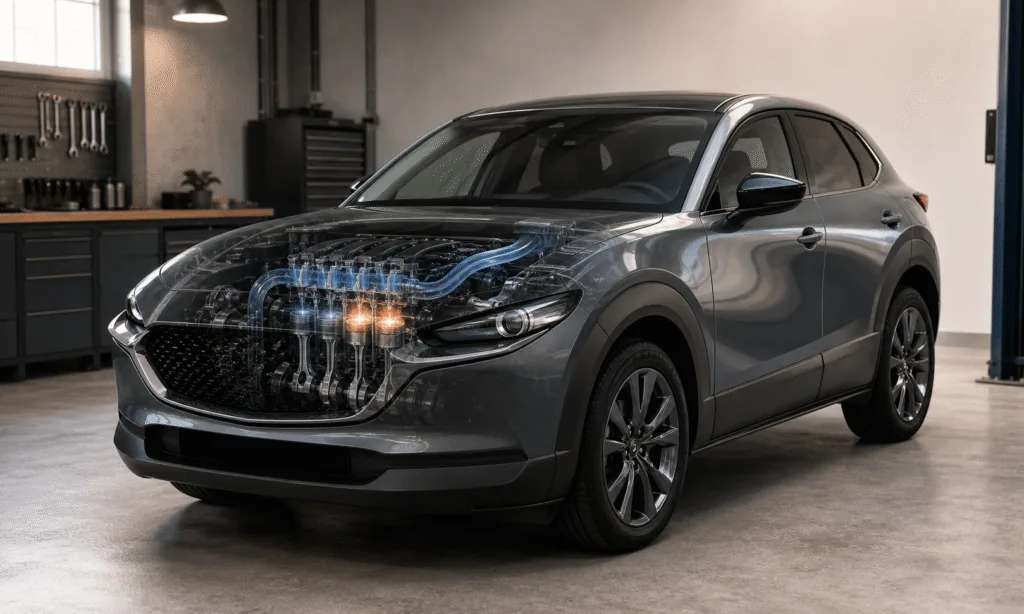
That is why SkyActiv is not just a badge on an engine cover. It is a package of decisions: compression ratio, combustion chamber design, piston geometry, exhaust layout, transmission calibration, and lightweight vehicle engineering. The result was not a single miracle engine, but a broader design philosophy that made Mazda feel different from rivals chasing either turbocharged power or hybrid fuel economy.
The Main SkyActiv Engines Compared
SkyActiv is often discussed as one technology, but buyers should treat it as a family. SkyActiv-G, SkyActiv-D, SkyActiv-X, and the coming SkyActiv-Z all have different goals and different tradeoffs.
| Engine family | Primary idea | Buyer takeaway |
|---|---|---|
| SkyActiv-G | High-compression gasoline combustion with broad use across Mazda’s lineup | The most relevant version for most used and new Mazda shoppers |
| SkyActiv-G 2.5 Turbo | Turbocharged gasoline performance in larger and higher-trim models | Stronger torque, but buyers should pay attention to known issue areas |
| SkyActiv-D | Low-compression diesel combustion intended to reduce emissions-related compromises | Rare in the U.S. and not the simple win diesel fans may expect |
| SkyActiv-X | Gasoline compression-ignition behavior using spark-controlled combustion | Technically fascinating, but limited market availability and cost hurt its case |
| SkyActiv-Z | Next-generation Mazda combustion engine planned with hybrid integration | The future-facing version, expected to matter first in the next CX-5 |
For shoppers, SkyActiv-G is the important one. It is the engine family most people will encounter on dealer lots and used-car listings. SkyActiv-D and SkyActiv-X are more useful as context: they show how far Mazda was willing to push combustion, even when the business case was not obvious.
Why SkyActiv-G Still Has Appeal
SkyActiv-G’s appeal is not complicated. It gives Mazda a naturally aspirated gasoline engine character in a market where many rivals moved toward small turbocharged engines. That matters because a naturally aspirated engine can feel predictable, linear, and easy to live with, especially in compact cars and crossovers.
The high-compression design is central to that identity. In simple terms, compression ratio describes how much the air-fuel mixture is squeezed before combustion. Squeeze it more effectively, and the engine can extract more energy from the same amount of fuel. That is the theory behind much of SkyActiv-G’s efficiency story.
Mazda also paired the engine strategy with transmissions and chassis tuning meant to preserve a more direct driving feel. That is one reason Mazda products often appeal to buyers who want a mainstream vehicle that does not feel completely anonymous. A CX-5 or Mazda3 may not be the quickest vehicle in its class, but the powertrain response and steering feel can make the car seem more cohesive than the spec sheet suggests.
There is also a practical maintenance angle. Many shoppers like the idea of an efficient gasoline engine without the added cost and complexity of a hybrid battery, high-voltage components, or plug-in charging routines. That does not automatically make SkyActiv cheaper to own, but it does make the ownership proposition easier to understand.
The tradeoff is that SkyActiv-G does not erase the laws of combustion. A conventional hybrid will often deliver better city fuel economy. A turbocharged rival may offer stronger low-end torque. An EV will be smoother and cheaper to fuel for some households. SkyActiv-G is best viewed as a balanced combustion solution, not a substitute for every alternative.
The Problem Areas Buyers Should Know
The engineering story is only half the story. Buyers should also look at reliability patterns, maintenance sensitivity, and model-year-specific issues before treating any SkyActiv engine as automatically low-risk.
Some SkyActiv-G engines can be sensitive to carbon buildup, especially in use cases that involve short trips, low-speed driving, or inconsistent maintenance. Direct injection can contribute to deposits because fuel does not wash over the intake valves the same way it does in a port-injected engine. Regular maintenance and occasional cleaning may matter more for long-term smoothness than the marketing around the technology suggests.
The SkyActiv-G 2.5 Turbo also deserves extra attention. Owners and service discussions have pointed to issues such as mass airflow sensor sensitivity and fault codes triggered by contamination. Turbocharged engines add heat, pressure, and additional components, so buyers looking at used examples should be more careful about service history than they might be with a simpler naturally aspirated model.
Mazda has also faced legal claims involving coolant leaks in some vehicles equipped with the SkyActiv-G 2.5T engine. The models named in that dispute included certain Mazda6, Mazda3, CX-30, CX-5, CX-9, and CX-50 vehicles across several model years. Mazda denied wrongdoing, and the matter was described as settled with reimbursement provisions for affected owners.
For buyers, the practical move is straightforward: do not shop by engine name alone. Check the exact model year, engine, service records, warranty status, and any repair history tied to coolant loss, overheating, check-engine lights, or recurring drivability complaints.
- Look for documented oil changes and cooling-system repairs.
- Ask whether carbon cleaning or intake service has been performed on higher-mileage cars.
- Scan for stored or pending engine codes before buying used.
- Pay special attention to turbocharged 2.5-liter models if the vehicle has incomplete maintenance records.
SkyActiv-D Was Interesting, But Not An Easy Win
SkyActiv-D is one of Mazda’s more ambitious combustion experiments. The idea was to make a diesel engine behave more cleanly and responsively by using a much lower compression ratio than traditional diesel engines. Mazda’s 2.2-liter SkyActiv-D used a 14:1 compression ratio, which is low for a diesel, along with twin turbochargers and an aluminum block.
In theory, the lower compression ratio could help reduce nitrogen oxides and soot formation, while the twin-turbo setup would help address lag. Mazda also pushed the engine toward a more gasoline-like character, including a higher redline than many diesel buyers might expect.
In the United States, though, SkyActiv-D barely registered. It appeared briefly in the 2019 Mazda CX-5, and that short run tells buyers most of what they need to know. Diesel passenger vehicles were already a tough sell in the U.S., and Mazda’s diesel did not arrive with the kind of price, performance, or availability advantage needed to change that.
In markets where diesel is more common, the engine made more sense on paper. But buyers still needed to account for the realities of modern diesel ownership: emissions equipment, particulate filters, carbon buildup, and the way short urban trips can be hard on diesel systems. A driver who does frequent highway mileage may have a very different experience from someone who mostly does cold starts and short city runs.
For most American shoppers, SkyActiv-D is less a buying target than a reminder of Mazda’s willingness to solve problems its own way. That attitude can produce fascinating engineering, but it does not always produce the easiest ownership case.
SkyActiv-X Showed The Limits Of Clever Combustion
SkyActiv-X may be the most technically interesting engine in the family. It was designed to combine traits of gasoline and diesel combustion by using Spark Controlled Compression Ignition, or SPCCI. Under the right conditions, the engine could use a small spark-triggered combustion event to help ignite a lean mixture more broadly in the cylinder.
The appeal is clear: use very little fuel, make combustion more efficient, and avoid the heavy battery hardware that comes with a full hybrid. It was a deeply Mazda solution, because it tried to preserve the feel of a combustion engine while extracting more efficiency from the burn itself.
The business case was harder. SkyActiv-X was more expensive to produce than SkyActiv-G, and in some markets it required premium-grade fuel to deliver its best performance. Its power advantage over comparable SkyActiv-G applications was not dramatic enough to make the price jump feel obvious to everyday buyers.
That is especially true in the U.S., where fuel economy matters but sticker price and performance still dominate many showroom decisions. A salesperson can explain a hybrid quickly: it saves fuel using an electric motor and battery. Explaining compression ignition in a gasoline engine is a harder pitch, particularly when the car is not dramatically quicker and the savings are not immediately visible.
SkyActiv-X did reach markets outside the United States, including Europe, but it never became the broad American answer Mazda might have wanted. Technically, it proved that Mazda could push gasoline combustion into unusual territory. Commercially, it showed that clever engineering still has to survive a simple buyer question: what am I paying more for?
Where SkyActiv-Z Fits Next
Mazda’s next major combustion step is SkyActiv-Z, a new generation of gasoline engine technology planned to arrive with the next-generation CX-5 in 2027. Mazda has described the engine as part of a strategy to keep combustion relevant while meeting stricter emissions rules.
The first version is expected to be a 2.5-liter four-cylinder. Mazda has also discussed an inline-six version for larger models. Just as important, the next CX-5 is expected to introduce Mazda’s in-house hybrid system for its smaller transverse-engine vehicles.
That matters because Mazda already uses hybrid and plug-in hybrid hardware in larger models such as the CX-70 and CX-90, but those vehicles use longitudinal platforms. A smaller crossover such as the CX-5 needs a different packaging solution. If Mazda gets it right, SkyActiv-Z could combine the brand’s combustion expertise with the city-efficiency gains buyers increasingly expect from hybrids.
Mazda’s pitch for SkyActiv-Z is not simply more peak horsepower. The more important claim is broader efficiency across the engine’s operating range. In plain English, the goal is to waste less heat and fuel more often, not just hit an impressive number in a narrow test condition.
That is the right problem to solve. Future emissions rules will not reward engines that only look good in a lab or only deliver efficiency under gentle driving. A modern combustion engine has to be clean, responsive, and efficient across the messy middle of daily use: merging, climbing hills, sitting in traffic, passing, and cruising.
What This Means For The Next CX-5
The CX-5 is the right place for SkyActiv-Z to debut because it sits at the center of Mazda’s business and brand identity. It is mainstream enough to matter commercially, but still tied to Mazda’s promise of sharper driving manners than the typical compact crossover.
The challenge is positioning. Mazda also sells the CX-50, which overlaps with the CX-5 in size and price territory. If the next CX-5 grows larger, the two crossovers may become harder to separate. The CX-50 has a more rugged image and stronger outdoor positioning, while the CX-5 has traditionally been the more road-focused, polished compact SUV.
SkyActiv-Z and hybridization could give the CX-5 a cleaner role: the efficient, refined, road-biased Mazda crossover for buyers who do not need a plug-in hybrid or a full EV. That would make sense if the powertrain delivers better fuel economy without dulling the driving feel that helped make the CX-5 popular.
The risk is that Mazda ends up with another technically impressive engine that is hard to explain against simpler alternatives. Toyota can sell hybrid efficiency in one sentence. Honda can sell broad reliability and easy ownership. Hyundai and Kia can sell value, warranty coverage, and feature density. Mazda has to sell feel, engineering, and efficiency together, which is a more nuanced pitch.
SkyActiv Versus Hybrids, Turbos, And EVs
For buyers, the best way to understand SkyActiv is to compare it with the alternatives rather than judging it in isolation.
| Choice | Strength | Tradeoff | Best fit |
|---|---|---|---|
| SkyActiv-G naturally aspirated | Linear response and relatively simple gasoline ownership | May trail hybrids in city fuel economy | Drivers who want a conventional car with good feel |
| SkyActiv-G turbo | Stronger torque and easier passing power | More complexity and closer attention to maintenance | Buyers who want a quicker Mazda crossover or sedan |
| Conventional hybrid | Excellent city efficiency and easy-to-understand savings | Can feel less direct depending on calibration | Urban and suburban commuters focused on fuel economy |
| Plug-in hybrid | Electric commuting with gasoline backup | Higher cost and charging habits matter | Drivers with home charging and shorter daily trips |
| EV | Smoothness, low home-energy cost, and no tailpipe emissions | Charging access and road-trip planning still matter | Households ready to build around charging |
This comparison is where SkyActiv still holds up. It is not the most efficient answer in every use case, but it remains a good fit for buyers who want a normal gasoline vehicle that feels well tuned. That is a narrower market than it used to be, but it is not a meaningless one.
The Buyer Verdict
Mazda’s SkyActiv engines still matter because they represent a clear engineering position: improve the combustion engine as much as possible before asking the buyer to accept more weight, cost, or complexity. That position is less dominant than it was when electrification was rare, but it still has value.
A naturally aspirated SkyActiv-G Mazda can be a smart buy for someone who wants predictable power delivery, respectable efficiency, and a car that feels more carefully tuned than many mainstream alternatives. A SkyActiv-G turbo model can be compelling, too, but it deserves a more careful inspection and a stronger service-history standard.
SkyActiv-D is too rare in the U.S. to matter for most buyers, and SkyActiv-X is best viewed as an impressive engineering chapter that never became a mainstream American product. SkyActiv-Z is the one to watch because it may decide whether Mazda’s combustion-first philosophy can survive in a market that increasingly expects hybrid assistance.
The practical advice is simple: buy the Mazda for how the whole vehicle works, not because the engine name sounds advanced. SkyActiv is a meaningful piece of Mazda’s identity, but the best ownership experience still depends on the exact engine, model year, maintenance record, and how well the car fits your driving routine.