
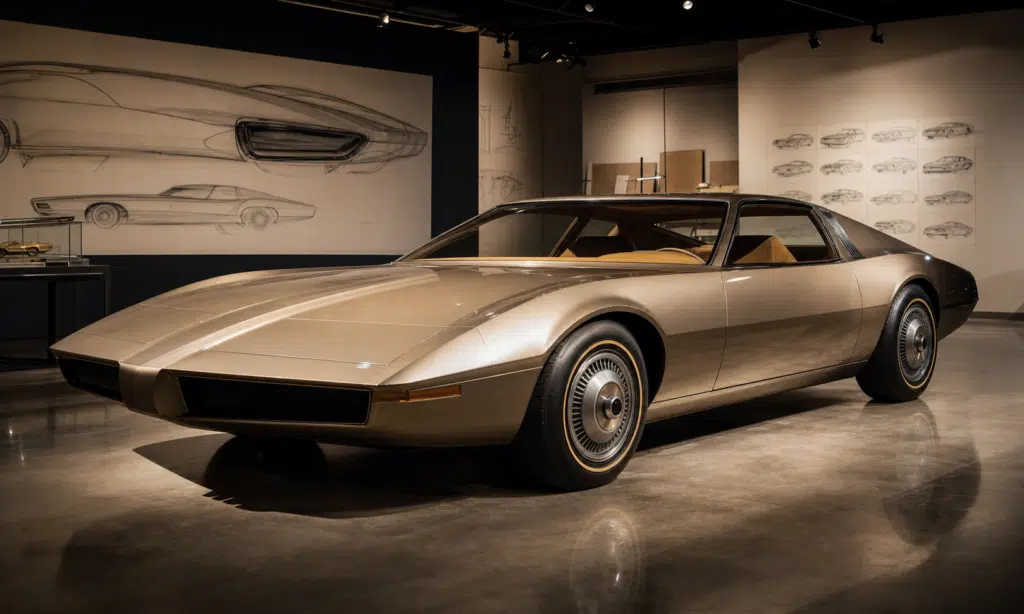
Most Pontiac fans can name the obvious icons: GTO, Firebird, Trans Am, maybe the Fiero if the conversation gets specific. The Pontiac Phantom sits in a different lane. It was never a showroom car, never became a common poster car, and never had the long public life that turns a model into shorthand for an era.
That is part of why it remains interesting. The Phantom is best understood as a late-1970s design statement from General Motors design boss Bill Mitchell, a figure closely associated with some of GM’s most recognizable postwar shapes. It appeared at a moment when American performance cars were being squeezed by emissions rules, fuel-economy pressure, insurance costs, and a market that was moving away from the big, emotional machines that had defined the previous decade.
The result was not a practical answer to the new market. It was a dramatic Pontiac concept with long-hood proportions, a low stance, and a grand-touring attitude that felt more like a final argument for style than a realistic product plan.
A Pontiac Built For The Wrong Moment
The Phantom’s timing mattered as much as its shape. By the late 1970s, the American muscle-car boom had largely cooled. Automakers were dealing with a new set of priorities, and those priorities were not especially friendly to large, expressive performance coupes.
Cars were becoming more efficiency-minded. Engine outputs were down from the peak years. Buyers were still interested in image and comfort, but the business case for an expensive, emotional Pontiac halo coupe was not the same one that had existed when the GTO and early Trans Am were building their reputations.
That makes the Phantom feel almost deliberately out of phase. It did not read as a downsized compromise or a conservative attempt to chase a changing market. Its proportions suggested something closer to a private luxury-performance coupe: long hood, short rear deck, sweeping roofline, and a body that emphasized presence over practicality.
For a modern buyer or collector, that context is important. The Phantom is not a forgotten production model waiting to be rediscovered in classifieds. It is a one-off concept tied to a very specific design culture inside GM. Its appeal is less about ownership potential and more about what it shows: Pontiac still had a performance identity even as the market around it had changed.
What The Phantom Was Trying To Say
The Phantom was reportedly developed as a personal project connected to Bill Mitchell near the end of his long GM career. Mitchell had succeeded Harley Earl as GM’s design chief and became associated with a sharper, more dramatic era of General Motors styling. The Phantom fits that reputation.
Rather than looking like a future production Pontiac with softened edges and obvious cost targets, it looked like a designer’s point of view made physical. The car blended muscle-car attitude with grand-tourer proportions, and it leaned into the visual drama that late-1970s production cars were often moving away from.
The car has been associated with GM’s advanced design environment and with the nickname Madame X, a name that suits its role as a private, almost insider object rather than a typical auto-show preview. It was not simply a clay exercise meant to preview next year’s grille. It was a rolling design idea, even if it was not a fully functional production prototype.
That distinction matters. Concept cars can serve different jobs. Some exist to test public reaction before a production launch. Some preview technology. Some are pure styling statements. The Phantom falls closest to the last category. It preserved a way of thinking about American cars at a time when the industry was being pushed toward something more restrained.
Why It Never Became A Showroom Pontiac
The simplest answer is timing. The Phantom arrived when GM had little reason to turn a dramatic two-seat Pontiac concept into a production program. Even if the design had drawn enthusiasm inside the company, the broader market was moving in another direction.
A production version would have needed a real platform plan, engineering investment, emissions compliance, safety validation, manufacturing tooling, and a sales case strong enough to survive the late-1970s market. Nothing about that environment favored a low-volume, style-led Pontiac grand tourer.
It also helps to separate the dream from the business. The Phantom was not killed the way a normal production car gets killed after development budgets and launch plans collapse. It appears to have remained a concept, and that status insulated it from the compromises that would have come with production. A showroom version would almost certainly have been heavier, simpler, less extreme, and more constrained by parts sharing.
In other words, the same thing that kept the Phantom from buyers also kept it pure. It did not have to become a late-1970s compromise with softened proportions and a diluted mission. It could remain an object built around one idea: Pontiac could still look emotional.
The Buyer Angle: Why This Car Still Matters If You Can’t Buy One
There is no normal buyer’s guide for the Pontiac Phantom because it was not a production car. You are not choosing between trim levels, checking common failure points, or comparing recent auction prices the way you would with a Trans Am, GTO, or Grand Prix.
But the Phantom still has practical value for enthusiasts and collectors because it helps explain the cars around it. If you are interested in late Pontiac design, GM concept history, or the way American brands responded to the end of the classic muscle era, the Phantom gives that story a sharper edge.
It also changes how the late 1970s look in hindsight. That period is often flattened into a simple story about emissions equipment, lower horsepower, and less exciting cars. The Phantom complicates that. It suggests that even inside a more constrained industry, designers were still imagining cars with presence, attitude, and identity.
For collectors, that matters because context affects desirability. A late-1970s Pontiac may not have the same raw performance appeal as an earlier muscle car, but the design lineage and internal ambition behind the brand remain part of the appeal. The Phantom is one of the clearest expressions of that ambition.
How It Fits Into Bill Mitchell’s GM Legacy
Bill Mitchell’s name is tied to several major GM designs, including the 1963 Chevrolet Corvette Sting Ray, the 1963 Buick Riviera, the Oldsmobile Toronado, and later Camaro and Firebird generations. Those cars did not all share the same mission, but they shared a willingness to make proportions and surfaces do real work.
The Phantom belongs in that broader pattern. It used Pontiac identity as a canvas for a more personal kind of design statement. The long hood and dramatic cabin placement echoed grand-touring and performance-car traditions, while the body language kept it unmistakably in the American concept-car world.
That is also why the Phantom can feel more relevant today than its obscurity suggests. Modern car design is often shaped by platform sharing, aerodynamic targets, screen placement, pedestrian-impact rules, and global-market packaging. Those constraints are real. The Phantom comes from another kind of constraint set, one where a senior designer could still use a concept car to make a direct emotional argument.
It does not make the Phantom more important than the production cars Mitchell influenced. It makes it more intimate. The Corvette Sting Ray and Buick Riviera changed what customers could actually buy. The Phantom showed what Mitchell still wanted to say when the market had moved on.
Why Younger Enthusiasts Rarely Know It
The Phantom’s low profile is not hard to understand. Cars become famous through repetition: dealership presence, magazine tests, racing, movie appearances, posters, video games, auctions, and ownership stories. The Phantom had almost none of that.
The GTO and Trans Am became cultural objects because people saw them, bought them, modified them, raced them, and argued about them. The Phantom lived a much quieter life. Without production numbers or a used market, it could not build the kind of public memory that keeps a name alive across generations.
The era also works against it. The late 1970s are not usually treated as Pontiac’s glory years. Enthusiasts tend to jump from the 1960s muscle boom to the second-generation Trans Am’s pop-culture fame, then later to the turbocharged and high-output performance stories of the 1980s and 1990s. A non-production 1977 concept can get lost between those louder chapters.
That does not make it unimportant. It makes it a specialist’s car, the kind of machine that rewards a deeper look at the people and internal design culture behind the familiar badges.
Where The Pontiac Phantom Is Today
The Phantom is associated with the Sloan Museum of Discovery in Flint, Michigan, where it has been preserved rather than lost to the fate that met many old concept cars. That preservation is central to the car’s modern appeal.
Many concept vehicles from the period were not built to survive for decades. Some were styling shells. Some were incomplete. Some were destroyed after their usefulness ended because they were never intended to be maintained like production cars. The Phantom reportedly survived because people connected to the project pushed for its preservation.
The car is described as an engine-less fiberglass shell rather than a complete, roadgoing Pontiac. That detail should temper expectations. It is not a secret production prototype waiting to be started, restored, and driven. It is closer to a design artifact, and that makes museum preservation the right kind of afterlife.
For enthusiasts, seeing it in person is less like inspecting a rare option-code muscle car and more like seeing a designer’s final draft. The value is in the shape, the proportions, and the historical moment it captures.
The Phantom’s Place In Pontiac History
Pontiac’s story is full of production cars that earned their reputations on the street. The Phantom did something else. It preserved a path Pontiac did not take.
It did not revive the muscle-car era. It did not create a new performance segment. It did not become a forgotten bargain or a collector-market sleeper. It remained a concept, and that limits how far its story can go.
But as a piece of Pontiac history, it is unusually clean. It shows a brand still capable of drama at a moment when the market was asking for restraint. It connects Bill Mitchell’s design legacy to the end of an era. And it gives modern enthusiasts a reason to look beyond the familiar showroom icons.
The Phantom arrived after the party had changed, if not fully ended. That is why it still works as a story. It was not the car Pontiac needed to sell in the late 1970s. It was the car that showed what Pontiac still wanted to be.