

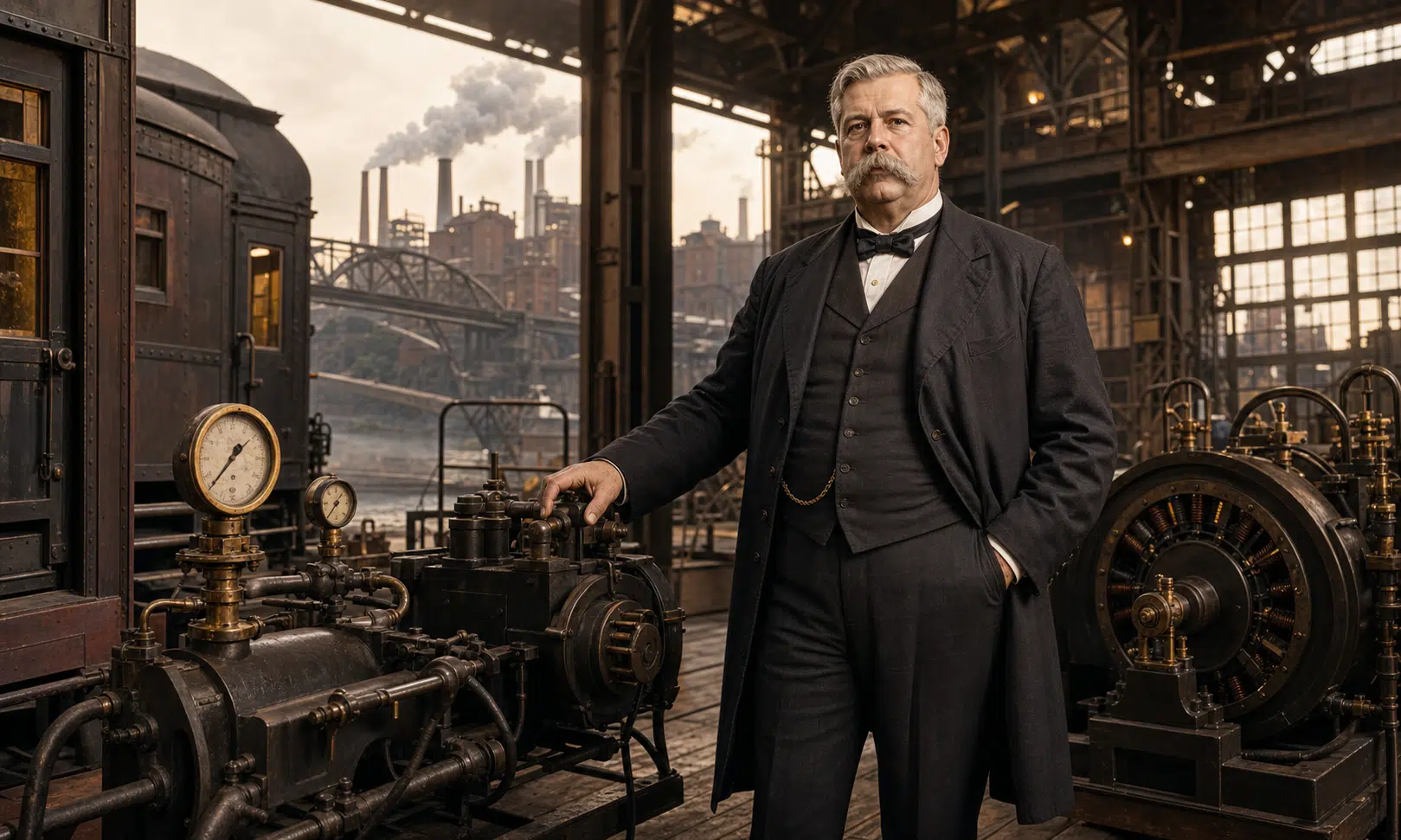

George Westinghouse is usually remembered, when he is remembered at all, as Thomas Edison’s rival in the war between alternating current and direct current. That is too narrow. Westinghouse was not merely the man who helped AC power win. He was an inventor, a systems thinker, a company builder, and an industrial leader whose work touched railroads, natural gas, electric power, signaling, manufacturing, and public safety.
For readers weighing what kind of business biography is worth their time, Westinghouse is a useful case because his story is not just about invention. It is about turning inventions into durable institutions. Edison became the more famous public figure. Nikola Tesla became the more mythologized genius. Westinghouse, by contrast, built companies that employed thousands, sold complex equipment around the world, and helped make large technical systems safer and more useful.
The practical verdict is simple: Westinghouse is one of the best examples in American business history of a founder who combined technical imagination with operational leadership. He was demanding, restless, and at times financially overextended, but he also appears to have taken unusually seriously the welfare of workers, customers, and the public.
Who This Story Is For
This is not only a story for readers interested in old machines, patent disputes, or the Current Wars. It is most useful for founders, engineers, operators, investors, and managers who want to understand how technical judgment becomes commercial judgment.
Westinghouse’s career shows several recurring business questions in concrete form:
- How do you sell a system that requires customers to change expensive existing infrastructure?
- When should a company defend patents, buy patents, or build around them?
- How much financial risk is justified when the market opportunity is enormous but the timing is uncertain?
- Can a hard-driving industrial company still treat workers with unusual decency?
- What happens when a founder’s ambition outruns the balance sheet?
Those questions make Westinghouse more than a historical figure. His life is a buyer-decision case study for anyone choosing between biographies of inventors, entrepreneurs, or industrial leaders. If you want a story about solitary genius, Tesla is the more obvious subject. If you want publicity, conflict, and invention as theater, Edison supplies plenty of material. If you want the tougher story of an inventor who repeatedly built companies around hard infrastructure problems, Westinghouse is the more useful study.

A Life of George Westinghouse
Henry G. Prout’s biography is a direct choice for readers who want a fuller account of Westinghouse’s inventions, companies, and industrial leadership. It is best suited to readers who want a historically focused biography rather than a lighter popular narrative.
As an Amazon Associate I earn from qualifying purchases.
Early Life: A Mechanic Before He Was a Magnate
George Westinghouse Jr. was born in Central Bridge, New York, on October 6, 1846. His father, George Westinghouse Sr., had worked as a farmer before building a business around machinery, including improvements to threshing equipment. The family eventually moved to Schenectady, where proximity to iron suppliers and industrial activity gave the elder Westinghouse better footing for his machine shop.
The younger George did not fit neatly into the role his father expected. He was mechanically curious, stubborn, and impatient with routine instruction. School did not seem to interest him much unless it involved drawing, mathematics, or machines. The standard classroom work of penmanship, spelling, and grammar held little appeal. Locomotives, engines, and practical mechanical problems did.
Accounts of his childhood often emphasize two traits that remained visible throughout his life: he knew what he wanted, and he preferred making something work to talking about it. A minister reportedly advised his father that the boy could not be shaped against his will. Whether or not that line captures the whole family dynamic, it describes the adult Westinghouse well. He could be persuaded by evidence, but he was not easily moved by consensus.
His father’s machine shop became the real school. While other young workers might follow assigned tasks, Westinghouse drifted toward his own devices and experiments. A sympathetic foreman reportedly helped him create a small private workspace where he could tinker. That early freedom mattered. Westinghouse’s later career was built on the habit of looking at a piece of machinery, asking why it failed, and refusing to accept the answer that this was simply how things were done.
As the Civil War began, some accounts say friends and older brothers were drawn toward service despite family hesitation. What is clearer is that Westinghouse himself eventually served. He joined the Union war effort as a teenager, first in the army and later in the navy, where he worked with engines as an acting assistant engineer. That experience gave him disciplined exposure to steam machinery and operating systems under pressure.
After the war, he briefly attended Union College in Schenectady. The fit was poor. He preferred nearby shops and working machinery to formal classes, and he left quickly. In 1865, while still a teenager, he received his first patent, for a rotary steam engine. Some biographies credit him with more than 400 patents over his life and say he was still sketching new ideas near the end, though the exact framing of those late projects is best treated cautiously rather than as a settled headline claim.
The First Pattern: Seeing a Dangerous System and Rebuilding It
Westinghouse’s early business career began with railroads, the most important industrial network in nineteenth-century America. Railroads were not merely transportation companies. They were the operating system of the national economy, connecting raw materials, factories, farms, ports, cities, and capital markets.
One of Westinghouse’s early opportunities came after seeing a derailed railcar handled inefficiently. He developed a car replacer, a device intended to help put derailed cars back on track more effectively. He raised money, patented the idea, and began selling into the railroad industry.
The device itself was important, but the larger lesson was more important. Railroads gave Westinghouse a market full of expensive, dangerous, imperfect systems. They also gave him demanding customers. A railroad would not buy a novelty because it was clever. It had to reduce delay, improve safety, protect cargo, or increase capacity.
He followed with improvements to railroad frogs, the track components that help trains move from one line to another. Cast iron parts were prone to wear and failure. Westinghouse saw room for better materials and better design, and he moved into cast steel alternatives.
This was the beginning of a pattern that would repeat throughout his career. Westinghouse rarely chased small conveniences. He looked for bottlenecks in large systems. He wanted the part that, if improved, would make the whole network safer, faster, cheaper, or more scalable.
The Air Brake: Westinghouse’s First Great Industrial Breakthrough
The air brake made Westinghouse famous and wealthy because it solved a brutal railroad problem.
Before reliable automatic braking, stopping a train required brakemen to move across or between cars and manually set brakes. The job was dangerous in ordinary conditions and deadly in bad ones. Trains were shorter than they otherwise could have been, stops were rough, and passengers and freight were thrown around as cars bumped and compressed unevenly.
Westinghouse tried several approaches before arriving at compressed air. Chain-based systems failed. Steam did not travel the length of a train effectively enough to solve the problem. The breakthrough came from applying compressed air through a line running the length of the train, with reservoirs and controls on individual cars.
The commercial challenge was at least as hard as the engineering one. Railroads had existing equipment, habits, and capital plans. Installing air brakes meant modifying locomotives and cars, training workers, and coordinating across a network where cars moved among different railroads. Even a superior safety system could be rejected if adoption was too disruptive.
Westinghouse had to demonstrate not just that the device worked, but that the system worked. That distinction is critical. A brake on one car was a product. A braking system across an entire train was infrastructure.
The Pennsylvania Railroad eventually gave the technology a serious test. Its adoption helped validate the system and opened the door to wider acceptance. In 1869, Westinghouse received a patent for his air brake system and formed the Westinghouse Air Brake Company. He was only in his early twenties.
The impact was immense. Air brakes improved safety, allowed longer trains, reduced damage to freight, and made railroad operations more controllable. Westinghouse did not merely sell equipment. He helped change what railroads could do.
The business also made him rich and gave him a base from which to build. What later became Wabtec traces part of its heritage to the Westinghouse Air Brake business, a reminder that some of his industrial work did not simply disappear into history.
| Problem | Westinghouse Response | Business Lesson |
|---|---|---|
| Manual railroad braking was dangerous and limited train operations. | Compressed-air braking system with controls across the train. | The best industrial products often improve the performance of an entire network. |
| Railroads resisted costly systemwide adoption. | Demonstrations, testing, and persistence with major customers. | Infrastructure buyers need proof, not enthusiasm. |
| Competitors and customers worked around patents. | Westinghouse defended patents and bought useful ones. | Patent strategy matters when a market is built around technical standards. |
Marriage, Partnership, and a Wider Ambition
In 1867, Westinghouse married Marguerite Erskine Walker. Their marriage lasted until his death, and biographical accounts consistently describe it as close and affectionate. They had one son, George Westinghouse III.
As his businesses grew, Westinghouse became wealthy, mobile, and increasingly prominent. Yet he was not primarily a social industrialist. He did not appear to enjoy public speaking or personal celebrity. He preferred shops, drawings, engineering discussions, and practical problems.
That preference shaped his leadership. He hired talented engineers, worked closely with them, pressed them hard, and often remained technically involved even as his organizations grew large. He was not a founder who escaped the details. He lived in them.
That could be a strength and a risk. His technical intuition allowed him to push past conventional limits. It also meant he could ask engineers and financiers to follow him into projects that looked too large, too early, or too expensive.
Switches, Signals, and the Move Toward Electricity
By the early 1880s, Westinghouse had moved beyond brakes into railroad switching and signaling. These were natural extensions of his earlier work. If brakes made trains safer in motion, switches and signals made rail networks safer and more efficient as systems.
In 1881, he incorporated the Union Switch & Signal Company, which became a major producer of railroad control equipment. The business also pulled him deeper into electrical technology. Signals and control systems required him to understand circuits, power, reliability, and the practical use of electricity in industrial environments.
That mattered because Westinghouse did not enter the electric business as a parlor inventor. He came to it through infrastructure. Electricity, to him, was not only about lighting homes. It was about powering factories, controlling rail systems, and building networks that could scale.
This helps explain why he later understood alternating current so clearly. Direct current could light nearby buildings, but it struggled over distance. Alternating current, with transformers that could raise and lower voltage, pointed toward a larger system. Westinghouse was already trained to think in those terms.
Natural Gas: Another Network Problem
Westinghouse’s work in natural gas followed the same logic. In the 1880s, natural gas discoveries near Pittsburgh created an opportunity, but the gas had to be transported over meaningful distances. Local gas systems existed, but long-distance transmission was a technical and legal challenge.
Westinghouse became interested in moving gas under pressure through pipelines. He even drilled on his own Pittsburgh property, Solitude, a name reportedly chosen by Marguerite as a hoped-for retreat from work. It did not remain quiet. The gas work became another business project.
He helped build a system for bringing natural gas into Pittsburgh, using a corporate vehicle called The Philadelphia Company. The name was geographically misleading, but the business became important in supplying Pittsburgh with gas. The cleaner and cheaper fuel was attractive to homes and industry in a coal-heavy city.
Again, the pattern is visible. Westinghouse identified a resource, saw that existing distribution systems were inadequate, and built a company around the transmission problem. His instinct was not only to invent a device. It was to organize capital, law, engineering, and labor around a system.
The Current Wars: Why Westinghouse Backed AC
The most famous chapter in Westinghouse’s career was the conflict between Edison’s direct current systems and the alternating current systems backed by Westinghouse and associated with Tesla.
Edison’s direct current system had real achievements. It powered incandescent lighting and helped show the public what electric service could mean. But DC had a severe limitation: it was difficult and expensive to transmit over long distances. Generating stations had to be close to the customers they served, and serving larger areas required heavy investment in copper and local infrastructure.
Alternating current offered a different model. With transformers, voltage could be stepped up for transmission and stepped down for use. That made longer-distance power distribution more practical. It also raised safety concerns, especially at high voltage, and many respected experts doubted whether AC could be made reliable and commercially acceptable.
Westinghouse saw the system advantage. He studied the European work on AC, hired and supported talented engineers, and bought Tesla’s AC patents. Tesla’s ideas were important, but Westinghouse’s role was different. He turned AC from a technical possibility into a commercial and industrial project.
The fight was ugly. Edison and his allies attacked AC as dangerous. Public demonstrations and the politics of electrocution became part of the campaign. Edison’s side tried to associate AC with death and Westinghouse with recklessness.
Westinghouse had to answer on several fronts at once: engineering, public trust, patents, manufacturing, and sales. He also had to compete with Edison-controlled lighting patents, forcing his company to develop alternatives.
The eventual victory of AC was not magic. It came through iteration, manufacturing, customer installations, and the practical superiority of long-distance transmission. Westinghouse understood that the winning system would be the one that could serve cities, factories, and regions economically.
Westinghouse Versus Edison: A Practical Comparison
Comparing Westinghouse and Edison can easily become simplistic. Edison was not merely a showman, and Westinghouse was not merely an operator. Both were inventive, ambitious, and commercially aggressive. But their strengths differed.
Edison was extraordinary at publicity, laboratory organization, and products that captured the public imagination. The phonograph, motion pictures, and incandescent lighting made him a household name. Westinghouse was less interested in fame and more interested in the heavy systems beneath daily life.
| Dimension | Thomas Edison | George Westinghouse |
|---|---|---|
| Public image | Celebrity inventor and public-facing genius. | Reluctant public figure and industrial builder. |
| Best-known arena | Lighting, recorded sound, motion pictures, laboratory invention. | Rail safety, AC power, natural gas, industrial systems. |
| Business style | Strong patent position and publicity-driven competition. | Systems selling, company building, global industrial expansion. |
| Core technical instinct | Products that made electricity visible to consumers. | Infrastructure that made power and transport scalable. |
For a reader deciding which figure to study, the distinction matters. Edison is valuable for understanding invention, branding, and the commercialization of new consumer-facing technologies. Westinghouse is more valuable for understanding how technical infrastructure becomes a business platform.
The 1893 Chicago World’s Fair: AC Becomes Public Theater
The World’s Columbian Exposition in Chicago gave Westinghouse one of the most important showcases of his career. The fair was designed as a spectacular public event, a White City of architecture, engineering, and display. Lighting it became a national demonstration of electrical capability.
Westinghouse underbid the Edison-linked competition and supplied an enormous lighting system. The effect was dramatic. Millions of visitors saw electric illumination at a scale far beyond ordinary city experience. At a time when most American homes still did not have electric service, the fair made electricity feel not experimental but inevitable.
This was publicity, but it was publicity grounded in performance. The lights had to work. The machines had to run. Visitors did not need a technical lecture on AC transmission to understand that they were seeing a new world.
For Westinghouse, the fair did two things. It raised his public standing, and it strengthened confidence in AC systems. The Current Wars were not won by argument alone. They were won by installations people could see, use, and trust.
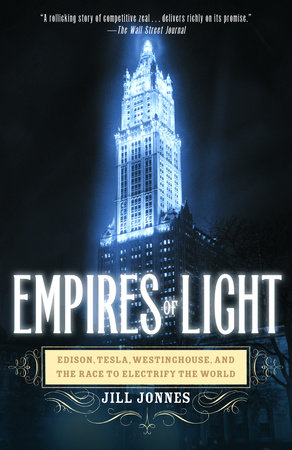
Empires of Light
Jill Jonnes’s Empires of Light gives readers the wider Edison-Tesla-Westinghouse story behind AC power, public spectacle, patents, finance, and Niagara. It is a useful companion for readers who want the competitive landscape around Westinghouse, not only his individual biography.
As an Amazon Associate I earn from qualifying purchases.
Niagara Falls: The System Proves Itself
If the Chicago fair showed the public the drama of electric light, Niagara showed the industrial value of electric power.
For decades, engineers and investors had imagined harnessing Niagara Falls. The challenge was not simply generating power. It was generating power at unprecedented scale, preserving the natural site, and transmitting electricity to customers at a distance. Buffalo, about 26 miles away, was a major target market.
Westinghouse and Tesla’s AC system fit the need. Westinghouse equipment was chosen for the project, and his engineers built generators at a scale that pushed beyond earlier experience. The Niagara project began producing power in the 1890s and helped prove that large-scale hydroelectric generation and long-distance AC transmission could support industrial demand.
The result was bigger than a successful contract. Cheap electric power attracted heavy users and helped redefine what industrial geography could look like. Factories no longer needed to sit directly beside every power source in the same old way. Power could travel.
That is why Niagara may matter more than the Chicago fair in judging Westinghouse’s legacy. The fair was a spectacle. Niagara was infrastructure.
Worker Treatment and Servant Leadership
Westinghouse was no soft manager. He expected speed, excellence, and persistence. He pressed engineers to solve problems other experts considered impossible. He could be immovable when convinced he was right.
Yet many accounts of his companies emphasize that he treated workers better than was common among large industrial employers of his time. He paid comparatively well, supported safety measures, offered benefits, and helped popularize the Saturday half-day. He also worked near the shop floor and seems to have taken pride in building stable employment.
This is where the phrase servant leader fits better than it does in many modern business profiles. Westinghouse did not merely talk about mission. His products were often public-safety or public-infrastructure products: brakes that saved lives, systems that transmitted power, gas networks that changed fuel use, signals that improved rail operations.
His leadership still had the contradictions of the age. He built large industrial firms, depended on patents, fought hard commercially, and took large financial risks. But he does not fit the simplest robber-baron stereotype. He appears to have believed that a company could serve customers, workers, and society while still pursuing ambitious growth.
That belief did not always protect him from financial strain. In fact, it may have contributed to it. Paying workers well, expanding internationally, funding experiments, and growing heavy manufacturing businesses all required cash.
The Financial Weakness: Growth Needed More Capital Than Control Allowed
Westinghouse’s greatest strength as a founder was also a source of vulnerability. He wanted control. He trusted his judgment. He believed deeply in the future of his companies. Those traits helped him push through resistance, but they made financial compromise painful.
In 1890, the collapse of Baring Brothers contributed to a wider credit crisis. Westinghouse Electric was growing quickly and needed cash. Like other companies in the young electric industry, it had accepted securities from customers and power companies, which left it exposed when credit tightened.
Westinghouse fought to keep banker control at bay. His workers reportedly offered sacrifices during the crisis, and Tesla agreed to release the company from future royalty obligations on AC patents. The company survived and continued to grow.
The deeper problem remained. Heavy infrastructure companies require capital before customers fully arrive. Factories, inventory, engineering, overseas expansion, and customer financing all consume money. If a founder wants rapid growth and tight control at the same time, the balance sheet eventually becomes the battlefield.
The crisis of 1907 was more damaging. A severe financial panic dried up credit, and Westinghouse Electric was again exposed. The company entered receivership, and Westinghouse lost control of the business most closely associated with his name.
Bankers criticized his spending on expansion, experimentation, and labor costs. Some of that criticism may have reflected real financial strain; some may have reflected the usual discomfort financiers have with founders who prioritize long-term technical bets. Either way, the outcome was clear. Westinghouse lost his electric company.
For a modern reader, this is one of the most important parts of the story. Vision can be correct and still be undercapitalized. A founder can be right about the future and still lose control before the future arrives.
What Happened to the Companies
Westinghouse’s companies did not remain in their original forms. Few nineteenth-century industrial empires did.
The air brake business became part of the lineage associated with Wabtec. Union Switch & Signal eventually became part of later rail and signaling industry combinations. The Philadelphia Company’s legacy is tied to the natural gas business in western Pennsylvania. Westinghouse Electric continued long after George Westinghouse lost control, becoming a major name in power generation, appliances, broadcasting, elevators, escalators, and nuclear technology.
In the late twentieth century, the original Westinghouse Electric Corporation changed dramatically. It moved into broadcasting, bought CBS, and eventually left much of its old industrial identity behind. The Westinghouse name and related businesses moved through later ownership structures and licensing arrangements.
Those corporate changes can make the legacy confusing. The simplest way to understand it is this: the original Westinghouse enterprises were broken apart, sold, merged, renamed, or absorbed, but the technical and organizational influence spread widely. Rail braking, electrical power, broadcast history, nuclear power, and industrial equipment all carry pieces of that inheritance.
The Man Behind the Machines
Westinghouse had few famous hobbies. Work appears to have been his consuming interest from youth until death. That narrowness can sound bleak, but in his case it produced an unusual concentration of effort. He kept returning to invention, drawing, testing, hiring, financing, and building.
He was also, by most accounts, personally amiable. He did not seek the spotlight the way Edison did. He avoided speeches when possible. He liked people, but he did not turn himself into a public brand.
His style was direct and practical. Once convinced, he moved. If experts said something could not be done, he often treated that as a temporary condition rather than a conclusion. Still, he was not incapable of changing course. His career shows repeated iteration. The air brake did not arrive fully formed. AC power required engineering refinement. Gas transmission required experiments, legal maneuvering, and business construction.
Westinghouse died in March 1914 at age 67. Marguerite died a few months later. By then he had already lost control of his most famous company, but not his reputation among those who understood the scale of his work.
Verdict: Why Westinghouse Still Matters
George Westinghouse is worth studying because he represents a kind of builder who is easy to underrate. He did not simply invent clever things. He built operating systems for the industrial world.
His air brake made railroads safer and more scalable. His work in switching and signaling improved control of rail networks. His natural gas efforts helped move fuel across distance. His backing of AC power helped make long-distance electrical transmission practical. His role at Chicago and Niagara helped move electricity from marvel to infrastructure.
For readers choosing a business-history subject, Westinghouse is especially strong on three dimensions:
- He shows how invention becomes a company only when engineering, sales, capital, and customer adoption align.
- He shows how infrastructure markets differ from consumer markets because adoption requires system-level trust.
- He shows the danger of building faster than financing can support, even when the underlying idea is right.
The most useful lesson is not that Westinghouse was a flawless genius. He was not. He could be stubborn, financially aggressive, and unwilling to surrender control until events forced the issue. But he had an unusually productive instinct for finding the pressure points in modern life.
When a train needed to stop safely, he saw the whole train. When a city needed fuel, he saw the transmission network. When factories needed power, he saw generation, transformers, distance, and demand. When workers built his machines, he seems to have seen them as people whose loyalty and dignity mattered.
That combination made him one of America’s great industrial originals: less famous than Edison, less mythologized than Tesla, but in many ways more useful to understand.