

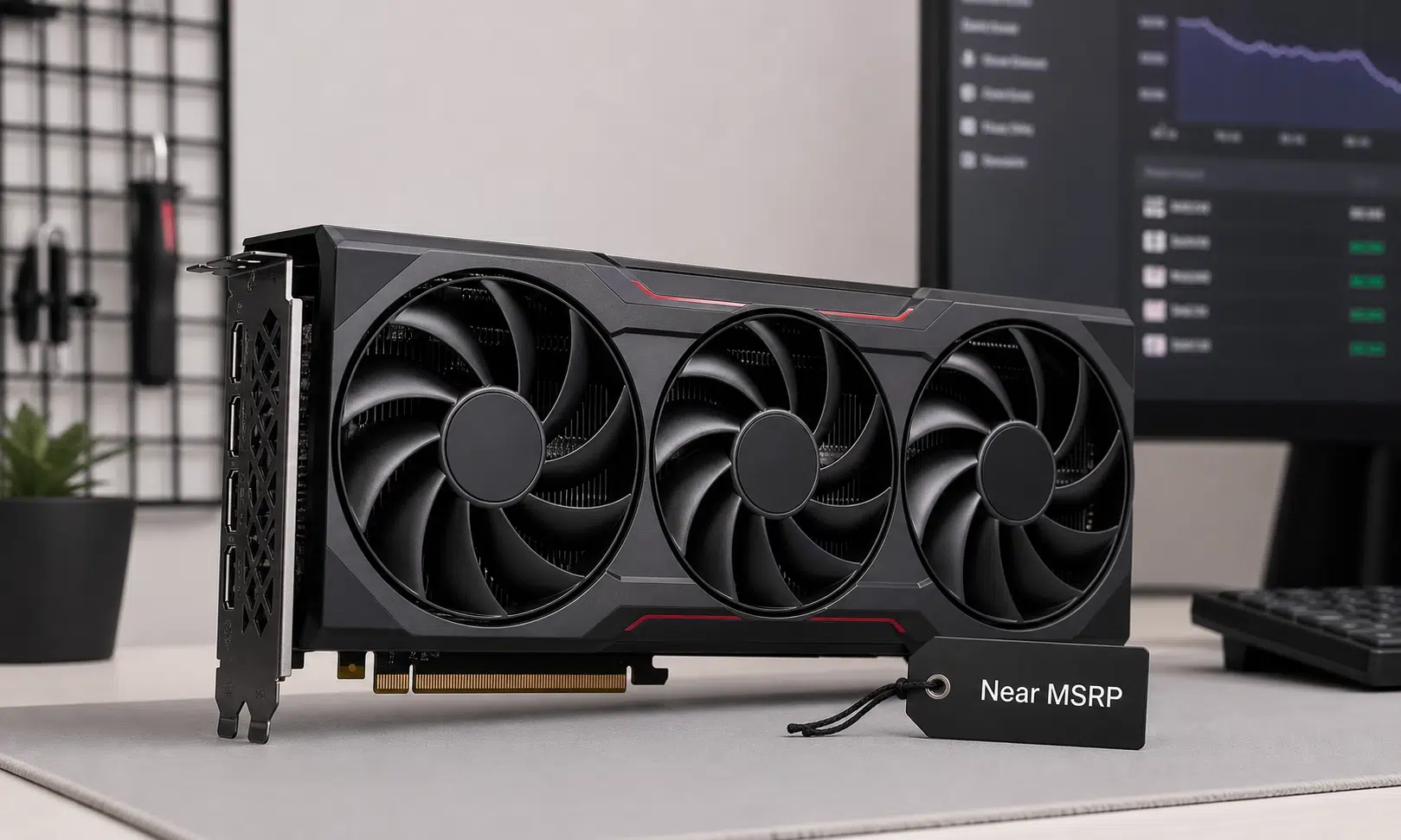

PowerColor’s Radeon RX 9070 Hellhound briefly appeared on Amazon at $554.03, putting the non-XT RDNA 4 card within a few dollars of AMD’s original $549 launch MSRP.
The offer did not last long. The listing was reported as expired shortly after it was spotted, which makes it less useful as a standing recommendation and more useful as a pricing signal for buyers watching the RX 9070 market.
RX 9070 pricing moves back toward MSRP
The PowerColor Hellhound RX 9070 listing was shown at $554.03, down from a previously listed $719.99 price. At that level, the card sat only about $5 above AMD’s original MSRP for the Radeon RX 9070 non-XT.

PowerColor Hellhound Radeon RX 9070 16GB
Use this as a current-price check for the PowerColor Hellhound RX 9070 rather than assuming the expired Amazon price is still available. Confirm seller, shipping source, and return terms before buying.
As an Amazon Associate I earn from qualifying purchases.
The listing applied to the PowerColor Hellhound model with 16GB of GDDR6 memory. Reports also described it as one of the lowest active RX 9070 prices in the US at the time, though that specific market ranking has not been independently verified here and should be treated as a snapshot rather than a permanent claim.
That distinction matters because GPU prices can move quickly, especially on Amazon. A card can appear near MSRP, sell through, then return at a higher price through a different seller or storefront within hours. Buyers comparing RX 9070 models should still check seller identity, shipping source, return policy, and whether the listing is for the exact model shown.
Why this short-lived RX 9070 deal matters
The RX 9070 has not produced many sustained near-MSRP offers in recent months. Earlier price cuts for the non-XT model have been reported, including a previously noted ASRock Challenger RX 9070 offer at $509.99 through Newegg, but that historical price has not been independently verified here and should not be treated as a current benchmark.
The cleaner takeaway is that a mainstream board partner card briefly returned close to AMD’s launch target. For buyers who have been waiting for non-XT RDNA 4 pricing to settle, that is worth watching even if this specific Amazon offer is gone.
A near-MSRP RX 9070 can make more sense when it is priced clearly below the faster XT models and when it avoids inflated launch-window pricing. The buyer calculation is simple: if the RX 9070 is only a small step below an RX 9070 XT, it may lose appeal. If it returns to the mid-$500 range, the non-XT card becomes easier to justify for 1440p-focused builds.
| Item | Reported detail |
|---|---|
| Graphics card | PowerColor Radeon RX 9070 Hellhound |
| Memory | 16GB GDDR6 |
| Reported Amazon price | $554.03 |
| AMD launch MSRP | $549 |
| Status | Reported expired shortly after appearing |
What buyers should check before chasing the next listing
Because this offer expired quickly, the useful part is the pattern, not the individual listing. If another RX 9070 appears near the same price, buyers should compare it against both the RX 9070 XT and competing GeForce options available at that moment.
A few checks are especially important when a listing drops sharply below its recent price:
- Confirm the seller is reputable and the card ships from a trusted channel.
- Make sure the listing is for a new card, not used, open-box, or marketplace stock with unclear warranty terms.
- Compare the final checkout price, including taxes and shipping, against other RX 9070 and RX 9070 XT listings.
- Check whether the same model is available from another retailer with a stronger return policy.

PowerColor Hellhound Radeon RX 9070 XT 16GB
Before buying a discounted RX 9070, check how close the price is to an RX 9070 XT. If the gap is small, the faster XT model may be the better value.
As an Amazon Associate I earn from qualifying purchases.
For shoppers who missed the PowerColor listing, the practical move is to set a target price rather than chase every temporary dip. Around MSRP, the RX 9070 becomes a more credible option. Well above MSRP, it needs a much stronger case against faster or similarly priced alternatives.
Other hardware notes from the same report
The source material also included separate hardware items unrelated to the RX 9070 deal, including reports of fake DDR5 SO-DIMM modules appearing through Japanese second-hand marketplaces and reservation-code references tied to Valve hardware packages.
The DDR5 warning centered on laptop memory modules that appeared normal at first glance but were later shown with dummy chip material instead of functional DRAM. The report said the issue was easier to spot on SO-DIMM modules because the chips are exposed, while desktop DDR5 kits can be harder to inspect when heatspreaders cover the PCB.
That part of the report is a useful reminder for used-memory buyers: avoid untested DDR5 kits when possible, compare the PCB and package layout with verified product photos, and be cautious with listings that do not show clear close-up images of the module.
The Valve item concerned code references to four Steam Machine package IDs in a reservation-system update. Those references were described as possible preparation for future hardware reservations, but pricing and package details were not announced in the source material. The reported interpretation was that the package IDs could correspond to storage options and controller bundles, but that remains speculative.
For the RX 9070, the bottom line is narrower and more practical: the PowerColor Hellhound listing briefly put a custom Radeon RX 9070 very close to AMD’s intended price. It expired quickly, but it gives buyers one more data point to watch as non-XT RDNA 4 pricing continues to move.