

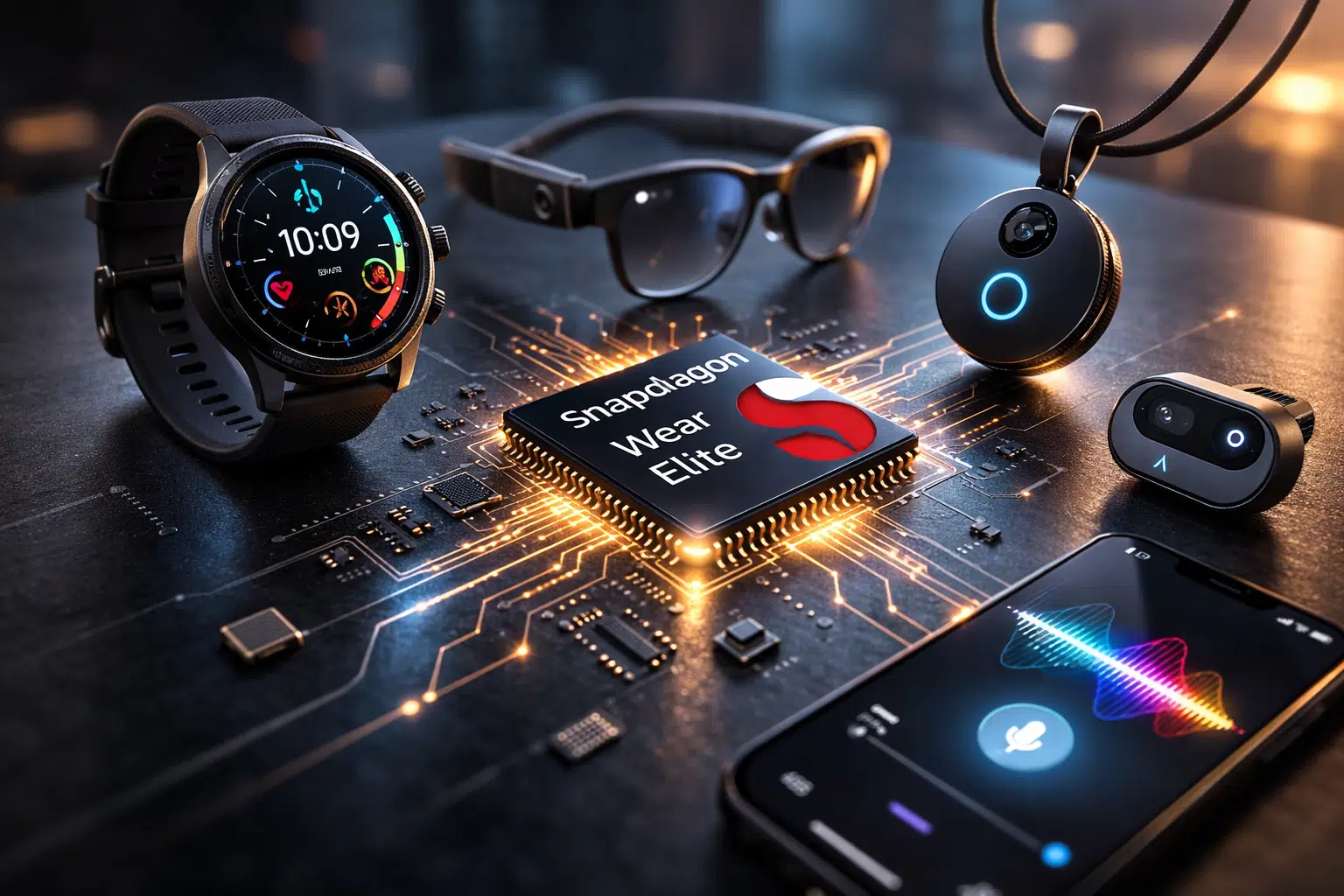

“Wearables” is starting to feel like one of those tech words that means everything and nothing. Smartwatches, rings, glasses, exoskeletons, lapel pins, pendants—if it attaches to your body, somebody will try to call it a wearable. Qualcomm is leaning into that ambiguity with its newest platform: Snapdragon Wear Elite, a chip meant for more than just watches.
Announced around MWC 2026 in Barcelona, Snapdragon Wear Elite is positioned as a “wrist plus” option—something that can live alongside Qualcomm’s existing smartwatch-focused silicon rather than simply replacing it. The pitch is clear: the next wave of AI gadgets may not look like a watch at all.

TicWatch Pro 5 Android Smartwatch
A Wear OS smartwatch built on Qualcomm’s Snapdragon Wear platform, with a focus on battery life and everyday fitness tracking.
Check Price on AmazonA 3nm wearable chip that’s basically an AI bet
Wear Elite is built on a 3nm process, and it’s designed around two different AI paths: Qualcomm’s Hexagon NPU for heavier on-device inference, plus an ultra-low-power eNPU “island” for always-on tasks like keyword detection and lightweight context sensing.
Qualcomm is also claiming a big performance jump versus the Snapdragon W5 Gen 2 family: up to 5× single-core CPU performance and up to 7× graphics improvements. That kind of uplift should matter for the boring stuff—app launch times, UI responsiveness, and anything that makes a watch feel less like it’s thinking about your request and more like it’s doing it.
The headline spec: “2B parameters on-device”
The most provocative claim is that Wear Elite can run an on-device model of up to 2 billion parameters, with Qualcomm also floating figures like up to 10 tokens per second in some briefings and coverage. In practical terms, that’s enough to run a small conversational model locally—at least for constrained prompts, short outputs, and tightly managed workloads.
For scale, Google’s Gemma 3 family includes a 270M-parameter variant. That doesn’t mean Gemma will run on this chip as-is (deployment is a whole different problem), but it shows how Qualcomm wants you to think about the tier of model it’s targeting.
Cameras, “AI vision,” and the always-online problem
Wear Elite also supports 1080p video at 60fps, which Qualcomm and partners are clearly framing as “AI vision ready.” The awkward reality is that a lot of the most compelling vision features still lean on the cloud—either because the model is too heavy, the context needs constant updating, or the product needs a safety net when the on-device inference gets shaky.
That “always connected” requirement is also where a bunch of AI wearables have faceplanted before. If your gadget needs reliable 5G or Wi-Fi to feel smart, it starts behaving less like a wearable and more like a liability you’re paying to babysit.

Ray-Ban Meta (Gen 2) Wayfarer Large Smart Glasses
Smart glasses that blend camera capture and audio features into a familiar frame—an example of the form factor Qualcomm expects to keep evolving.
Check Price on AmazonQualcomm wants pins, pendants, and whatever comes next
Qualcomm execs have been talking up a future where “wearable” means a lot more than “watch,” and where the killer form factor hasn’t been invented yet. The company’s message is basically: stop arguing about whether an AI pin is cringe, because the supply chain is already preparing for a post-watch wearable category.
That’s not a theoretical conversation. We’ve already seen prototypes and pitches that range from glasses to headsets to neck-worn cameras—and many of them are still trying to solve the same basic problem: why a person would want a camera and a microphone pointed outward all day.
The Humane problem isn’t just the chip
If this all sounds familiar, it’s because the AI-wearable boom has already produced some high-profile disasters. Humane’s AI Pin became a case study in what happens when you ship a product that’s dependent on connectivity, runs hot doing basic tasks, and doesn’t deliver a clear daily-use win—before the company ultimately sold assets to HP and wound down the pin business.
Qualcomm’s bet is that better efficiency, better on-device inference, and a more flexible platform will help device makers avoid those traps. But chips don’t create product-market fit. A wearable AI gadget still has to answer the question that killed the last few attempts: what is this for, exactly, beyond a demo?
Altman’s comments on OpenAI’s Pentagon deal
Claude’s App Store surge amid the Pentagon dispute
Qualcomm’s Ventana acquisition and its CPU ambitions