
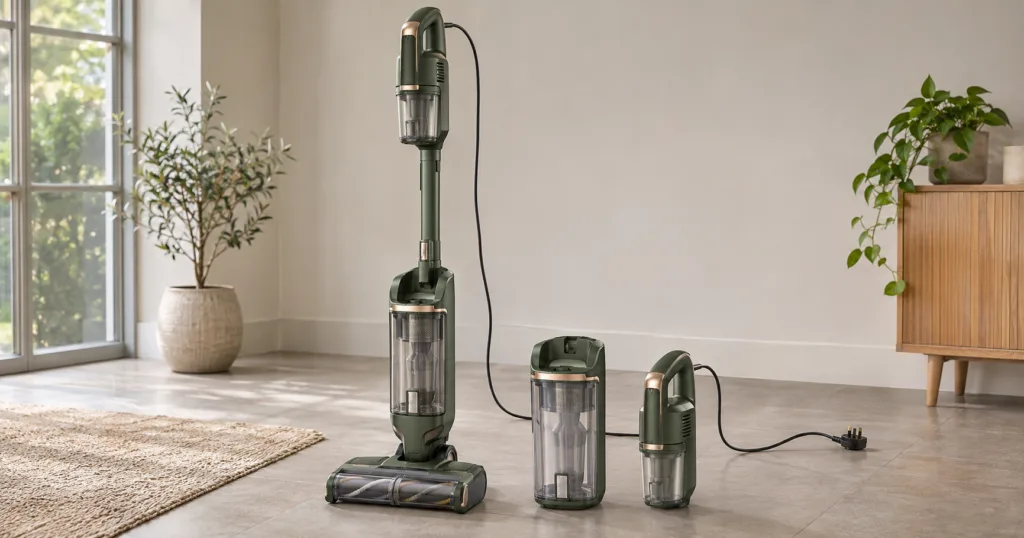
Reviewer Josh Russell reported single-pass pickup of loose tea and hard-floor lentils with the Shark PowerDetect Transformer in findings published on November 8, 2026. His assessment also identified limitations: hair occasionally collected near the main cyclone chamber, and his sound readings reached 74 dB during upright use and 82 dB during the automatic emptying cycle.
SharkNinja launched the Transformer on June 30, 2026, describing it as a system that converts between upright, stick and handheld vacuums. The company’s design combines removable modules with a floorhead intended to respond automatically to dirt, floor surfaces, edges and cleaning direction.
The machine remains corded in all three configurations. Its smaller dust chamber can transfer collected debris into the main upright bin when the modules are reconnected, a feature Shark calls Auto-Empty. That transfer takes place inside the vacuum; the larger collection bin still needs to be emptied.
A modular design with three corded configurations
The Transformer changes its physical layout by removing sections of the upright assembly. Shark describes the upright configuration as the full-size option, the stick configuration as a lighter arrangement for floor cleaning and the handheld configuration as the option for stairs, upholstery and other surfaces above floor level.
In the upright arrangement, the main vacuum pod sits on the wand. Removing that pod leaves the stick vacuum with a separate, smaller dust chamber. Detaching the upper hand vacuum provides the third configuration. The system therefore changes both the amount of equipment being moved and the chamber used to collect debris.
Shark’s design removes the hose used on conventional upright vacuums for above-floor cleaning. The pod instead reconnects to the wand and airflow connection.
Russell described switching between the configurations by releasing and reconnecting the modules. He found the complete upright more physically demanding to move than the reduced stick and handheld arrangements.
For the Deep Sage Green UK model, LX5001UKT, Shark lists a complete-machine weight of 8.02 kg, close to the rounded 8 kg or 17.6 lb figure associated with the reviewed unit. The manufacturer also specifies an 8 m cable. Removing the pod reduces the equipment being carried; the complete-machine figure does not describe the weight of the reduced configurations.
As a corded vacuum cleaner in each configuration, the Transformer has no battery charging stage when changing modes. Its operating range depends on access to a power socket and the cable’s length.
Detection features adjust the floorhead
Shark’s PowerDetect system is advertised as responding to four cleaning conditions: the type of floor, the amount of dirt, proximity to edges and the direction in which the vacuum is moving.
Shark describes the intended roles of these controls as follows:
- Floor Detect identifies the floor type and adjusts brushroll speed.
- Dirt Detect identifies debris and increases cleaning power.
- Edge Detect senses edges and corners and increases suction power.
- Direction Detect responds to forward or reverse movement and directs suction accordingly.
The DuoClean Detect floorhead uses two brushrolls for carpets and hard floors. Shark says the arrangement is intended to collect dirt, debris and hair without requiring a different floorhead when moving between those surfaces. A self-cleaning brushroll is also intended to reduce hair wrapping around the roller.
Reveal lighting is a separate feature. Shark describes its LED illumination as a way to make otherwise difficult-to-see dust and debris more visible. The lighting makes debris visible, while the detection functions control the vacuum’s response to cleaning conditions.
Manual surface settings cover the following cleaning conditions:
- Hard floors.
- Carpet or low pile.
- Thicker carpet or rugs.
Russell said he generally left the vacuum to adjust automatically during household cleaning rather than changing those settings himself.
Reported pickup results and their limits
Russell said he tested the Transformer over several weeks, combining household cleaning with debris tests. Loose tea served as a fine-debris test, while lentils provided larger pieces to collect. He used hard flooring and carpet and also placed debris along room boundaries.
On laminate flooring, he reported collecting the scattered tea in one pass. He described the same result when repeating that test on medium-pile carpet.
The larger-debris test produced a different result on carpet. Russell reported that the vacuum collected all the lentils from the hard floor in one pass, but left three of roughly 50 lentils behind on carpet. He said a backward pass then collected the remaining pieces.
Russell associated the return pickup with the direction-sensitive cleaning system. His carpet result therefore required two passes, compared with one on the hard floor.
Along a room edge, Russell reported collecting the lentils he had placed against the baseboard in one sweep.
His pet-hair testing included a ball of shed cat fur and an upholstered chair. Russell said the powered pet attachment removed hair from the upholstery without hair wrapping around its brush bar during that test.
He nevertheless reported a separate problem elsewhere in the airflow path. On several occasions, long hair became caught around the opening or airlock into the main pod and began collecting near the cyclone chamber. His account therefore distinguished brushroll tangles from blockages elsewhere in the machine.
Russell also used the handheld arrangement inside a sofa and on a raised surface, and described the reduced assembly as easier to position for those tasks. These uses differed from the upright debris tests and did not provide a direct measurement of performance across the three configurations.
Dust transfer, filtration and noise
Shark describes Auto-Empty as a transfer from the smaller handheld dust cup into the main collection chamber when the pod is reattached after stick or handheld use. The company says this occurs within a sealed system.
The feature changes how debris moves between the vacuum’s chambers. The main bin still requires manual disposal. Russell described detaching that collection section and releasing its bottom catch over a waste bin to empty it.
His account also separates automatic dust transfer from ongoing maintenance. Hair caught near the connection to the main chamber remained a potential obstruction even though the smaller chamber could be emptied automatically.
For filtration, Shark lists HEPA filters and its Anti-Allergen Complete Seal system.
Shark also describes odor-neutralizing technology intended to control smells inside the vacuum. Russell referred to an adjustable cartridge in the floorhead. Odor control is a separate function from collecting particles and filtering the exhaust air.
Russell recorded sound levels with a sound-level meter and reported 74 dB during upright operation and 82 dB during the automatic emptying cycle. The higher number therefore refers to a different operating stage from ordinary floor cleaning.
The readings describe Russell’s testing. They do not provide a comparison with another vacuum measured under matching conditions.
UK specifications, accessories and historical pricing
Shark’s specifications for the Deep Sage Green UK model describe the complete machine. Regional versions sold under the Transformer name can have different specifications and package contents.
| Item | Detail |
|---|---|
| Configurations | Corded upright, stick and handheld |
| Complete-machine weight | 8.02 kg |
| Dimensions | 117.2 cm high × 30.61 cm wide × 28.5 cm long |
| Cable length | 8 m |
| Color | Deep Sage Green |
Shark lists the following accessories with that UK model:
- Crevice tool.
- Multi-surface tool.
- HairPro Pet Power Brush.
- Accessory bag.
The powered pet tool is intended for hair on upholstery and other soft furnishings. Russell also mentioned a stair tool and an anti-allergen dusting brush, but those items are absent from Shark’s standard contents list for the UK model above.
The two colors described for the range were Chimera Blue and Deep Sage Green. The UK listings identify them as LX5000UKT and LX5001UKT respectively.
The stated list prices in November 2026 were US$529.99, £499.99 and AU$699.99. These are historical list prices, which may differ from promotional or later checkout prices. SharkNinja’s June 30 launch announcement described the US starting price as $529.
SharkNinja named its own store and TikTok Shop as the initial US sales channels in June and said additional retailers would follow.
The maintenance schedule described by Russell called for monthly cleaning of the pre-motor filters in both chambers. He reported longer intervals for the post-motor filters:
- Hand vacuum: cleaning every six months and replacement every 2.5 years.
- Upright: cleaning annually and replacement every three years.
He also noted that the detection sensors could require occasional wiping. Those intervals describe the reviewed machine; maintenance requirements should follow the instructions supplied with the specific regional model.