


Power banks are everywhere, but the Solly stands out because it tries to combine several travel and emergency charging tools in one compact block. It is a 20,000-mAh portable battery with fast USB-C output, built-in outlet prongs, and a solar panel wrapped around the outside for backup recharging when wall power is not available.
That mix makes the Solly more interesting than a basic phone charger, especially for travelers, remote workers, campers, and anyone who already carries both a power bank and a travel adapter. The tradeoff is that it is still a crowdfunded product, so the specifications are promising, but buyers should treat the campaign with the usual caution.
A compact battery with laptop-level output
The Solly is built around a 20,000-mAh battery pack. According to the campaign materials, that is enough capacity to recharge an iPhone 17 Pro Max up to four times, though real-world results will vary depending on battery health, cable quality, device settings, and whether the phone is being used while charging.
The more useful detail for many buyers is the output. Solly includes two USB-C ports rated at up to 140 W, which puts it in the range needed for demanding devices such as laptops, gaming handhelds, tablets, and larger phones that can accept high-wattage charging. It also includes a USB-A port for older cables and accessories.
That port mix matters because many travel chargers force you to choose between fast modern USB-C and support for older gear. Solly appears to cover both, at least on paper, while keeping the overall device small enough for a bag or jacket pocket.
The company lists the dimensions at 3.15 x 2.36 x 1.38 inches, or 8 x 6 x 3.5 cm. The outlet prongs fold into the body, which should make the unit easier to pack without snagging on fabric or scratching other items in a tech pouch.
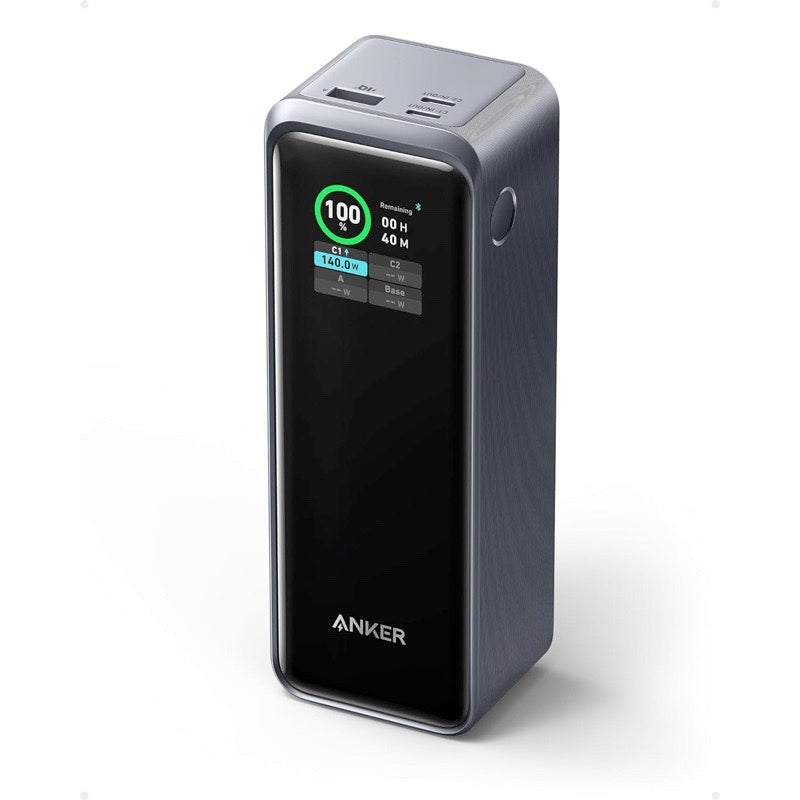
Anker Prime laptop-capable USB-C power bank
Readers who like Solly’s high-output USB-C idea but do not want to wait on crowdfunding may prefer a proven laptop-capable power bank. Look for enough wattage for your specific laptop and enough capacity for travel without exceeding airline battery limits.
As an Amazon Associate I earn from qualifying purchases.
Solar charging is useful, but not fast
The headline feature is the built-in solar panel. Instead of requiring a separate folding panel, Solly wraps solar charging hardware around the exterior of the power bank. The idea is simple: if you are away from an outlet, sunlight can slowly feed energy back into the battery.
Solly lists the solar recharge rate at 800 mAh per hour. That is not fast enough to treat sunlight as a full replacement for wall charging. A 20,000-mAh pack would need well over a full day of strong sun to refill from empty under ideal conditions, and real outdoor results can be affected by angle, shade, heat, clouds, and how consistently the panel is exposed.
For that reason, the solar panel is best understood as backup charging rather than primary charging. It could be useful on a long hike, at a campsite, during travel delays, or in an outage where even a partial top-up is valuable. It is less compelling if the plan is to drain the battery every day and expect the panel to fully recover it by sunset.
Solly also includes a protective layer intended to reduce scratching on the solar panel. That detail matters because a portable charger is likely to spend its life in bags, pockets, drawers, and travel kits, where exposed surfaces can take a lot of abuse.
Wall charging, pass-through use, and travel adapter features
When wall power is available, the Solly is designed to charge much faster than it does from sunlight. The company says the device can be fully charged from a wall outlet in 26 minutes. That claim will depend on the charger, outlet, thermal conditions, and the final shipping hardware, but it is a major part of the appeal if it holds up in production units.
The Solly can also work as a travel adapter. US, UK, and EU plugs are built into the product line, and the campaign mentions an optional accessory for compatibility with additional outlet types elsewhere. That makes the device more useful for international travel than a plain power bank, because it can reduce the number of separate charging blocks and adapters in a bag.
The device supports pass-through charging as well. In practice, that means it can be plugged into the wall while powering connected gear. Solly says this mode can send power to demanding devices such as workstation laptops or gaming handhelds without necessarily prioritizing the internal battery first.
For buyers, the practical value is consolidation. Instead of packing a power bank, a wall charger, a travel adapter, and a backup solar charger, Solly attempts to fold those roles into one unit. That is convenient, but it also creates a single point of failure. If the Solly is lost, damaged, or not delivered as expected, several charging functions disappear at once.
- 20,000-mAh listed battery capacity
- Two USB-C ports with up to 140-W output
- One USB-A port for older charging cables
- Built-in solar panel rated at 800 mAh per hour
- Foldaway travel plug design
- Pass-through charging support

EPICKA 70W GaN universal travel adapter
A standalone universal adapter can be the safer choice if you already own a good power bank. Check that your devices support dual voltage, since travel adapters typically do not convert voltage.
As an Amazon Associate I earn from qualifying purchases.
The battery chemistry claim deserves caution
Solly describes the internal battery as a solid-state design. In general, solid-state batteries use a solid electrolyte rather than the liquid electrolyte found in many conventional lithium-ion cells. That can be associated with safety and durability advantages, but the specific safety performance of this product has not been independently verified here.
The campaign says the battery should retain more than 80% of its performance and charge capacity over at least 3,500 cycles, which would be a strong figure for a compact consumer power bank if confirmed in real-world use. As with any crowdfunded hardware specification, buyers should treat cycle-life numbers as manufacturer claims until independent testing or customer units are available.
The exterior is also described as shock-proof and water-resistant. Those are useful claims for a travel charger, especially one meant to be used outdoors, but the exact protection level matters. A formal IP rating would be more informative than a broad water-resistance statement, particularly for anyone planning to use the device around rain, boats, beaches, or dusty trails.
The safer way to read the pitch is this: Solly is promising a more durable and travel-ready power bank than the average pocket charger, but buyers should wait for confirmed ratings and third-party testing if battery chemistry, water resistance, or impact protection are deciding factors.
Kickstarter price and delivery expectations
The Solly is currently being offered through Kickstarter, with early pricing listed from $79. The expected retail price is listed at $115. Three color options are mentioned, along with accessories such as a short USB-C cable that can double as a lanyard and a dock designed to charge five Solly units at once.
The campaign lists worldwide shipping with orders planned for August 2026 if production goes according to plan. Delivery costs are expected to be calculated later, which is worth noting because shipping can materially change the final cost of a crowdfunded gadget, especially for international backers.
As always, crowdfunding is not the same as buying an in-stock product from a retailer. Backers are supporting a project, and timelines can slip. Hardware can change before mass production. A new brand’s first product also carries extra uncertainty because there is less public history around manufacturing execution, customer support, warranty handling, and long-term reliability.
That does not make the Solly unappealing. It just means the buying decision should be based on risk tolerance as much as the feature list. For someone who wants a shipping product immediately, a conventional high-capacity USB-C power bank and a separate travel adapter may be the safer route. For someone willing to back a new design, the Solly offers an unusually dense combination of features.
Who the Solly makes the most sense for
The Solly is most compelling for people who value compactness and redundancy. Frequent travelers may like the built-in plugs. Outdoor users may appreciate the solar backup, provided they understand its limits. Laptop users may care most about the 140-W USB-C output. Emergency-preparedness buyers may see value in a battery that can accept wall power quickly but still gather some charge from sunlight when needed.
It is less ideal for anyone who needs guaranteed delivery by a specific date, verified safety certifications before purchase, or high-speed solar charging. The solar panel is a useful backup feature, not a replacement for a dedicated outdoor solar setup. The battery and durability claims are also worth revisiting once production units are available for independent testing.
Taken as a concept, Solly is a practical attempt to merge a fast power bank, travel adapter, and emergency solar charger into one pocketable device. The promise is convenience. The caveat is that the final product still has to prove itself outside the campaign page.
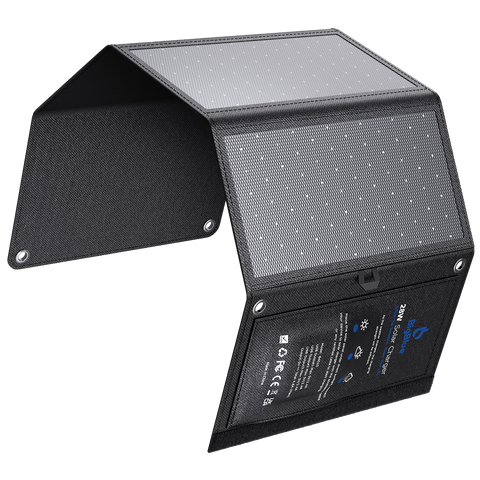
BigBlue 28W foldable solar charger
A foldable solar panel is less pocketable than an all-in-one power bank, but it gives outdoor users more surface area for daylight charging. Pair it with a battery pack instead of expecting solar to power devices continuously.
As an Amazon Associate I earn from qualifying purchases.