

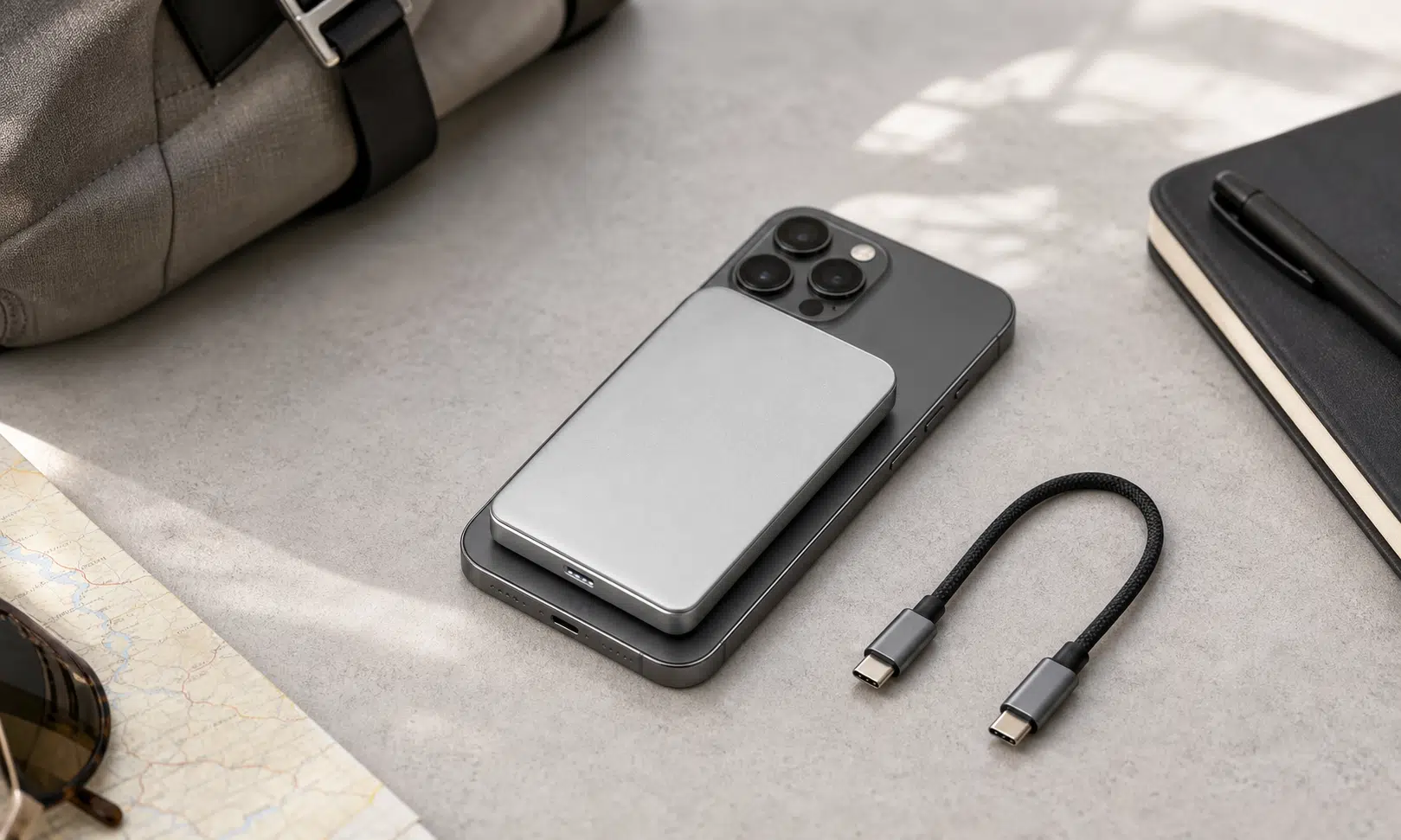

BMX is pitching its SolidSafe power bank lineup as a different kind of upgrade for portable charging: less emphasis on headline charging speeds, and more attention on the battery chemistry inside.
The company says the magnetic power banks use semi-solid-state battery cells, a design intended to reduce the amount of flammable liquid electrolyte used in conventional lithium-ion and lithium-polymer packs. BMX says that change is meant to improve thermal stability and reduce risks tied to overheating, swelling, and fire. Those safety claims should still be read as manufacturer claims unless independently tested model by model.
The lineup was first shown at CES 2026, according to BMX, and the company lists models starting at about $59. The products are aimed at phone users who want magnetic wireless charging in a compact battery pack, especially for travel or everyday carry.

Anker MagGo Qi2 Magnetic Power Bank
Anker’s MagGo Qi2 power bank is a practical comparison point for shoppers looking at magnetic wireless charging, USB-C charging, and a compact phone-friendly design. Check device compatibility and capacity needs before choosing between a slim 5,000mAh pack and a larger 10,000mAh option.
As an Amazon Associate I earn from qualifying purchases.
What BMX says is different
Most portable phone chargers compete on familiar specs: capacity, wired output, wireless output, size, weight, and price. BMX is trying to make battery chemistry part of that comparison.
Semi-solid-state batteries are not the same as fully solid-state batteries. In this case, BMX describes the cells as using significantly less liquid electrolyte than conventional power bank batteries. The company says that construction gives the packs better resistance to thermal stress and physical damage, though buyers should treat those claims as product-specific assertions rather than a universal guarantee.
The SolidSafe range includes 5,000mAh and 10,000mAh magnetic models with Qi2 wireless charging, USB-C charging, and aluminum bodies, according to BMX. The larger models also include practical add-ons such as a built-in USB-C lanyard cable, a color display for charging information, and support for up to 30W USB-C charging. BMX also describes one variant as adding a microSD card slot for onboard storage.
The slim model is the attention grabber
The most distinctive model in the lineup is the SolidSafe Air, a 5,000mAh magnetic power bank that BMX claims is the world’s thinnest semi-solid-state Qi2 power bank. The company lists it at 6.8mm thick, with an 18.5Wh battery, a titanium-reinforced body, 15W Qi2 wireless charging, and 20W USB-C wired charging.
That thin profile is central to how BMX is positioning the device. A magnetic power bank only works well as an everyday accessory if it does not make a phone awkward to hold or carry, and the SolidSafe Air appears designed around that problem. The tradeoff is familiar for slim 5,000mAh banks: it is meant more for topping up a phone than replacing a larger battery pack on longer trips.
Why it matters for buyers
The bigger point is not that one company has solved power bank safety. It is that portable chargers may be entering a phase where the cell design becomes part of the buying conversation, alongside wattage and capacity.
For now, BMX’s claims are strongest as a product positioning story: semi-solid-state cells, Qi2 magnets, compact bodies, and safety-focused messaging in a category that often looks interchangeable. Buyers interested in the SolidSafe line should still compare the basics, including capacity, wired output, wireless charging support, device compatibility, size, and price.
If the battery claims hold up in independent testing, the SolidSafe lineup could give phone owners another reason to look beyond the usual spec sheet. Until then, it is best understood as an early consumer push toward safer battery chemistry in everyday charging accessories.