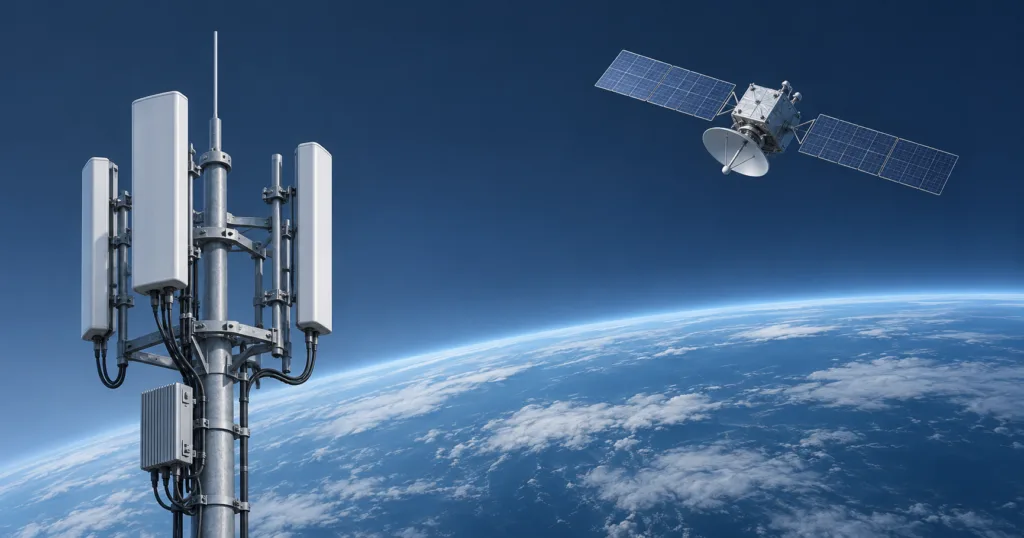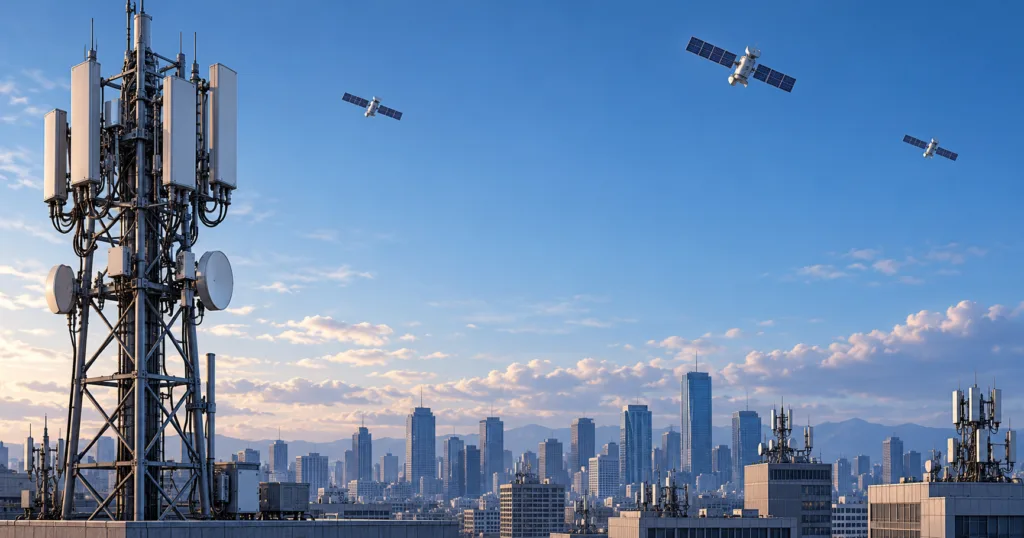
SpaceX is reportedly seeking access to at least 80,000 U.S. cell sites for Starlink Mobile and is discussing that goal with at least one major cellular infrastructure company, people familiar with the matter said. The prospective leases could give tower owners a new customer as SpaceX pursues a network combining satellite and ground coverage.
The discussions remain unconfirmed by the companies involved. Crown Castle CEO Chris Hillabrant declined to identify prospective customers during the company’s October 21, 2026, earnings call. Citi analysts nevertheless view the reported plans as a potential benefit for Crown Castle, American Tower and SBA Communications, which collect rental income from wireless operators.
Tower owners could gain another major tenant
Crown Castle, American Tower and SBA Communications lease space for equipment used by mobile carriers. A SpaceX deployment on their infrastructure could generate additional recurring revenue without requiring those landlords to operate the new wireless service themselves.
The opportunity would also broaden their customer base. AT&T, Verizon and T-Mobile account for roughly 85% of American Tower’s revenue in the United States and Canada. A substantial new tenant could reduce that concentration, although the effect would depend on how many sites SpaceX leases and the terms of any agreements.
Hillabrant did not confirm a SpaceX contract when asked about discussions with satellite companies. “You can assume that we’re talking to all parties,” he said. His response indicated broad commercial discussions rather than a commitment to a particular operator or deployment.
Hillabrant also said Crown Castle could offer approximately 40,000 sites. He argued that using existing towers and rooftops could help an operator deploy more quickly, with some locations already having passed zoning and permitting processes. He cautioned that the timetable would depend on SpaceX’s chosen network design.
The reported 80,000-site target should not be treated as a confirmed order for 80,000 individual towers. Cell sites can include rooftop installations, and the eventual combination of infrastructure would determine how much leasing business reaches each tower owner.
Spectrum agreement supports ground and satellite coverage
SpaceX has taken a confirmed step toward expanding Starlink Mobile through its agreement to acquire Grain Management’s nationwide 800 MHz spectrum portfolio. Grain announced the transaction on October 8, 2026, subject to Federal Communications Commission approval and other customary closing conditions.
The purchase price has been reported at about $8 billion. The agreement remains distinct from the cell-site discussions: a spectrum acquisition gives SpaceX access to airwaves, while infrastructure agreements would provide locations for the equipment needed to use them on the ground.
Low-band spectrum can support coverage over long distances and inside buildings. SpaceX says the additional airwaves would complement its satellite-to-phone service and help Starlink Mobile serve customers from both space and terrestrial infrastructure.
SpaceX also has authorization for up to 15,000 Starlink Mobile satellites. That authorization establishes a deployment ceiling; it does not mean the entire constellation has been launched or that a nationwide ground network has been completed.
The company’s existing connectivity business provides financial context for the expansion. SpaceX reported 13.6 million Starlink consumer subscribers as of September 30, 2026. Its connectivity segment generated approximately $3.5 billion in adjusted earnings before interest, taxes, depreciation and amortization in the third quarter, up 82% year over year.
Those results describe the existing connectivity operation. They do not establish the cost, customer demand or profitability of a separate nationwide mobile network.
Network capacity and construction costs remain obstacles
A terrestrial network would address a different challenge from providing broad satellite coverage. Satellites can reach large areas, but available capacity must be shared among users. Serving many customers in a concentrated urban area would require a network designed for that demand.
TD Cowen estimates that constructing a nationwide wireless network could cost more than $80 billion and take years. The estimate underscores the investment required beyond acquiring spectrum or obtaining permission to launch satellites; it is not a disclosed SpaceX construction budget.
T-Mobile technology chief John Saw has argued that SpaceX’s spectrum holdings would fall well short of those supporting established networks. In October 2026, he described the approximate holdings as follows, including SpaceX’s proposed acquisition:
| Operator | Approximate spectrum cited by John Saw |
|---|---|
| T-Mobile | Nearly 400 MHz |
| SpaceX / Starlink Mobile | About 80 MHz |
Saw also noted that some of SpaceX’s spectrum would support uplinks only. The figures represent his comparison of spectrum portfolios, rather than measured network performance. T-Mobile already partners with SpaceX on satellite-to-cell service, giving the companies an existing commercial relationship alongside the prospect of broader competition.
Verizon executive Katie Magnotta has similarly questioned the value of spectrum holdings without the infrastructure needed to deploy them. Both executives’ comments concern the practical requirements of operating a competitive network.
Analysts differ on the likely scale of deployment
The reported tower discussions do not resolve whether SpaceX will build a full nationwide terrestrial network or combine a smaller deployment with access to another carrier’s infrastructure.
New Street Research analyst David Barden says SpaceX has continued to express interest in becoming a mobile virtual network operator, which would involve buying wholesale access to an existing carrier’s network. Such an agreement could reduce the scale of a tower buildout, although Barden says the two approaches are not mutually exclusive.
Citi takes a different view, considering a virtual-operator arrangement a low-probability outcome. Its analysts see the potential arrival of another network competitor as a risk for AT&T, T-Mobile and Verizon while regarding the tower companies as potential beneficiaries.
The amount and timing of additional tower revenue therefore remain uncertain. Rental income would depend on completed agreements, equipment deployments and the network architecture SpaceX ultimately adopts. Hillabrant’s comments establish Crown Castle’s willingness to participate, while leaving the identity of individual customers and any lease commitments undisclosed.