

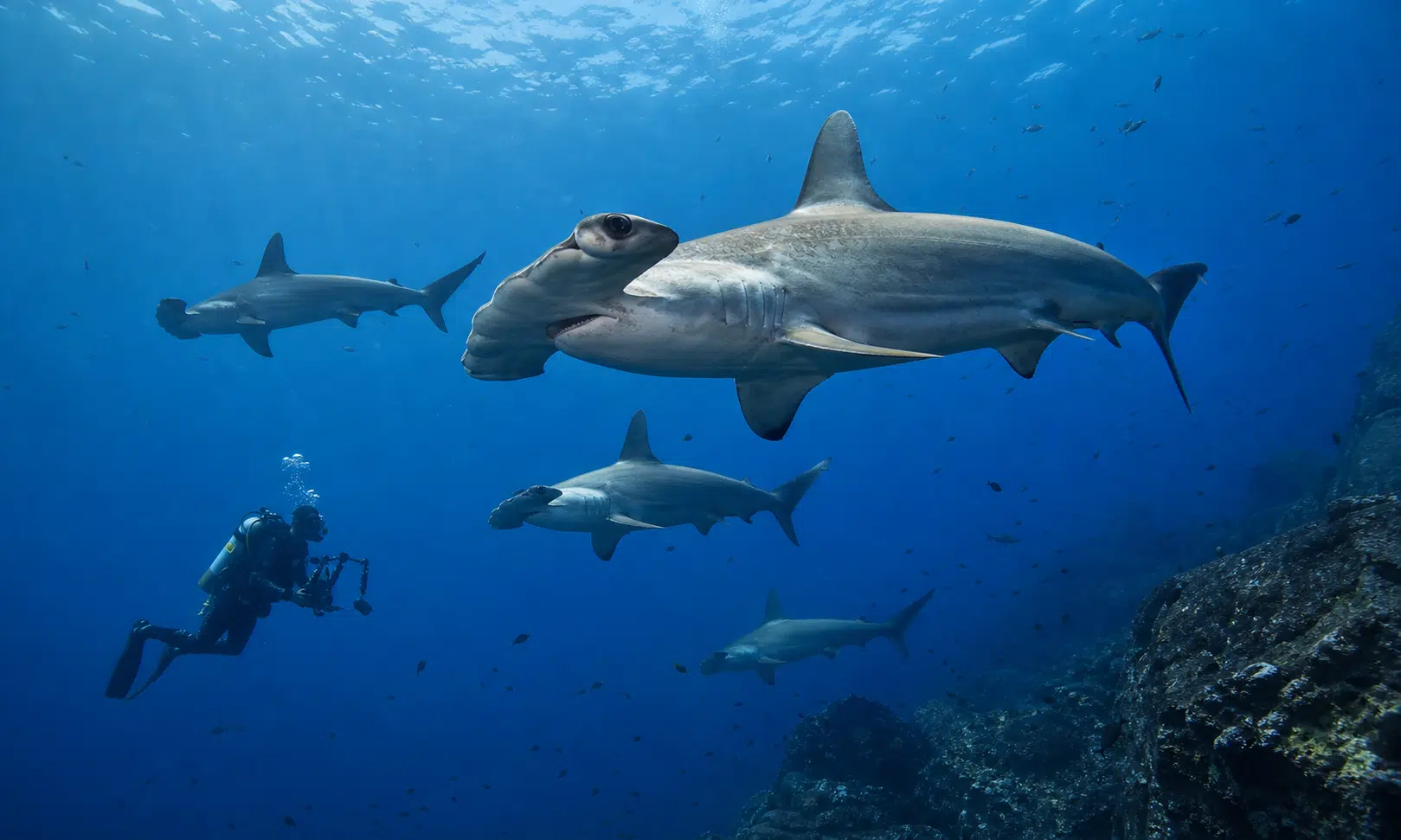

Scalloped hammerhead sharks can appear abundant around the northern Galápagos Islands, where marine protections have helped preserve one of the Pacific’s great shark refuges. But researchers studying their movements say that local abundance may hide a larger conservation problem: many of the sharks leave the reserve on long migrations that take them through fishing grounds, nursery areas and high-seas feeding zones.
The concern has sharpened as scientists with the Charles Darwin Foundation track where the sharks go after gathering around Darwin and Wolf, the remote northern islands inside the Galápagos marine reserve. Their work suggests the archipelago is not a self-contained sanctuary for the species. It is one important stop in a much wider life cycle.
That matters because scalloped hammerheads are listed as critically endangered, and researchers attribute much of their global decline to fishing pressure. In Galápagos, the sight of large groups of hammerheads can give a different impression. The question facing conservation teams is whether protected waters around the islands are enough when the same animals move beyond them.
A refuge that does not cover the whole journey
Darwin and Wolf have become central to the research because scalloped hammerheads gather there in large numbers. Divers working with the Charles Darwin Foundation have described frequent encounters with groups of sharks, especially during parts of the year when colder, food-rich waters draw more marine life into the area.
Researchers do not treat those sightings as proof that the species is secure. The foundation’s teams use less invasive methods to study the sharks because the animals are considered highly sensitive to stress. Instead of catching and handling them, divers collect small skin samples, deploy underwater camera systems and use tagging equipment designed to track movements after the sharks leave the islands.
Those methods are intended to answer several linked questions: how many sharks are using the Galápagos refuge, what they are feeding on, how environmental shifts affect them and where they travel during breeding cycles. The work has built on years of sampling and repeated expeditions, while avoiding the kind of handling that could harm the animals being studied.
The foundation’s researchers have also used baited remote underwater video systems to monitor shark numbers and other fish life around Darwin and Wolf. Chemical analysis of skin samples can indicate diet without requiring scientists to examine stomach contents. Together, those tools help build a long-term picture of a population that is visible in Galápagos but vulnerable elsewhere.
Tracking pregnant sharks toward Panama
The migration data are especially important. Pelayo Salinas de León, a senior marine ecologist with the Charles Darwin Foundation, has worked on methods for tagging free-swimming hammerheads without capturing them. The approach involves divers getting close enough to attach satellite transmitters while minimizing disturbance.
According to the research account, one satellite-tagged scalloped hammerhead in 2023 was tracked from the Galápagos Islands to the coast of Panama, a journey of roughly 800 miles, before continuing westward for about another 1,800 miles. Since then, researchers have tagged more sharks in the archipelago, and several tracked animals have moved toward Panama.
The pattern points to a critical part of the sharks’ life cycle. Many of the migrating animals are believed to be pregnant females nearing the end of gestation. Panama’s mangrove-lined sheltered waters offer nursery habitat that is less available along the rockier shores of Galápagos.
That makes the journey both biologically important and dangerous. A shark that is protected while feeding or gathering at Darwin and Wolf may still pass through waters where fishing is legal, poorly controlled or difficult to monitor. The risk does not end at the nursery grounds. Researchers say young hammerheads and females arriving to give birth can still be caught in local fisheries.
Panama has banned the international shark trade, but artisanal fishing remains a concern in the areas researchers describe as important nurseries. Salinas de León and colleagues have argued that reducing the catch of baby sharks and migrating females in those areas is essential if protections in Galápagos are to translate into recovery for the species.
New protection under a migratory species treaty
The migration evidence has also fed into international conservation discussions. In March 2026, Salinas de León presented findings at a meeting of the Convention on the Conservation of Migratory Species in Brazil, where governments considered stronger protections for scalloped hammerhead sharks.
The species was moved into Appendix I under the convention, the category used for migratory species that require the highest level of protection within the treaty framework. That change is significant because scalloped hammerheads do not remain inside one country’s waters. Their routes can cross marine reserves, national jurisdictions, nursery areas and open ocean.
The listing means signatory countries are expected to introduce or strengthen protections within their waters. How much difference that makes will depend on implementation, enforcement and coordination across the sharks’ range.
Fishing pressure along the route
Even inside protected waters, enforcement can be difficult. During a March 2026 expedition described by the research team, divers encountered illegal longlines in the Galápagos marine reserve. One line reportedly became tangled around a research boat, and another was found near Darwin’s Arch with green turtles hooked on it. The team also described releasing a scalloped hammerhead from an artisanal longline inside the reserve the previous year.
Those incidents underline a practical problem: formal protection does not automatically remove fishing gear from the water. Illegal fishing inside reserves, legal fishing outside them and gaps between protected areas can all affect a migratory animal.
Between Galápagos and Panama, some no-fishing zones may offer protection, including areas connected to the Hermandad marine reserve and Isla del Coco national park. But researchers say the route also includes gaps where industrial and semi-industrial fishing fleets operate.
For hammerheads, those gaps can matter as much as the reserves. The animals do not follow legal boundaries. Pregnant females moving toward nursery habitat may encounter longlines or nets before they reach safer waters. Juvenile sharks in coastal nurseries may then face local fishing pressure before they are old enough to join wider migrations.
The high seas remain a harder problem
After giving birth, surviving females are expected to move west again, passing the Galápagos and continuing toward the Pacific equatorial front. Researchers describe that region as a productive high-seas zone where currents mix and marine life gathers. It is also attractive to industrial fishing fleets.
That part of the journey is harder to manage than a marine reserve or a coastal nursery. The high seas involve different legal tools, larger enforcement challenges and fishing fleets that may operate far from public view. Salinas de León has indicated that future research could examine whether seasonal closures or changes in fishing gear would reduce harm to hammerheads in that feeding area.
The larger lesson is that the Galápagos marine reserve remains vital but incomplete. It protects an extraordinary aggregation site, and it allows scientists to observe a version of the ocean where sharks are still common. But the same population depends on waters far beyond the reserve.
For conservationists, the task is no longer simply to protect the places where hammerheads are easiest to see. It is to protect enough of the route that pregnant females can reach nurseries, young sharks can survive their early life and adults can feed without running a gauntlet of hooks and nets.
That is why the Galápagos can be both a success story and a warning. The reserve shows what protection can preserve. The migrations show why protection has to follow the sharks beyond it.