

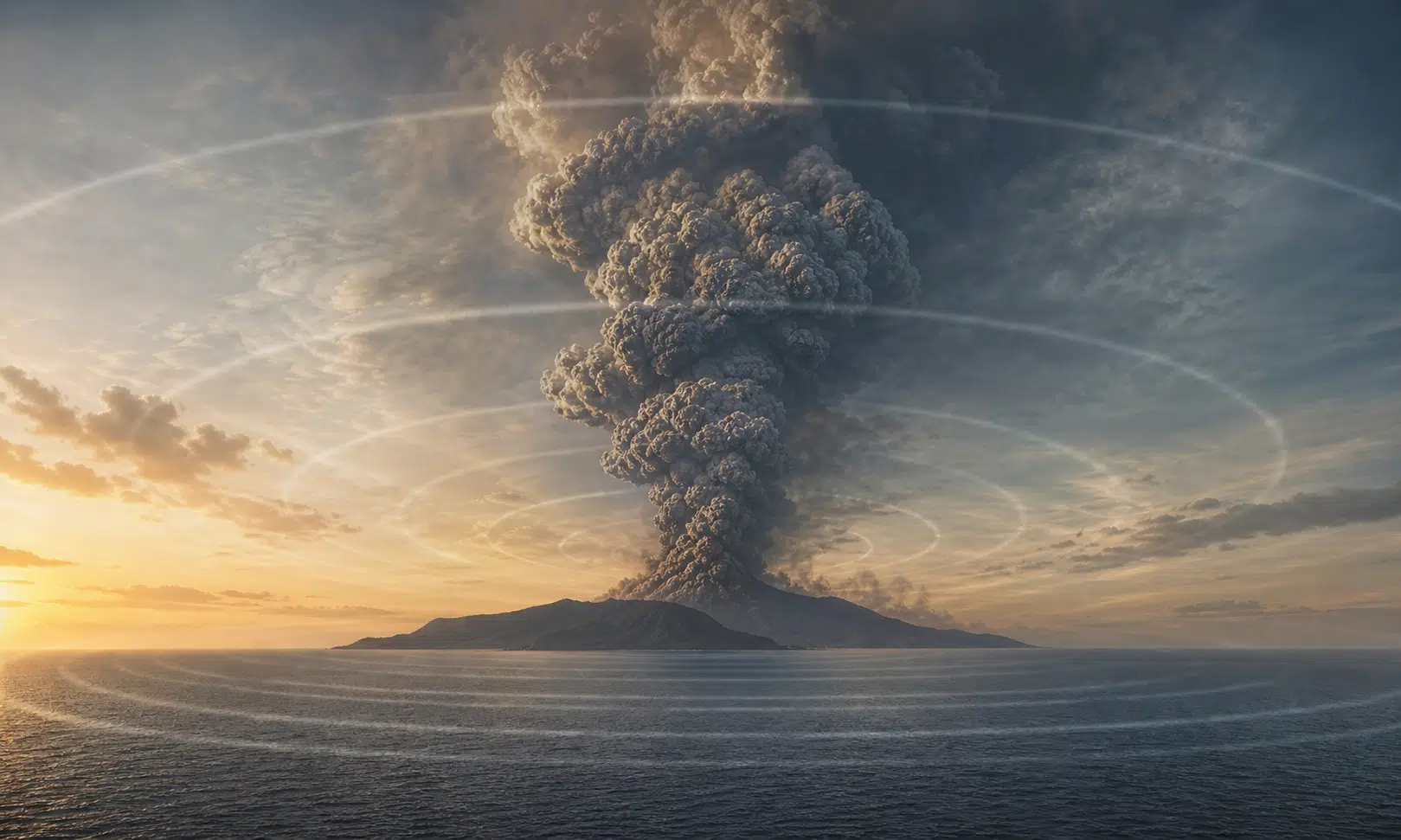

Krakatoa is often described as the source of the loudest sound ever recorded, but the strongest version of that claim needs careful wording. The 1883 eruption in the Sunda Strait between Java and Sumatra clearly produced one of the most powerful atmospheric pressure waves ever documented by human observers and instruments. Whether it should be treated as a neatly measured sound record is more complicated.
The usual story says that the eruption was heard thousands of kilometres away, disturbed barometers around the world, and injured sailors far from the volcano. Those details appear repeatedly in historical summaries of the event, but they are not all equally firm. Some are supported by instrument records and repeated historical accounts. Others depend on later retellings, estimates, or reports that should be framed as reported history rather than as laboratory-grade measurement.
That does not make the Krakatoa account weak. It makes it more interesting. The event sits at the boundary between sound, shock wave, weather record, disaster history, and scientific reconstruction. A practical reading is this: Krakatoa remains one of the strongest candidates for the loudest natural sound-like event in recorded history, but the most precise numbers attached to it should be handled as estimates, not as exact readings.
Verdict: a strong claim, but not a simple measurement
The short verdict is that Krakatoa is widely cited as the loudest sound in recorded history, yet the claim is better understood as a historical and scientific reconstruction than as a direct modern sound-meter reading.
The eruption took place on 27 August 1883, when Krakatoa produced a series of major explosions during a destructive volcanic episode. Accounts commonly identify a late-morning explosion as the largest and loudest. Because the fact-check notes mark the exact timing and sequence as not independently verified for this rewrite, the safer wording is that historical summaries commonly place the climactic blast that morning and describe it as the most powerful part of the eruption.
The same caution applies to the familiar claim that the blast was the third of four major explosions. That may be how many standard accounts present the event, but it should not be treated here as a newly verified fact. What can be said without overreaching is that the eruption produced multiple major detonations and that one of them generated an atmospheric disturbance large enough to be recorded far beyond Indonesia.
For readers trying to judge the claim, the key point is not a single dramatic sentence. It is the convergence of three kinds of evidence: distant audible reports, global barometer readings, and physical effects close to the eruption. Taken together, they explain why Krakatoa keeps appearing in discussions of the loudest sound ever recorded.
What the distant sound reports actually show
The most quoted detail is distance. Krakatoa is often said to have been heard in Perth, Western Australia, roughly 3,110 kilometres away, and on Rodrigues in the Indian Ocean, roughly 4,800 kilometres away. Those reports are central to the legend of the eruption, but the responsible phrasing is that historical accounts describe the sound as having been heard at those distances.
That distinction matters. A person hearing a distant boom in 1883 was not holding a calibrated acoustic instrument. Reports from distant locations tell us that the eruption produced an extraordinary audible or sound-like event, but they do not give a precise decibel reading at the source. They are eyewitness and administrative records, not controlled measurements.
Still, the distance is remarkable. Even if treated cautiously, the reports suggest that Krakatoa produced a low-frequency atmospheric disturbance capable of travelling far beyond the normal range of any ordinary sound. The event was not comparable to thunder, artillery, or an industrial explosion in any everyday sense. It was a volcanic blast moving energy through the atmosphere over oceanic distances.
Why decibels get tricky at Krakatoa scale
The decibel scale is logarithmic, so small-looking differences can represent very large changes in acoustic pressure. That part of the explanation is sound physics, but the specific Krakatoa numbers are less certain. Some popular summaries give estimated levels around 172 to 180 decibels at about 160 kilometres from the volcano. Because the fact-check instructions mark that specific claim as unverified here, it should be presented only as a commonly repeated estimate, not as a confirmed measurement.
There is another complication: close to the eruption, the disturbance may not have behaved like ordinary sound at all. At extreme intensity, the boundary between sound wave and shock wave becomes important. A normal sound wave is a pressure variation moving through air. A sufficiently violent explosion can create a pressure front that behaves more like a blast wave than like the sound from a speaker, engine, or storm.
That is why the phrase “loudest sound” can be misleading if it is read too literally. Krakatoa’s atmospheric disturbance was sound-like and was heard as sound in some places, but near the source it was also a violent pressure event. The best practical description is that Krakatoa produced one of the most powerful sound-like pressure waves in recorded natural history.
The ship and eardrum story needs cautious handling
One of the most dramatic parts of the Krakatoa account involves sailors on the British ship Norham Castle, often described as being about 65 kilometres from the volcano. The usual version says the pressure wave ruptured the eardrums of many crew members, and a captain’s log entry is often quoted to convey the terror of the blast.
For this rewrite, that episode should be softened. The fact-check instructions do not support presenting the exact distance, timeline, quotation, or injury count as independently verified. A safer version is that later accounts describe severe effects on people aboard a nearby ship, including reported ear injuries, but the exact wording and medical details should not be treated as freshly confirmed here.
That caution does not erase the broader point. Close to a major volcanic explosion, intense pressure changes can injure hearing and damage structures. But a careful article should not use the ship story as if every detail were settled beyond dispute. It is better as a reported historical episode than as the foundation for a precise scientific claim.
The strongest evidence: barometers around the world
The most persuasive part of the Krakatoa story is not the distant boom. It is the pressure wave recorded by instruments. Barometers in many places registered unusual atmospheric pressure changes after the eruption, and later analysis connected those readings to the Krakatoa blast.
Many summaries say the wave travelled around the planet multiple times. The most careful phrasing is that instrument records are widely described as showing repeated passages of the atmospheric wave around the Earth. Some accounts count the pattern as more than three full circuits, while popular retellings often round that to about four. Because the exact count depends on how the readings are interpreted, “multiple times” is stronger than a rigid number.
This is where Krakatoa becomes more than a disaster story. It was a global atmospheric event during an age when meteorological instruments and telegraph networks were making worldwide comparison possible. Observers did not have satellites, but they had enough distributed instruments to recognize that the same disturbance had passed across distant stations.
How Krakatoa compares with Hunga Tonga
The closest modern comparison is the January 2022 eruption of Hunga Tonga-Hunga Haʻapai. That event also generated atmospheric waves detected around the world, and modern sensors captured it in far greater detail than anything available in 1883.
Some reports say audible booms from Hunga Tonga were detected or reported at very long distances, including Alaska. That makes the comparison useful but not simple. Krakatoa’s reputation rests on historical accounts, barometer records, and reconstructed intensity. Hunga Tonga benefits from modern instrumentation and global sensor networks.
A cautious comparison looks like this:
| Question | Krakatoa, 1883 | Hunga Tonga, 2022 |
|---|---|---|
| Was it heard far away? | Historical accounts report audibility thousands of kilometres away. | Modern reports describe audible effects across very long distances. |
| Was the pressure wave global? | Barometer records are widely described as showing repeated global passages. | Modern instruments recorded atmospheric waves around the planet. |
| Is the peak loudness exact? | No. It is reconstructed from historical and instrumental evidence. | Better measured, though still complicated by shock-wave physics. |
| Best practical takeaway | A leading historical candidate for the loudest sound-like natural event. | A modern benchmark for volcanic atmospheric-wave measurement. |
This comparison also shows why “loudest ever” depends on definitions. Are we counting what people heard? What instruments recorded? Estimated pressure at a distance? Reconstructed energy at the source? The answer can shift depending on the standard used.
What to believe about the Krakatoa claim
The Krakatoa eruption deserves its reputation, but the cleanest version of the claim is not the most viral one. A careful editor would avoid saying that every detail is settled exactly: the precise decibel level, the exact number of times the wave circled Earth, and some of the shipboard injury details all need caution.
The defensible version is still powerful: in 1883, Krakatoa produced a catastrophic eruption whose atmospheric pressure wave was recorded across the world and whose sound was reported at extraordinary distances. That is enough to place it among the most extreme acoustic or sound-like events in human records.
So was Krakatoa the loudest sound ever recorded? In popular and historical terms, it remains one of the strongest answers. In strict measurement terms, it is better described as the most famous historical candidate for the loudest natural sound-like pressure event, reconstructed from reports and barometric evidence rather than captured by modern sound equipment.