

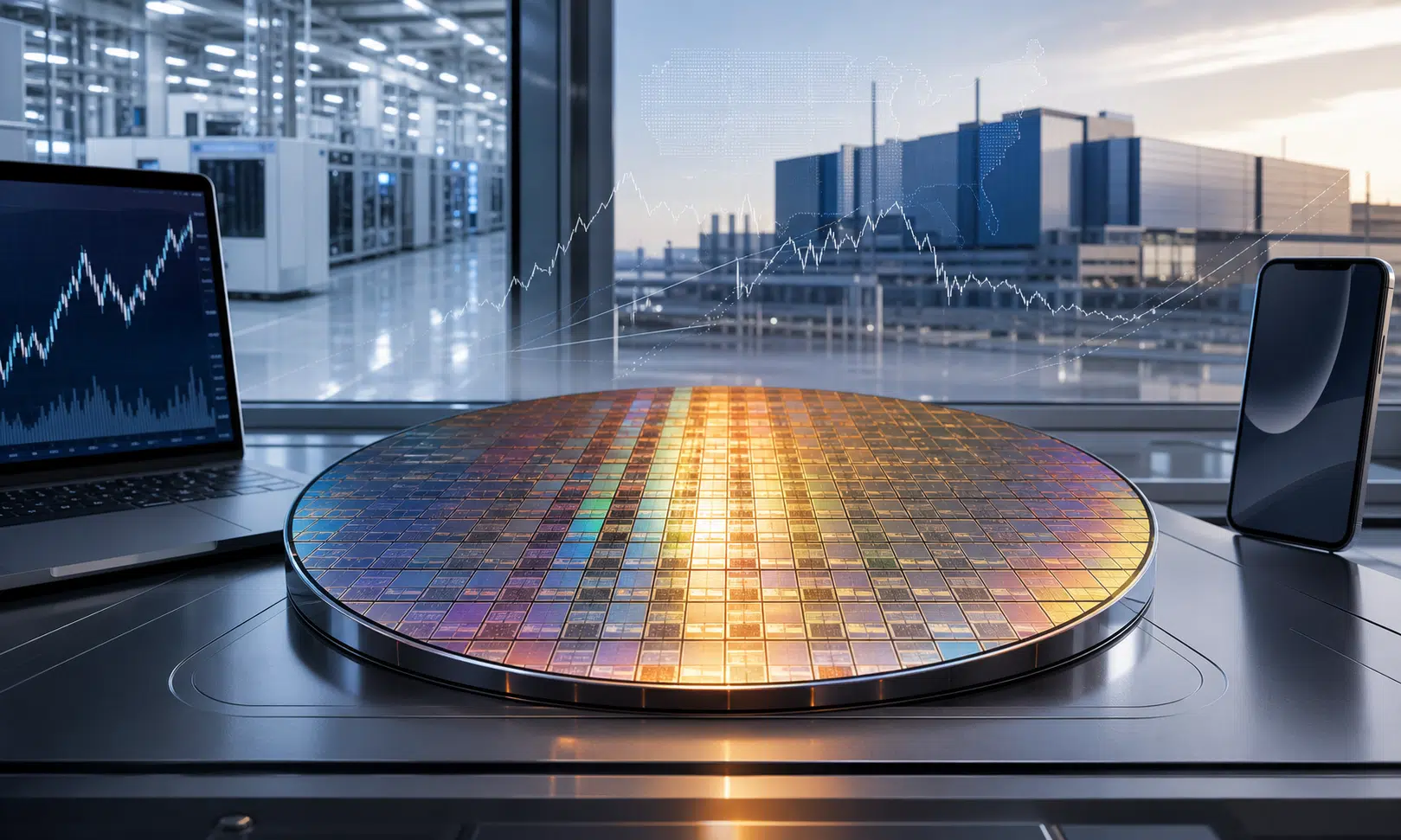

Intel’s latest stock move says less about one possible Apple deal and more about how much pressure is sitting on the company’s foundry turnaround.
After President Donald Trump said on June 18, 2026 that Apple had agreed to work with Intel on chips designed and manufactured in the United States, Intel shares rallied. The important caveat is that neither Apple nor Intel has publicly confirmed a foundry agreement, so the market reaction is still being built around a prospective partnership rather than a signed customer win.
That distinction matters. If Apple were to use Intel for any meaningful chip production, it would be a major credibility boost for Intel Foundry and for the broader push to move more advanced semiconductor manufacturing onto U.S. soil. But it would not, by itself, solve the harder parts of Intel’s investment case: yields, scale, spending discipline, and whether its manufacturing roadmap can turn into profitable outside customer volume.
Why an Apple foundry deal would matter
Apple is one of the most important chip customers in the world, even though it does not manufacture its own processors. The company designs its own silicon and relies on contract manufacturers for production. A role for Intel would therefore be less about Apple returning to Intel-designed processors and more about Apple potentially diversifying where some of its future chips are made.
That is exactly why the rumor landed so strongly with investors. Intel has spent years trying to convince the market that it can become a serious third-party foundry, competing for customers that have historically relied on TSMC for leading-edge production. A public Apple win would be one of the clearest possible signs that major customers see Intel as more than an internal manufacturing arm for Intel CPUs.
The possible upside is straightforward: a marquee customer could validate Intel’s foundry roadmap, support demand for its U.S. fabs, and strengthen the political argument for domestic advanced chip manufacturing. It could also make Intel’s foundry business look more relevant to companies that want alternatives for advanced nodes and advanced packaging.
The risk is just as clear. A prospective Apple relationship does not prove Intel can manufacture at the necessary quality, cost, and volume. It only raises the stakes for a company that still has to show its newest process technology and packaging operations can perform consistently.
The investment case still comes down to execution
For investors, Intel remains a turnaround story with an unusually wide gap between the optimistic version and the cautious version. The optimistic case is that the company’s foundry and AI-related manufacturing push eventually offsets years of pressure, turning heavy investment into a more durable growth engine. The cautious case is that the same spending becomes a drag if Intel cannot win enough outside business or hit competitive manufacturing yields.
A possible Apple connection supports the bullish narrative, but only conditionally. It would be evidence that the right customers are at least looking seriously at Intel’s manufacturing capabilities. It would not erase the near-term questions around Intel’s advanced process roadmap, including the performance and manufacturability of 18A-P, or the company’s ability to scale advanced packaging work into reliable revenue.
That is why Intel’s leadership moves around foundry operations are getting more attention. Intel appointed Seok-Hee Lee as executive vice president of Intel Foundry, with a focus that includes advanced packaging, system integration, and back-end manufacturing. That mandate sits close to the center of the company’s foundry pitch: modern chip production is no longer just about the smallest transistor. Packaging, memory integration, and system-level manufacturing are increasingly important, especially for AI accelerators and high-performance computing.
If Intel can pair better packaging execution with progress on advanced nodes, it has a more complete argument for customers weighing alternatives to TSMC. If it cannot, the Apple speculation becomes another example of investor excitement arriving before the business has proved the model.
How to read the Apple-Intel comparison
The buyer-decision version of this story is not about choosing a phone or laptop. It is about how an investor should compare the upside and downside cases for Intel after the Apple headline.
| Question | Bullish read | Cautious read |
|---|---|---|
| Apple relationship | A confirmed deal would validate Intel as a serious outside foundry option. | No deal has been publicly confirmed by Apple or Intel. |
| U.S. manufacturing | Intel could benefit from demand for more domestic advanced chip capacity. | National strategy does not guarantee profitable customer volume. |
| 18A-P and advanced nodes | Progress could make Intel more credible for high-end customers. | Yield, cost, and scale remain the key proof points. |
| Advanced packaging | Packaging leadership could help Intel compete in AI and system integration. | Execution complexity is high, and the payoff may take time. |
| Financial outlook | Revenue and earnings could recover if foundry demand scales. | Heavy investment can pressure returns if customer wins arrive slowly. |
That comparison is the cleanest way to frame the stock. Intel is not moving only on a single political comment or a single customer rumor. It is moving because the market is trying to price the possibility that Intel’s foundry strategy has a real path to premium customers.
The bottom line for investors
The Apple angle is meaningful because Apple would be exactly the kind of customer Intel needs to change the perception of its foundry business. But until Apple or Intel confirms the arrangement, it should be treated as an unconfirmed catalyst rather than a finished deal.
For anyone evaluating Intel, the central question is still whether the company can convert interest in U.S.-based chip manufacturing into dependable, profitable production. The upside case depends on Intel proving that its advanced nodes, packaging technology, and organizational structure can support demanding external customers. The downside case is that the company keeps spending heavily while the foundry business remains difficult to scale.
That makes Intel a comparison between potential and proof. A confirmed Apple manufacturing relationship would be a strong signal. The harder test is whether Intel can turn that kind of signal into volume, margins, and a foundry business that works beyond the headline.