


Ukraine’s war has turned cheap air-defense sensors from a niche capability into a serious planning problem for Western militaries.
The issue is not that advanced air-defense systems suddenly stopped mattering. High-end radars, interceptors, and command networks remain central to defending against aircraft, missiles, and large-scale strikes. But the daily pressure of drones has exposed a different kind of gap: low-flying, relatively cheap aerial threats can be hard to spot early, costly to engage, and numerous enough to stress systems designed for a different era of air warfare.
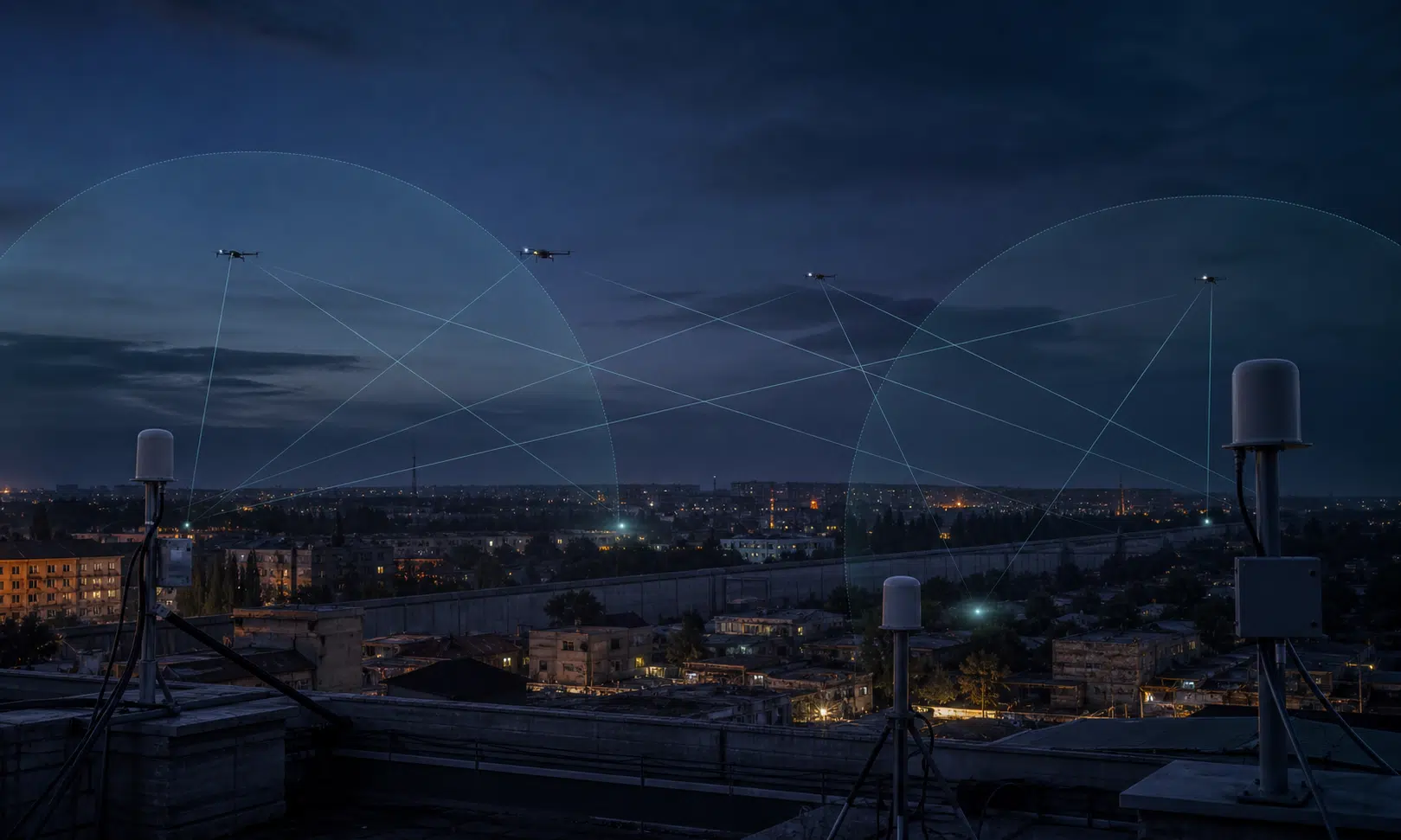
That is why acoustic sensors, essentially microphone-based detection systems that listen for drones, are getting more attention. They are not a replacement for radar or missile defense. Their value is different: they can be distributed widely, bought at lower cost, and used as part of a layered network that gives defenders more warning and more options.
For militaries looking at Ukraine as a live test bed, the lesson is practical rather than futuristic. The future of air defense may depend as much on sensor density, software integration, and procurement speed as on the most advanced interceptor in the arsenal.
Why drones are forcing a sensor rethink
Traditional air defense was built around threats that are easier to justify expensive detection and interception systems against: fighter jets, bombers, cruise missiles, ballistic missiles, and other high-value targets. Many of those threats fly faster, higher, or with clearer signatures than small drones.
Drones complicate that model. They can fly low. They can be slower. They can have smaller profiles. Some are cheap enough that shooting them down with a multimillion-dollar interceptor turns into bad math very quickly.
That does not mean Western systems are blind to drones. The better way to frame the problem is that many legacy systems were not optimized for a battlefield where small, low-cost drones appear in large numbers and at low altitude. A radar and missile battery designed to protect against aircraft and missiles may still play a role, but it is not automatically the most efficient tool for every drone threat.
This is where cheap sensors become interesting. A low-cost acoustic sensor does not need to do everything. It only needs to add another layer of detection, especially in places where a drone may be approaching too low or too cheaply to make high-end systems the first answer.
The case for acoustic sensors
Acoustic sensors are simple in concept: they listen. A network of microphones can help detect the sound signatures of incoming drones and pass that information into a wider air-defense picture. The hardware is cheaper than military radar, and the systems can potentially be spread across a wider area.
That matters because air defense is a coverage problem as much as a weapons problem. A country or military base cannot defend what it cannot see, and the most expensive sensors cannot be everywhere at once. A wider sensor grid can help cue other systems, narrow the search area, and give defenders more time to decide what to use.
Ukraine’s use of low-cost sensor networks has become one of the most closely watched examples of this approach. The broad idea is not that microphones beat radars. It is that microphones, radars, electronic-warfare systems, interceptors, guns, and command software can each cover different weaknesses when they are stitched together properly.
That layering is the key. Cheap sensors are useful because they can be numerous. High-end sensors are useful because they are more capable. A modern defense network needs both, because each type of sensor has strengths and weaknesses.
What Western militaries are trying to learn
Western defense officials and analysts have increasingly described Ukraine’s experience as a prompt to rebuild the lower end of air defense. The challenge is especially clear at low altitude, where small drones can exploit gaps in coverage.
Sir John Stringer, NATO’s Deputy Supreme Allied Commander Europe, has argued that defensive air defense needs investment across a wider range of sensors, including cheap acoustic systems. Maj. Modris Kairišs, who leads Latvia’s Autonomous Systems Competence Center, has made a similar point about adding more sensors for low-altitude detection.
The logic is straightforward: quantity and variety both matter. A single sensor type will miss things another sensor might catch. A radar may perform well in one context, while acoustic systems, visual sensors, electronic detection, or other tools may help in another. The most useful system is not a single perfect device; it is a network that combines imperfect devices into a more complete picture.
That also changes the procurement question. Western militaries may already have much of the underlying technology they need. The harder part is often buying, integrating, and fielding it quickly enough to matter.
The cost curve is becoming harder to ignore
The drone problem is also an accounting problem. Air defense has always involved expensive equipment, but Ukraine has made the mismatch more visible: cheap threats can force defenders to spend expensive missiles unless they have cheaper ways to detect, track, jam, or destroy them.
One example often used in this debate is the Iranian-designed Shahed one-way attack drone, versions of which Russia also produces. Estimates have put Shahed-type drones in the tens of thousands of dollars per unit, while a US-made Patriot PAC-3 interceptor has been estimated at roughly $3.7 million.
| System or threat | Approximate cost discussed in defense circles | Why it matters |
|---|---|---|
| Shahed-type one-way attack drone | About $20,000 to $50,000 | A relatively cheap threat can be launched in numbers. |
| Patriot PAC-3 interceptor | About $3.7 million | Using high-end interceptors against cheap drones can become unsustainable in a long conflict. |
| Ukraine-style acoustic sensor coverage | Reported as less than $54 million for broad low-altitude coverage | Low-cost sensors can expand detection coverage without replacing high-end systems. |
The exact numbers can vary by contract, configuration, and operating cost, but the strategic problem is clear enough. If every cheap drone demands an expensive interceptor, the defender is losing money even when the shot succeeds.
Cheap sensors do not solve that by themselves. They do not destroy drones. But they can help the defender choose a better response, such as routing alerts to cheaper interceptors, guns, electronic warfare, mobile teams, or other systems designed for small aerial targets.
A drone wall needs more than a wall
European officials have discussed a “drone wall,” a proposed network of sensors and defenses intended to detect and counter drone threats, especially around countries closest to Russia. The phrase makes the concept sound cleaner than it is.
A real drone-defense network would need multiple layers: acoustic sensors, radar, optical systems, electronic detection, command-and-control software, and weapons matched to the threat. It would also need enough coverage to matter, enough redundancy to survive attack, and enough operators and maintenance capacity to stay useful over time.
Andrius Kubilius, the European Union’s defense commissioner, has warned that Europe’s existing ability to detect low-flying drones is limited. He has also pointed to Ukraine’s sensor-heavy model as something Europe should study, particularly because low-altitude detection is not the same problem as tracking aircraft or missiles.
Baltic countries have been among the most attentive to this lesson. Their geography makes the problem immediate: they are NATO members bordering Russia, and they have strong incentives to improve early warning against small drones and other low-altitude threats.
Cheap does not mean simple
The risk in the cheap-sensor conversation is assuming that low-cost hardware automatically creates a capable defense network. It does not.
A microphone in a field is only useful if it can detect the right sound, filter out noise, share reliable data, and feed that data into a system that can act on it. A dense sensor network also creates its own problems: false alarms, communications load, maintenance, power supply, cybersecurity, and the challenge of merging data from many different systems.
That is why the real lesson from Ukraine is not just “buy cheap sensors.” It is closer to this:
- Use cheaper sensors to widen coverage, especially at low altitude.
- Keep high-end radars and interceptors for threats that require them.
- Connect different sensor types so each one offsets another’s weakness.
- Match the response to the target, instead of defaulting to the most expensive weapon.
- Procure and deploy quickly enough that the network can evolve with the threat.
This is a different mindset from buying a small number of exquisite systems and expecting them to handle every scenario. Modern drone warfare rewards density, speed, and adaptability.
What buyers and planners should take from Ukraine’s example
For governments, defense ministries, and security planners, the decision is not whether cheap sensors are better than expensive sensors. That is the wrong comparison. The useful question is where cheap sensors can reduce blind spots and preserve expensive interceptors for targets that actually justify them.
A practical evaluation should start with the defended area. A national border, a city, an air base, a logistics hub, and a power plant all have different coverage needs. Low-altitude drone detection may require sensors across wide areas, while a critical facility may need tighter integration with jammers, short-range air defense, and rapid response teams.
The second question is integration. A cheap sensor that cannot feed into command software is just another isolated device. The value comes when alerts can be verified, prioritized, and passed to the right defensive system.
The third question is scale. Ukraine’s experience suggests that numbers matter. A handful of sensors may help protect a site, but broad air-defense coverage requires a network. That puts pressure on procurement systems that are often better at buying expensive platforms slowly than buying cheaper systems quickly and in volume.
The bigger air-superiority lesson
The rise of cheap sensors points to a larger shift: air superiority may be harder to secure in future wars, and it may look less absolute than it did in some recent Western campaigns.
Drones, missiles, electronic warfare, and dense air defenses all make the airspace more contested. That does not make air superiority irrelevant. It makes the work of gaining and preserving it more complicated.
Stringer has argued that militaries still need to secure access and maneuver for the joint force. The tools may change, but the requirement does not disappear. Cheap sensors are one part of that adaptation: less glamorous than fighters or missile batteries, but potentially critical to seeing enough of the sky to defend it.
Ukraine’s drone war is making that point in a hard, practical way. The next air-defense network will not be defined only by its most expensive weapons. It will also be defined by how many threats it can detect early, how cheaply it can respond, and how quickly it can adapt when the battlefield changes again.