

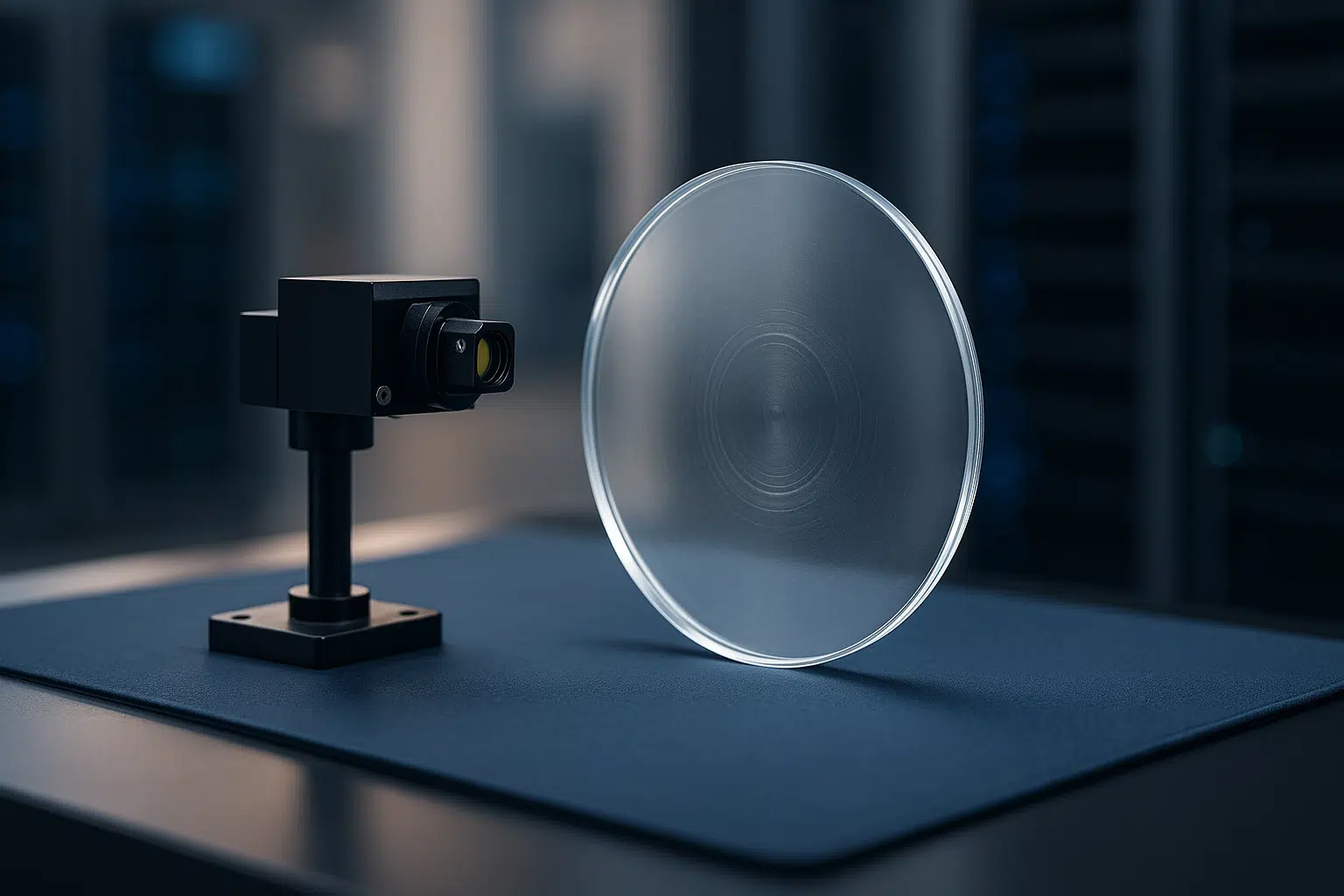

A startup called SPhotonix says its fused-silica “memory crystal” is edging closer to real-world use for cold data, with plans to run data-center pilots over the next couple of years.
In an interview with The Register, the company said it has pushed its 5D Memory Crystal technology beyond the lab-demo stage and is now working to move from Technology Readiness Level (TRL) 5 to TRL 6—a step that typically means validating the system in relevant operational environments, not just controlled test setups.
A Southampton-born idea, commercialized as a US company
SPhotonix was founded in 2024 and commercializes “5D” optical storage research that originated at the University of Southampton. While it’s often described as a UK spinout, SPhotonix is US-headquartered (Newark, Delaware), with R&D activity spanning the UK and Switzerland, according to the interview and company materials.
The announcement also coincides with the startup’s first disclosed round of external funding: a $4.5 million pre-seed round led by Creator Fund and XTX Ventures.
How “5D” glass storage works
Instead of magnetic tape or hard drives, SPhotonix uses a fused silica glass platter as the storage medium. Data is written using a femtosecond laser, which encodes information as nanoscale structures inside the glass.
The “five dimensions” come from:
- Three spatial coordinates (x, y, z) — where a data “voxel” sits in the glass
- Two optical properties of the structure (often described as orientation and strength of birefringence), read back optically using polarization-sensitive techniques
SPhotonix says the long-term goal is up to 360TB on a 5-inch glass plate—an “ultimate” target often cited in this research area. The company also notes that current work includes smaller test media on the path toward that larger format.
Longevity claims: bold, but based on extrapolation
SPhotonix leans hard into durability: glass is inherently air-gapped, needs no power to retain data, and is pitched for archives where 10+ seconds of access latency is acceptable.
The company also repeats a headline-grabbing longevity number: stability on the order of the age of the universe (13.8 billion years)—but it’s important to understand what that means. In practice, this figure is typically described as an extrapolated estimate at elevated temperatures (e.g., around 190°C) rather than a literal guarantee under every real-world condition.
Performance and cost: still early
SPhotonix’s prototypes are not yet competitive on speed with mainstream storage:
- Write: ~4 MB/s
- Read: ~30 MB/s
The company says it has a roadmap to reach 500 MB/s sustained read/write in about three to four years.
On pricing, it estimates early systems at roughly:
- $30,000 for a writer
- $6,000 for a reader
- A field-deployable reader in about 18 months
Those numbers are best read as early guidance rather than a finalized price list—especially given how much depends on packaging, robotics, and integration.
Not the only glass (or ceramic) cold storage bet
SPhotonix isn’t alone in pushing “non-magnetic” archival storage. Microsoft’s Project Silica has publicly tested glass media for long-term storage, while startups like Cerabyte are promoting ceramic-based approaches aimed at automated, robotic library systems.
Where SPhotonix says it differs is strategy: it’s aiming to license the media and optical platform into existing data-center architectures, rather than building a full end-to-end storage service itself.
The real test: can it scale beyond the demo?
SPhotonix’s pitch is compelling—massive density, long-lived media, and no idle power draw. But the deciding factor won’t be the physics demo. It’ll be whether SPhotonix can turn the platform into a system that data centers can actually deploy at scale: reliable robotics, reasonable throughput, predictable cost per TB, and a workflow that fits how cold storage is managed today.
If it succeeds, 5D glass could become a serious option for deep archives. If it doesn’t, it may still find a niche—valuable, but limited—alongside tape and other specialty archival mediums.